

Browser-based tracking is quietly breaking. Every time a potential customer clicks your ad from an iOS device, uses Safari, or has an ad blocker installed, your pixel may fail to fire. The conversion goes unrecorded. Your attribution data gets a little less accurate. And the decisions you make about where to spend your budget become a little less reliable.
For B2B SaaS marketing teams running paid campaigns on Meta and Google, this is not a minor inconvenience. It is a structural problem that compounds over time. Missed conversions mean your ad platform's algorithms are optimizing on incomplete data. Incomplete data means your cost-per-acquisition figures look worse than they actually are, or your best-performing campaigns get underfunded because the signal is too weak to surface them.
Server side tracking is the modern answer to this problem. Instead of relying on a browser-based pixel to capture and send conversion data, your own server handles that job, forwarding enriched event data directly to ad platforms via their APIs. The result is more complete data, more accurate attribution, and a tracking setup that does not depend on browser behavior to function correctly.
This article breaks down exactly why browser-based tracking is losing ground, how server side tracking works in practice, and the specific benefits B2B SaaS marketing teams gain from making the switch.
Why Browser-Based Tracking Is Losing the Battle
Client-side pixels have been the backbone of digital advertising measurement for years. The model is straightforward: a small JavaScript tag fires in a user's browser when they complete an action, and that event gets sent to the ad platform. It worked well when browsers were permissive and privacy expectations were low. That era is over.
Three forces have systematically dismantled the reliability of client-side tracking. The first is ad blockers. Among professional and technical audiences, which represent a significant portion of B2B SaaS buyers, ad blocker adoption is particularly high. These tools do not just block ads. They block the tracking scripts that fire alongside them, meaning a meaningful share of your conversions may never be recorded.
The second force is browser-level privacy restrictions. Apple's Intelligent Tracking Prevention (ITP) limits the lifespan of cookies set by third-party scripts in Safari. iOS devices running recent versions of Safari restrict cross-site tracking in ways that directly interfere with pixel accuracy. Since Safari and iOS together represent a substantial portion of web traffic, this is not an edge case. It is a mainstream problem that affects every B2B SaaS team running paid campaigns. Understanding how to prepare for iOS link tracking restrictions has become essential for any team relying on paid acquisition.
The third force is third-party cookie deprecation. Major browsers have either deprecated third-party cookies or are actively phasing them out. This removes the mechanism that many client-side tracking solutions rely on to persist user identity across sessions and attribute conversions back to the correct ad interaction. A cookieless tracking solution is no longer optional for teams that need reliable attribution data.
The downstream effects on your marketing data are significant. Conversions get missed entirely. Attribution windows shrink because the data needed to connect a click to a conversion is no longer available. Cost-per-acquisition figures become inflated because the denominator, your actual conversions, is undercounted. And when you take that data to your next budget planning meeting, you are making decisions based on a distorted picture of reality.
This problem hits B2B SaaS companies especially hard. Unlike e-commerce, where a purchase might happen in a single session, B2B SaaS buying cycles often span weeks or months. A prospect might click a LinkedIn ad, read a blog post, attend a webinar, and then convert on a demo request form two weeks later. Every one of those touchpoints matters for attribution. When browser restrictions cause even a fraction of those events to drop, the multi-touch picture you depend on for budget decisions becomes unreliable. The longer the sales cycle, the more damage incomplete tracking does.
How Server Side Tracking Actually Works
The core mechanic of server side tracking is a shift in where conversion data originates. With a client-side pixel, the browser is responsible for detecting the event and sending it to the ad platform. With server side tracking, your own server takes on that responsibility.
Here is how the data flow works in practice. A user clicks your ad and lands on your website. Your site may still fire a client-side pixel for speed and redundancy, but the critical event data, things like form submissions, demo requests, or trial sign-ups, also gets sent to your server. Your server then forwards that event directly to the ad platform's API, such as the Meta Conversion API or Google Enhanced Conversions, without ever relying on the browser to complete that transmission.
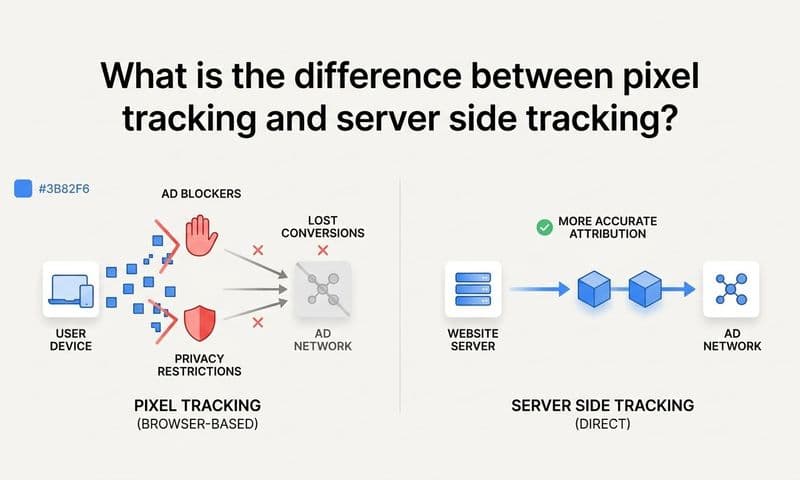
Because the event is sent from your server rather than the user's browser, it is completely unaffected by ad blockers, ITP restrictions, or cookie deprecation. The browser's privacy settings are simply irrelevant to a server-to-server connection. The data travels a different path entirely.
First-party data plays a central role in this model. When your server captures and sends the event, it is using data that your company collected directly from your own users, not data sourced from third-party scripts or shared cookie pools. This is significant for two reasons. First, first-party data is more reliable and accurate than third-party data because you own the collection mechanism. Second, it is more resilient to future privacy changes because it does not depend on third-party infrastructure that regulators and browser vendors are actively restricting.
To understand why this matters, compare the two data paths side by side. In the client-side path, a conversion event must pass through the user's browser, which may have ad blockers active, ITP restrictions in place, or cookies disabled. Each of those conditions is a potential point of failure where the event can be lost or degraded before it ever reaches the ad platform. In the server-side path, the event travels from your server directly to the ad platform's API. There are no browser-level variables in that path. The event either succeeds or it does not, and when it does succeed, the data is typically richer and more complete because your server can attach additional context, such as customer identifiers or CRM data, that a browser pixel cannot access. This is precisely why server-side tracking is more accurate than any client-side alternative.
This is why server side tracking is increasingly considered the standard for marketing teams that need accurate, complete conversion data. It is not a workaround. It is a more architecturally sound approach to event tracking that happens to also be more privacy-resilient.
The Core Benefits of Server Side Tracking for Marketing Teams
Understanding how server side tracking works is useful. Understanding what it actually does for your marketing performance is what drives adoption. There are three primary benefits that matter most for B2B SaaS teams.
Higher match rates and more complete conversion signals: When you send conversion events via server-side APIs, you can include richer identifying information, such as hashed email addresses, phone numbers, or customer IDs, that help the ad platform match the event to a specific user in their system. Higher match rates mean more of your conversions are attributed to the correct ad interactions, which gives the platform's algorithm a stronger signal to optimize against. On Meta, this directly influences how the Conversion API improves campaign delivery. On Google, Enhanced Conversions use the same principle to close attribution gaps that standard pixel tracking leaves open. Teams struggling with Facebook pixel tracking data loss will find that server-side events dramatically improve match rates and signal quality.
Improved attribution accuracy: When browser-based pixels miss conversions, your attribution data has gaps. Those gaps distort every report you generate, every channel comparison you make, and every budget decision that follows. Server side tracking closes those gaps by capturing events that client-side pixels would have dropped. The result is a more complete picture of which ads, campaigns, and channels are actually driving conversions. For a B2B SaaS team managing spend across multiple platforms, this accuracy is not just a reporting improvement. It is the foundation for making smarter decisions about where to scale and where to cut.
Stronger first-party data ownership: With server side tracking, your server is the first stop for every conversion event. You capture the data, you control what gets enriched and forwarded, and you are not dependent on third-party scripts or cookies to make it work. This gives your team genuine ownership over your conversion data in a way that client-side pixels never could. It also future-proofs your tracking setup against whatever privacy changes come next. Browser vendors and regulators will continue tightening restrictions on third-party data collection. A server-side architecture built on first-party data is not vulnerable to those changes in the same way.
Taken together, these benefits compound. More complete data means better signals. Better signals mean more accurate attribution. More accurate attribution means better decisions. And better decisions mean your marketing budget works harder over time. This is why the benefits of server side tracking extend well beyond a technical improvement. They represent a direct upgrade to the quality of your marketing intelligence.
How Better Tracking Data Translates to Ad Performance Gains
There is a direct line between the quality of conversion data you send to ad platforms and the quality of campaign performance you get back. Ad platforms like Meta and Google use machine learning to optimize campaign delivery. Those algorithms learn from conversion signals. The more complete and accurate those signals are, the better the algorithm can identify which users are likely to convert and when to show them your ads.
When client-side pixels miss conversions, the algorithm is learning from an incomplete dataset. It may be optimizing toward the types of users who convert in ways the pixel can capture, while missing the users who convert through channels or devices where the pixel fails. Over time, this creates a feedback loop where the algorithm's model of your ideal customer is built on a biased sample of your actual customers.
Server side tracking breaks that feedback loop by sending more complete conversion signals back to the platform. When the algorithm has access to a fuller picture of who is converting and how, it can optimize more effectively. This is a widely understood principle in paid advertising: better input data produces better algorithmic output. The practical result is that campaigns trained on server-side conversion data tend to reach higher-quality audiences more efficiently over time. Learning how to improve ad tracking accuracy is one of the most direct levers a paid media team has for improving campaign efficiency.
This also applies directly to lookalike audience quality. Lookalike audiences are built by the ad platform based on the characteristics of your existing converters. If your conversion dataset is incomplete because your pixel has been dropping events, your lookalike audience is modeled on a partial picture of your best customers. Richer, more complete conversion data from server-side tracking gives the platform a more accurate profile to work from, which produces higher-quality lookalike audiences that more closely resemble your actual buyers.
Beyond platform-level optimization, server side tracking enables more accurate cross-channel tracking on your own side. Because server-side events capture conversions that client-side pixels would have missed, your internal attribution reports become more complete. Growth teams can see the full customer journey rather than a fragmented version of it. For B2B SaaS companies with multi-touch sales cycles, this is particularly valuable. When you can see every touchpoint that contributed to a conversion, including the ones that happened on iOS Safari or behind an ad blocker, you can make much more informed decisions about channel mix and budget allocation.
Implementing Server Side Tracking: What B2B SaaS Teams Need to Know
Knowing the benefits of server side tracking is one thing. Getting it implemented correctly is another. There are a few key considerations that B2B SaaS teams should understand before diving in.
Tag manager-based approach versus direct API integration: There are two primary implementation paths. A tag manager-based approach, such as using server-side Google Tag Manager, routes events through a server container that you control, which then forwards them to ad platforms. This approach is more accessible for teams without deep engineering resources and integrates with existing tag management workflows. A direct API integration involves your engineering team building a custom server-side event pipeline that sends events directly to platform APIs like Meta CAPI or Google Enhanced Conversions. This gives you more control and flexibility but requires more technical investment. The right choice depends on your team's technical capacity and the level of customization you need. A detailed guide on how to set up server side tracking can help teams evaluate which path fits their infrastructure.
Event deduplication is non-negotiable: Most teams run a client-side pixel alongside server-side events, at least during the transition period. This creates a risk of double-counting conversions if both the pixel and the server-side event fire for the same action. Ad platforms like Meta and Google have deduplication mechanisms built in, but they require you to send a consistent event ID that allows the platform to recognize and discard duplicate events. Getting deduplication right is critical. If you skip this step, your conversion counts will be inflated, your cost-per-acquisition will look artificially low, and your campaign optimization will be based on false data. Reviewing how to fix conversion tracking gaps is a useful step before finalizing any server-side implementation.
Data enrichment matters as much as data transmission: Sending an event from your server is only part of the value. The real advantage comes from enriching that event with first-party data before it leaves your server. This means attaching customer identifiers, hashed contact information, or CRM data that helps the ad platform match the event to a real user with high confidence. The richer the event data, the higher the match rate, and the more value you extract from the server-side setup.
This is where platforms like Cometly become genuinely useful. Rather than building a custom server-side pipeline from scratch, Cometly connects your ad platforms, CRM, and website data into a unified pipeline that handles event collection, enrichment, and transmission automatically. It sends conversion-ready events to Meta, Google, and other platforms while also feeding that data back into Cometly's own attribution engine. The result is a setup that improves both your ad platform performance and your internal attribution reporting at the same time, without requiring your engineering team to build and maintain a custom solution.
Building a Future-Proof Tracking Foundation
The case for server side tracking is ultimately a case for better marketing intelligence. When you capture more conversion events, you send better signals to ad platforms. Better signals produce better algorithmic optimization. Better optimization leads to more efficient spend and improved campaign performance. And when your internal attribution data is complete, the budget decisions you make are grounded in reality rather than a partial view of your customer journey.
These advantages compound over time. A tracking setup that captures more data today builds a stronger historical foundation for the attribution models and audience strategies you will rely on in the future. The teams that invest in server-side infrastructure now are not just solving a current problem. They are building a durable competitive advantage in how they measure and optimize marketing performance.
It is worth reframing how you think about server side tracking. This is not a technical project that lives in the engineering backlog. It is a strategic marketing investment with a direct line to ROI. Every conversion your current pixel misses is a signal that never reaches your ad platform's algorithm, a touchpoint that disappears from your attribution model, and a data point that cannot inform your next budget decision. Fixing that leak is one of the highest-leverage things a B2B SaaS marketing team can do.
Cometly is built to make this investment as straightforward as possible. It handles server side tracking alongside multi-touch attribution, customer journey analytics, and revenue attribution in a single platform. You get enriched conversion events flowing to your ad platforms, complete attribution data in one place, and AI-driven recommendations that tell you which campaigns to scale and which to cut. It connects your ad spend directly to pipeline and closed revenue, giving your team a single source of truth for every marketing decision.
If your current tracking setup is leaving conversions on the table, the time to address it is now. Get your free demo and see how Cometly can implement server side tracking and attribution for your team, so you can stop optimizing on incomplete data and start making decisions you can actually trust.