Most B2B marketing and sales teams are running the same play: generate as many leads as possible, hand them to sales, and hope the numbers work out. The problem is that volume-focused strategies treat all leads equally, which means high-intent accounts that are genuinely ready to buy often get the same slow-drip nurture sequence as someone who downloaded a blog post and never came back.
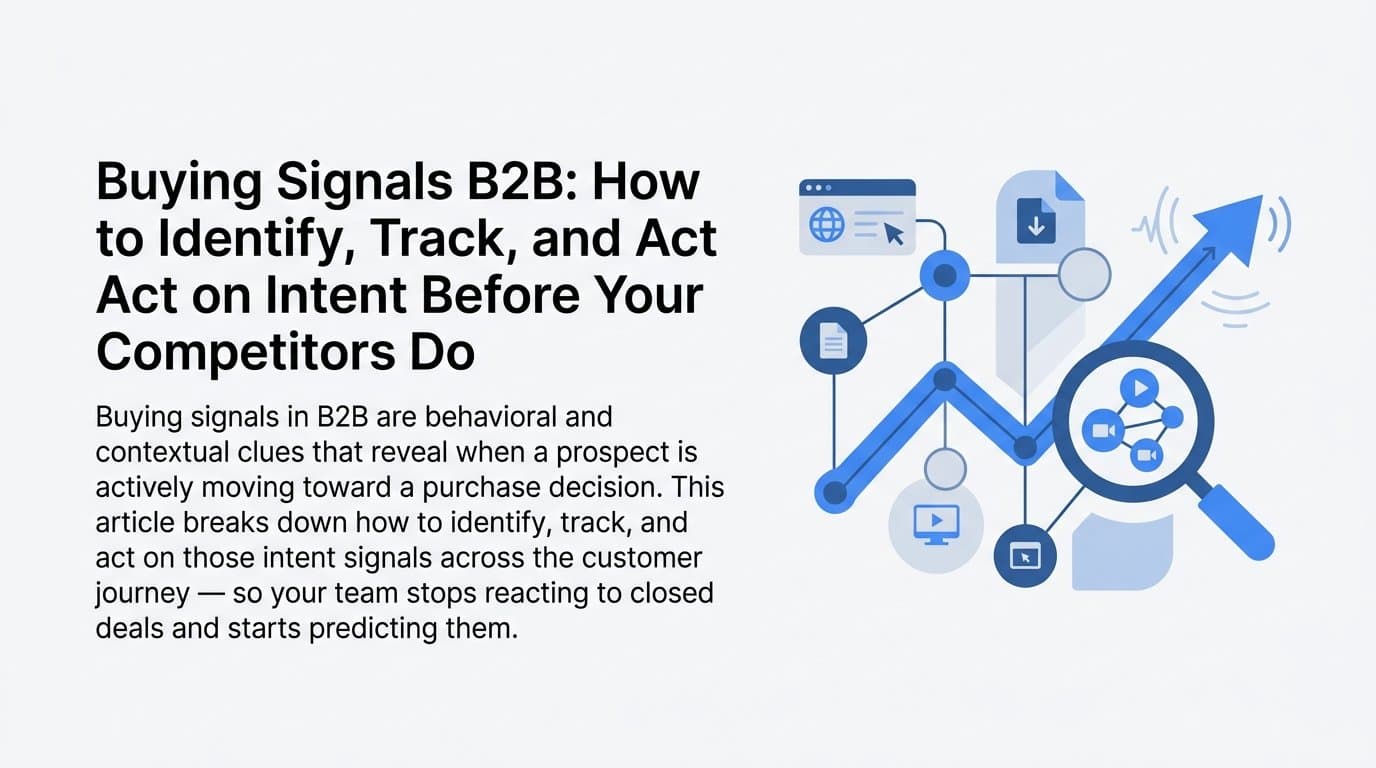
Buying signals change that equation. In B2B, a buying signal is any behavioral or contextual clue that a prospect is actively moving toward a purchase decision. These signals are already happening across your channels right now. The question is whether your systems are built to capture them, connect them, and act on them before a competitor does.
This article walks through what buying signals actually look like in a B2B context, where they surface across the customer journey, how to connect intent data to real revenue outcomes, and how to build a framework that scales. If you manage marketing spend, run campaigns, or own pipeline, this is the infrastructure thinking that separates teams who react to closed deals from teams who predict them.
The Invisible Hand: What Buying Signals Actually Look Like in B2B
Not all buying signals are created equal, and in B2B, the gap between a signal that looks like interest and one that indicates real purchase intent can be significant. Getting that distinction right is the foundation of everything else.
At the broadest level, buying signals fall into two categories: behavioral triggers and contextual signals.
Behavioral triggers are actions a prospect takes directly with your content or product. These include visiting your pricing page, requesting a demo, signing up for a free trial, returning to a feature comparison page multiple times, or engaging with bottom-of-funnel ad creative. These are signals generated by the prospect's direct interaction with your brand.
Contextual signals come from outside your owned channels. A company announcing a new funding round, posting job openings in a department that would use your product, or adopting a complementary technology in their stack are all indicators that something has changed internally. That change may be creating the conditions for a purchase decision even before the prospect has engaged with your brand at all.
Within behavioral signals, it helps to separate passive signals from active ones. Passive signals are early-stage research behaviors: reading a blog post, clicking a social ad, or consuming educational content. These indicate awareness and curiosity, but not urgency. Active signals are direct indicators of intent: a pricing page visit, a second or third return session to your product pages, a demo request form interaction, or direct navigation to your site by typing the URL rather than clicking a link. Active signals suggest the prospect is in evaluation mode.
This distinction matters more in B2B than in B2C for a few reasons. B2B buying cycles are longer, often spanning weeks or months. Multiple stakeholders are involved, meaning the person doing the research is frequently not the person who signs the contract. And because the stakes are higher, prospects spend more time in consideration before taking any visible action.
What this means in practice is that a single passive signal from an individual contact tells you relatively little. But a pattern of active signals from multiple people at the same account, especially when combined with contextual triggers, tells you a great deal. Account-level signal aggregation is what separates noise from genuine purchase intent in B2B.
Where Buying Signals Hide Across the Customer Journey
Buying signals do not announce themselves. They surface quietly across a range of digital touchpoints, and the challenge is that most teams are only seeing a fraction of them at any given time.
The primary channels where intent surfaces include paid advertising, website behavior, and CRM activity. Each one tells a different part of the story.
Paid ad engagement is often the first place a buying signal appears. A prospect clicking a bottom-of-funnel ad, engaging with a retargeting campaign, or repeatedly seeing and interacting with your creative is signaling something. Even the type of ad they engage with matters: someone clicking a product comparison ad is further along than someone clicking a thought leadership piece.
Website behavior is where intent becomes most visible. Pages visited, time spent on specific pages, the sequence in which pages are viewed, and return sessions all carry signal value. A prospect who visits your homepage once is browsing. A prospect who visits your pricing page, then your integrations page, then returns two days later to your feature detail page is evaluating. The pattern and order of those visits matter more than any single pageview.
CRM activity rounds out the picture. Email open rates, reply rates, meeting bookings, and engagement with sales sequences are all behavioral signals that indicate where an account stands in the buying process. A prospect who opens every email but never replies is in a different position than one who replies with specific product questions.
Here is where most teams run into a structural problem: signal fragmentation. Ad data lives in Google Ads or Meta Ads Manager. Website analytics sit in a separate platform. CRM data is in HubSpot or Salesforce. And because these systems rarely talk to each other in real time, no one has a unified view of which accounts are heating up across all three.
The result is that a sales rep might reach out to an account based on a form fill, without knowing that the same account has visited the pricing page four times in the past week and engaged with three retargeting ads. That context would change the conversation entirely.
This is the concept of touchpoint sequencing: it is not one signal that predicts purchase intent, it is the pattern and order of signals across channels and over time. A pricing page visit after an organic blog read after a paid ad click tells a very different story than a pricing page visit from a cold outbound email. Attribution infrastructure is what makes that sequencing visible.
From Signal to Insight: How Attribution Connects Intent to Revenue
Capturing buying signals is only useful if you can connect them to outcomes. Without attribution, you know someone visited your pricing page, but you do not know which campaign drove them there, what they did before that visit, or whether accounts that exhibit that behavior pattern tend to close. Attribution closes that gap.
Multi-touch attribution transforms raw behavioral data into a structured view of which channels and campaigns are generating the highest-intent leads, not just the highest volume. This is a critical distinction. A channel that drives large numbers of top-of-funnel leads might look impressive in a last-click model while contributing almost nothing to closed revenue. A channel that drives fewer but more qualified leads might be systematically undervalued.
Different attribution models tell different parts of the buying signal story.
First-touch attribution credits the channel that generated the initial awareness. This is useful for understanding which sources introduce your brand to accounts that eventually become customers.
Last-click attribution credits the final interaction before conversion. This highlights what closes deals, but it often over-credits bottom-of-funnel channels while ignoring the earlier touchpoints that built the relationship.
Linear attribution distributes credit evenly across all touchpoints in the journey. This gives a more balanced view but can obscure which signals carry the most predictive weight.
Data-driven attribution uses algorithmic modeling to assign credit based on which touchpoints actually correlate with conversion. This is the most accurate model for teams with sufficient data volume, and it is the one most aligned with how buying signals actually work in complex B2B journeys.
The real power of attribution comes when you connect ad platform data to CRM and pipeline data. When you can see that accounts who visited your pricing page after clicking a specific ad campaign are closing at a higher rate and at a shorter sales cycle length, that is not just a marketing insight. That is a signal about where to concentrate budget, which creative to scale, and which audience segments to prioritize.
This is the difference between knowing that a buying signal happened and knowing that a buying signal predicted revenue. Attribution is what makes that connection explicit.
The Tracking Gap: Why Most Teams Miss High-Intent Signals
Even if your attribution model is well-configured, it can only work with the data it receives. And right now, most teams are receiving significantly less data than they think.
Browser-based tracking, the pixel and cookie infrastructure that most digital marketing has relied on for years, has become increasingly unreliable. Privacy changes across major browsers have shortened cookie lifespans and blocked third-party tracking by default. Ad blockers are widely used among the professional audiences that B2B teams most want to reach. And regulatory pressure has added additional friction to cookie-based data collection in many markets.
The practical result is that a meaningful portion of high-intent signals are going unrecorded. A prospect visits your pricing page from a browser with strict privacy settings, and the pixel fires but the data is dropped. A demo request comes through from a user with an ad blocker, and the conversion event never makes it back to your ad platform. These are not edge cases. They represent a systematic blind spot in traditional tracking infrastructure.
Server-side tracking and Conversion API (CAPI) integrations are the modern infrastructure fix. Instead of relying on a browser-side pixel to fire and transmit data, server-side tracking sends conversion events directly from your server to the ad platform. The signal does not pass through the browser at all, which means it is not affected by ad blockers, browser privacy settings, or cookie restrictions. The result is a more complete and more accurate record of the buying signals that are actually occurring.
First-party data enrichment takes this further. When an anonymous ad click can be tied to a known lead in your CRM, every subsequent action that lead takes becomes a richer buying signal. You are no longer tracking anonymous sessions. You are tracking the behavior of identified accounts across the full journey. A return visit to your pricing page stops being an anonymous session and becomes a named account showing late-stage intent.
This combination of server-side infrastructure and first-party data is what allows teams to close the tracking gap and ensure that the signals they are acting on reflect what is actually happening, not just what their browser-based pixels managed to capture.
Turning Buying Signals Into Smarter Ad Campaigns
Buying signal data is not just useful for sales outreach. It is also the fuel that makes your ad campaigns significantly more efficient.
Meta and Google's ad algorithms are trained on conversion event data. When you send accurate, enriched conversion signals back to these platforms via Conversion API or enhanced conversions, the platform's AI can optimize toward the audiences most likely to exhibit the same behaviors. In practical terms: if you feed the platform data that shows which ad interactions preceded closed deals rather than just form fills, the algorithm will find more accounts that match that high-value behavioral profile.
This is why signal quality matters as much as signal volume. A large volume of low-quality conversion events, such as top-of-funnel form fills that rarely convert to revenue, trains the platform to find more of those low-quality leads. Richer signals tied to actual pipeline and revenue outcomes train the platform to find accounts that look like your best customers.
AI-powered analysis of buying signal patterns can also surface which ad creatives, audiences, and channels are attracting the highest-intent prospects rather than just the highest volume. A creative that generates many clicks but low pricing page visits tells a different story than one that generates fewer clicks but consistently drives accounts into active evaluation behavior.
This creates a compounding advantage over time. Better signal data produces better ad targeting. Better targeting attracts better-fit prospects. Better-fit prospects generate cleaner, more predictive signal data. Each cycle improves the next, and teams that build this feedback loop early develop a structural edge that is difficult for competitors to replicate quickly.
Building a Buying Signal Framework That Scales
Understanding buying signals conceptually is one thing. Building a system that captures and acts on them consistently is another. A practical framework rests on four pillars.
Signal definition: Start by agreeing on which behaviors indicate intent at each stage of the funnel. Early-stage signals might include blog consumption, social ad engagement, and organic search visits on problem-aware keywords. Mid-stage signals might include webinar attendance, gated content downloads, and email reply rates. Late-stage signals are your highest-value indicators: pricing page visits, demo requests, return sessions to feature comparison pages, and direct navigation to your site. Document these definitions so that marketing and sales are operating from the same playbook.
Instrumentation: Once you have defined your signals, ensure every relevant touchpoint is actually tracked. This means server-side tracking for conversion events, CRM integration for pipeline and deal activity, and ad platform connections for campaign-level data. If a signal is not captured, it cannot be acted on.
Unification: Bring data from ads, website, and CRM into a single attribution layer. This is the step that most teams skip or underinvest in, and it is the one that makes everything else possible. When marketing and sales share the same view of which accounts are showing intent and what signals they have exhibited, handoffs improve and pipeline velocity increases. A single source of truth eliminates the version-of-events problem where marketing sees one picture and sales sees another.
Activation: Create clear response workflows for each signal tier. Early-stage signals should inform content targeting and ad audience segmentation. Mid-stage signals should trigger sales outreach, with context about what the account has engaged with. Late-stage signals should activate deal acceleration tactics: personalized outreach, executive involvement, or time-sensitive offers. The faster and more relevant the response to a high-intent signal, the higher the probability of converting it into a meeting or a deal.
The goal is not to build a perfect system on day one. It is to build a system that gets progressively smarter as more signal data flows through it, and that keeps marketing and sales aligned around the accounts that actually matter right now.
Putting It All Together
Buying signals are already happening across your channels. Prospects are visiting your pricing page, engaging with your ads, returning to your site, and exhibiting all the behaviors that indicate they are in active evaluation mode. The question is not whether the signals exist. It is whether your infrastructure is built to capture them, your attribution layer is built to interpret them, and your teams are aligned to act on them.
The progression is straightforward in concept, even if it takes investment to build: identify which signals matter at each stage, instrument every touchpoint to capture them reliably, unify the data into a single attribution view, and create workflows that turn signal patterns into sales and marketing action.
Cometly is built for exactly this kind of work. It connects your ad platforms, CRM, and website data into one attribution layer so you can see which signals actually predict closed revenue, not just which ones generate the most activity. With server-side tracking, Conversion API integration, and AI-powered analysis across every channel, Cometly gives your team a complete, real-time view of which accounts are heating up and which campaigns are driving the highest-intent prospects into your pipeline.
If your current setup is leaving buying signals on the table, now is the time to fix that. Get your free demo today and start capturing every touchpoint to maximize your conversions.