
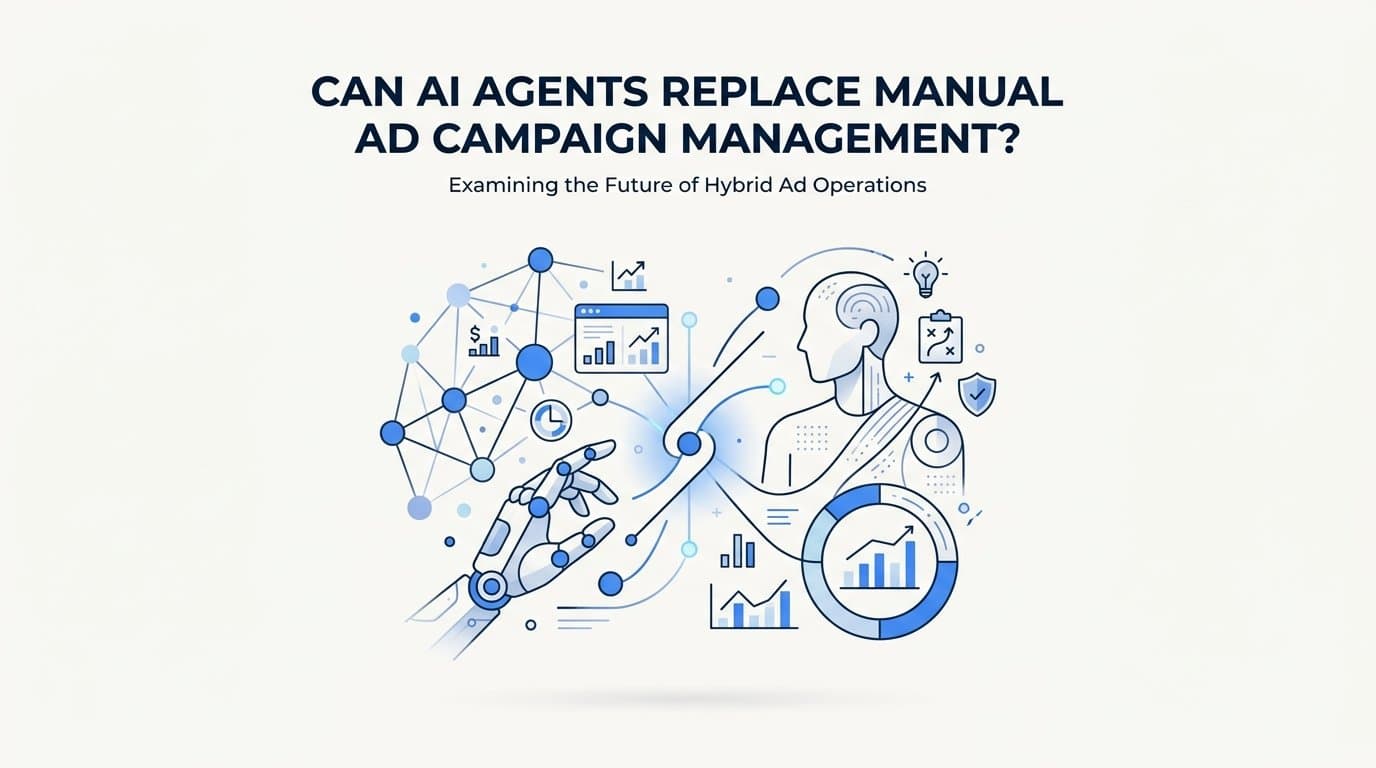
AI agents can automate a significant portion of ad campaign management tasks, including bid adjustments, audience targeting, budget pacing, and performance reporting. But they cannot fully replace human judgment in strategy, creative direction, and brand decision-making.
For most B2B SaaS marketing teams, the most effective approach is a hybrid model: AI handles repetitive optimization work while humans focus on high-level strategy and creative decisions. The catch is that AI optimization is only as reliable as the data feeding it. Without accurate attribution connecting ad clicks to pipeline and revenue, automation will optimize toward the wrong signals and scale the wrong outcomes.
This article breaks down exactly what AI agents handle well, where they fall short, and how to structure your team and your data infrastructure to get the most from both.
1. What Tasks AI Agents Can Actually Automate in Ad Management
The Challenge It Solves
Ad campaign management involves dozens of repetitive, data-intensive decisions every day. Manually adjusting bids across hundreds of ad groups, monitoring budget pacing across campaigns, and rotating creatives based on performance data is time-consuming and prone to human error. AI agents are purpose-built for exactly this kind of high-frequency, rules-based work.
The Strategy Explained
There is a clear line between what AI agents automate reliably and what still requires human review. Understanding that line is the first step to deploying automation effectively.
Fully automatable tasks: Bid management and Smart Bidding optimization, budget pacing and daily spend distribution, audience expansion based on conversion signals, A/B test rotation and creative serving, anomaly detection and performance alerting, and ad scheduling based on historical engagement patterns.
Tasks that still require human review: Creative concept development and messaging strategy, campaign structure decisions, budget allocation across channels, interpretation of attribution data, and response to competitive or market changes.
Google's Performance Max and Meta's Advantage+ campaigns are real examples of platforms that have moved deep into the first category. Performance Max automates creative serving, bidding, and placement across Search, Display, YouTube, Gmail, and Maps simultaneously. Advantage+ automates audience targeting and creative combinations without requiring manual audience segmentation.
Implementation Steps
1. Audit your current campaign management workflow and categorize every task as either data-driven and repetitive or judgment-based and contextual.
2. Map each repetitive task to a specific automation feature inside your ad platforms or management tools.
3. Define which tasks will remain human-owned and document the decision criteria for each.
Pro Tips
Start automation with bid management before expanding to audience and creative automation. Bidding is the most data-driven task in campaign management and the lowest-risk place to hand control to AI. Once you see stable results there, expand automation gradually with clear performance benchmarks at each stage.
2. Where AI Agents Fall Short Without Clean Attribution Data
The Challenge It Solves
AI optimization systems are not neutral. They optimize toward whatever conversion signals they receive. If those signals are incomplete, delayed, or misattributed, the AI will make confident decisions based on bad data and scale the wrong campaigns. This is one of the most underappreciated failure modes in automated ad management.
The Strategy Explained
Browser-based tracking has become increasingly unreliable. Cookie deprecation, ad blockers, iOS privacy changes, and cross-device journeys all create gaps in the conversion data that ad platforms use to train their bidding algorithms. When a significant share of conversions go untracked, the AI sees a distorted picture of what is actually working.
Google's own documentation states that Smart Bidding requires sufficient conversion data to optimize effectively. When conversion volume is low or signal quality is poor, automated bidding systems default to less precise optimization strategies. The result is wasted spend, not efficient automation.
Server-side tracking solves this problem at the source. Meta's Conversion API and Google's Enhanced Conversions are server-side solutions designed to send conversion data directly from your server to the ad platform, bypassing browser-based data loss entirely. Cometly integrates with both and adds a critical layer: connecting those conversion signals to actual pipeline and revenue data from your CRM, so the signals you send back to ad platforms reflect real business outcomes rather than just form fills or page events.
Implementation Steps
1. Audit your current tracking setup to identify gaps between reported conversions in your ad platforms and actual leads or revenue in your CRM.
2. Implement server-side tracking through Meta's Conversion API and Google's Enhanced Conversions to recover lost conversion signals.
3. Connect your attribution platform to your CRM so that the conversion events you optimize toward reflect qualified pipeline, not just top-of-funnel activity.
Pro Tips
The quality of your attribution data is a direct multiplier on the quality of your AI's decisions. Before expanding automation, invest in tracking infrastructure. Clean data fed into an AI system produces better outcomes than more sophisticated AI fed dirty data.
3. The Human Skills AI Cannot Replicate in Campaign Management
The Challenge It Solves
There is a real risk of over-automating in response to the efficiency gains AI delivers. Marketing teams that hand too much control to AI agents often discover that their campaigns become technically optimized but strategically hollow: high click-through rates with no brand coherence, efficient spend with no competitive differentiation.
The Strategy Explained
AI agents are pattern-matching systems. They are exceptional at finding correlations in large datasets and acting on them quickly. What they cannot do is understand organizational context, interpret competitive dynamics, make ethical judgment calls, or build the kind of brand narrative that creates long-term market positioning.
Brand strategy and positioning: AI can test which ad copy performs better in the short term. It cannot determine whether that copy is consistent with your brand voice, your product roadmap, or your competitive differentiation strategy.
Creative direction: AI can rotate creatives and identify which combinations drive clicks. It cannot conceive original creative concepts, understand cultural context, or make the judgment call about whether a particular message is appropriate for your audience right now.
Competitive response: When a competitor launches a new product or changes their messaging, the strategic response requires market knowledge, product understanding, and organizational alignment that AI systems do not have access to.
Stakeholder communication: Explaining campaign performance to a CFO, aligning with a product team on a launch campaign, or navigating internal budget discussions are inherently human conversations.
Ethical targeting judgment: Decisions about which audiences to target, which messages are appropriate, and where to draw lines around sensitive topics require human accountability.
Implementation Steps
1. Define a clear list of decisions that require human sign-off before implementation, regardless of what automation recommends.
2. Assign specific team members as owners of brand strategy, creative direction, and competitive positioning.
3. Build a review cadence where humans evaluate AI-generated recommendations against strategic context before approving changes above a defined threshold.
Pro Tips
The best AI-human teams treat AI recommendations as inputs, not instructions. Your AI system surfaces what the data suggests. Your team decides what to do with that information given everything else they know about your business, your market, and your customers.
4. How to Structure a Hybrid AI-Human Ad Management Model
The Challenge It Solves
Most marketing teams either over-rely on manual management and miss the speed advantages of automation, or they hand too much control to AI and lose visibility into what is actually happening in their campaigns. A structured hybrid model solves both problems by defining clear ownership at every level of decision-making.
The Strategy Explained
The hybrid model works when you treat AI as an execution layer and humans as the strategy and oversight layer. The key is defining the boundary between the two clearly enough that neither side is doing the other's job.
AI-owned execution tasks: Bid adjustments within approved ranges, budget pacing within approved daily limits, audience expansion within approved targeting parameters, creative rotation within approved asset libraries, and performance alerting when metrics cross defined thresholds.
Human-owned strategy tasks: Campaign structure and objective setting, budget allocation across channels, creative concept development, attribution model selection, and response to significant performance changes.
Attribution data is the oversight layer that connects both sides. When you can see which campaigns are actually driving pipeline and revenue, you can evaluate whether AI decisions are producing real business outcomes, not just platform-level metrics. Cometly's AI ads manager is built for this exact use case: it surfaces which campaigns are driving pipeline and revenue so your team knows where to intervene and where to let automation run.
Implementation Steps
1. Define guardrails for every automated decision: maximum bid changes per day, budget variance limits, audience expansion boundaries, and creative rotation rules.
2. Build an approval workflow for changes above your guardrail thresholds, requiring human review before implementation.
3. Set a weekly review cadence where your team evaluates AI performance against pipeline and revenue attribution data, not just platform metrics.
Pro Tips
Start with tight guardrails and loosen them as you build confidence in your AI's decision quality. A 10% bid adjustment limit is a reasonable starting point. As your attribution data confirms that AI decisions are producing the right business outcomes, you can expand the range of autonomous action.
5. Which Attribution Model Works Best When AI Is Managing Bids
The Challenge It Solves
Last-click attribution is the default setting in many ad platforms, and it is one of the most damaging inputs you can feed an AI bidding system. When AI optimizes toward last-click conversions, it systematically undervalues upper-funnel channels that initiate the customer journey and overvalues the final touchpoint before conversion. The result is an AI that defunds the channels doing the most work.
The Strategy Explained
Attribution models determine which touchpoints receive credit for a conversion. In automated bidding environments, the attribution model you use directly shapes the optimization signals the AI receives. Feed it last-click data and it will optimize for last-click outcomes. Feed it multi-touch data and it will optimize across the full customer journey.
Multi-touch attribution distributes credit across all touchpoints in the conversion path, giving the AI a more accurate picture of which channels and campaigns are actually contributing to revenue. Data-driven attribution goes further, using machine learning to weight touchpoints based on their actual impact on conversion probability rather than applying a fixed credit distribution rule.
For B2B SaaS companies with longer sales cycles, connecting ad spend to pipeline and closed revenue adds another layer of signal quality. A campaign that drives a high volume of demo requests but low pipeline conversion is a different optimization target than a campaign that drives fewer demos but higher close rates. Cometly connects ad spend directly to Stripe revenue and CRM pipeline data, giving AI bidding systems the kind of downstream conversion signals that reflect actual business value.
Implementation Steps
1. Audit your current attribution model settings in Google Ads and Meta and switch from last-click to data-driven attribution where available.
2. Connect your attribution platform to your CRM to capture pipeline and revenue data as conversion signals, not just top-of-funnel events.
3. Review your conversion event hierarchy to ensure the events you are optimizing toward represent qualified outcomes, not just activity volume.
Pro Tips
If you are running Google Performance Max or Meta Advantage+ campaigns, the attribution model you select has an outsized impact because the AI has broad control over placement and audience decisions. Getting attribution right before scaling these campaigns is not optional. It is the prerequisite for results that are actually tied to revenue.
6. AI Agents Across Channels: Google, Meta, and Beyond
The Challenge It Solves
AI automation works differently across platforms, and marketers who treat all channel automation as equivalent end up with blind spots. Understanding what each platform controls automatically, what you can still override, and how to maintain visibility across all channels simultaneously is essential when AI is running multiple campaigns at once.
The Strategy Explained
Each major ad platform has built AI automation into its core products, but the level of control you retain varies significantly.
Google Performance Max: PMax automates creative serving, bidding, audience targeting, and placement across all of Google's channels simultaneously. Marketers control asset inputs, audience signals, budget, and campaign objectives. What you cannot directly control is which placements or audiences the AI prioritizes. Placement exclusions and brand safety settings are the primary override mechanisms available.
Meta Advantage+: Advantage+ campaigns automate audience targeting, creative combinations, and placement decisions. Marketers retain control over creative assets, campaign objectives, and budget. Audience controls are more limited than in traditional campaign structures, which makes creative quality and conversion signal quality the primary levers available to marketers.
Cross-channel management: When AI is running campaigns across Google and Meta simultaneously, cross-channel attribution becomes critical. Each platform's AI will claim credit for conversions that the other platform also touched. Without a unified attribution layer outside the platforms, you will see inflated reported performance from both and have no accurate view of how budget should be allocated across channels.
Cometly's cross-channel attribution gives B2B SaaS teams a single source of truth that sits outside the ad platforms, connecting every touchpoint to pipeline and revenue so you can evaluate Google and Meta performance on equal terms.
Implementation Steps
1. Document which decisions each platform's AI controls automatically and which settings remain under marketer control for every campaign type you run.
2. Implement a cross-channel attribution platform that reports performance independently of the ad platforms' own attribution models.
3. Set a monthly cross-channel budget review process using attribution data to evaluate how spend should be distributed based on actual pipeline contribution, not platform-reported ROAS.
Pro Tips
Platform-reported ROAS from Google and Meta will almost always tell a more optimistic story than your actual revenue data. Build the habit of reconciling platform metrics against your CRM and revenue data monthly. The gap between what platforms report and what actually closed is where budget allocation decisions get made well or poorly.
7. Measuring Whether AI Agents Are Actually Improving Results
The Challenge It Solves
AI campaign management can look good in platform dashboards while underperforming on actual business outcomes. Click-through rates, impression share, and platform-reported conversions are all metrics that AI systems optimize for directly, which means they will often improve even when pipeline and revenue do not. Measuring AI performance correctly requires looking beyond the metrics AI is already optimizing toward.
The Strategy Explained
The metrics that matter for evaluating AI campaign management are the ones connected to actual business outcomes: cost per acquisition against qualified pipeline, return on ad spend measured against closed revenue, pipeline contribution by channel, and revenue per channel over time.
Running controlled experiments is the most rigorous way to evaluate AI versus manual management. A holdout test, where a portion of your budget runs under manual management while the rest runs under AI automation, gives you a direct comparison under the same market conditions. The comparison should be evaluated on pipeline and revenue metrics, not platform metrics.
Knowing when to pull back automation is equally important. Signs that AI management is underperforming include: platform metrics improving while pipeline contribution declines, increasing spend concentration in a narrow set of placements or audiences without corresponding revenue growth, and creative fatigue that the AI is not detecting because it is optimizing for short-term click signals rather than long-term conversion quality.
Cometly's pipeline and revenue attribution data gives you the measurement layer to evaluate these outcomes clearly. When you can see which campaigns are contributing to closed revenue and which are generating activity without business impact, you have the information you need to decide where automation is working and where human intervention is required.
Implementation Steps
1. Define your primary success metrics for AI campaign management before you expand automation: target CPA against qualified pipeline, ROAS against closed revenue, and pipeline contribution by channel.
2. Run a structured holdout experiment comparing AI and manual management on a defined budget segment for a minimum of four to six weeks.
3. Review attribution data monthly to identify signals that AI decisions are drifting away from revenue-generating outcomes, and define the threshold at which you will reduce automation scope.
Pro Tips
Set a clear rule before you start: if pipeline contribution from AI-managed campaigns declines for two consecutive months while spend holds constant, you will reduce automation scope and review your conversion signal quality. Having that rule in place before you need it prevents the common trap of rationalizing poor AI performance with platform-level metrics that still look good.
Related Questions About AI in Ad Campaign Management
What can AI agents do in ad campaign management?
AI agents can automate bid management, budget pacing, audience expansion, creative rotation, A/B test management, anomaly detection, and performance alerting. They cannot autonomously handle brand strategy, creative concept development, competitive positioning, or stakeholder communication.
Do AI agents work better with more conversion data?
Yes. AI bidding systems require sufficient conversion volume and signal quality to optimize effectively. Low conversion volume or incomplete tracking leads to less precise optimization. Server-side tracking and first-party data improve signal quality, which directly improves AI decision quality.
What is the difference between AI-managed and manual ad campaigns?
AI-managed campaigns automate execution decisions like bids, pacing, and audience targeting at a speed and scale that manual management cannot match. Manual management retains full control over every decision but requires significantly more time and is limited by human processing capacity. The hybrid model combines both: AI handles execution, humans own strategy and oversight.
How do I know if AI is improving my ad performance?
Evaluate AI performance against pipeline and revenue metrics, not just platform-reported conversions. If cost per qualified lead is declining and pipeline contribution is growing, AI is improving results. If platform metrics look good but CRM data shows no corresponding improvement in qualified pipeline, AI is optimizing toward the wrong signals.
Which ad platforms have the most advanced AI automation?
Google's Performance Max and Meta's Advantage+ campaigns represent the most comprehensive AI automation available in major ad platforms as of 2026. Both automate audience targeting, creative serving, bidding, and placement decisions. The trade-off is reduced marketer control over individual levers, which makes attribution data and conversion signal quality more important, not less.
Putting It All Together
AI agents are genuinely capable of managing a large share of the repetitive, data-intensive tasks in ad campaign management. Bid adjustments, budget pacing, audience expansion, and performance alerting are all areas where automation adds real speed and scale that manual management cannot match.
But the quality of AI decisions depends entirely on the quality of the data feeding those decisions. Without accurate attribution connecting ad clicks to pipeline and revenue, AI optimization will chase the wrong signals and scale the wrong outcomes. The most sophisticated bidding algorithm in the world produces poor results when it is optimizing toward incomplete or misattributed conversion data.
The path forward for B2B SaaS marketing teams is not a choice between AI and human management. It is building the infrastructure that makes both work well together: clean server-side tracking, multi-touch attribution connected to pipeline and revenue data, clear human ownership of strategy and creative, and a measurement framework that evaluates AI performance against actual business outcomes.
Cometly gives B2B SaaS marketing teams the attribution layer that makes AI management trustworthy: multi-touch attribution, server-side tracking, Conversion API integration, and real-time pipeline data all in one place. If your team is evaluating how far to push AI automation in your ad programs, start by auditing your attribution setup. Accurate data is what separates AI that scales your results from AI that scales your waste.
Ready to build the attribution foundation your AI campaigns need? Get your free demo and see exactly which ads and channels are driving pipeline and revenue for your business.