Running paid campaigns across Meta, Google, TikTok, LinkedIn, and other channels means your marketing data is scattered across a dozen different dashboards. You end up toggling between tabs, exporting CSVs, and trying to stitch together a coherent picture of what is actually driving revenue.
A centralized marketing data platform solves this by pulling all your campaign data, attribution insights, and conversion metrics into one unified view. The result: faster decisions, clearer reporting, and the ability to confidently scale what works.
We evaluated these platforms based on integration depth, data accuracy, ease of use, attribution capabilities, and pricing transparency. Whether you are an in-house marketing team or an agency managing multiple clients, here are the best options available today.
1. Cometly
Best for: Marketing teams and agencies that need accurate attribution and AI-powered optimization across all paid channels.
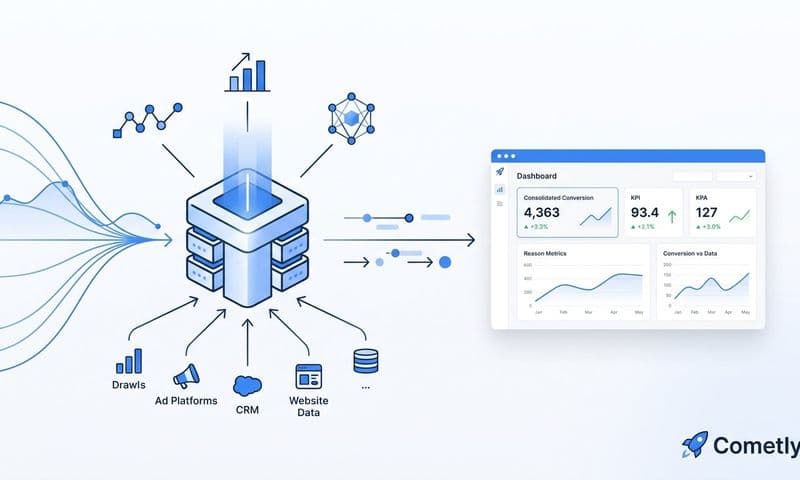
Cometly is an AI-powered marketing attribution platform that centralizes cross-platform ad data, tracks the full customer journey with server-side tracking, and feeds enriched conversion data back to ad platforms for smarter optimization.
 9 Best Marketing Attribution Platforms to Compare in 2026
Where This Tool Shines
Most attribution tools tell you what happened. Cometly goes a step further by telling you what to do about it. The platform connects your ad platforms, CRM, and website to track every touchpoint in real time, giving you a complete picture of which campaigns, ads, and channels are actually driving revenue.
What sets it apart is the Conversion Sync feature, which sends enriched first-party conversion data back to Meta, Google, TikTok, and other platforms. This feeds the ad platform algorithms better signals, improving targeting and reducing wasted spend over time. For teams dealing with iOS tracking limitations or cookie deprecation challenges, this is a meaningful advantage.
Key Features
Multi-Touch Attribution: Tracks every paid channel touchpoint in real time, so you can compare attribution models and see the full customer journey from first click to conversion.
Server-Side Tracking: Collects conversion data beyond browser limitations, improving accuracy across privacy-restricted environments and reducing data loss from ad blockers.
Conversion Sync: Sends enriched, conversion-ready events back to Meta, Google, TikTok, and more, improving ad platform targeting and optimization signals.
AI Ads Manager: Surfaces optimization recommendations based on your actual performance data, helping you identify which ads to scale and which to cut.
AI Chat: Lets you query your marketing data in natural language, so you can get answers without digging through dashboards or exporting spreadsheets.
Best For
Cometly is a strong fit for performance marketers, growth teams, and agencies managing paid media across multiple channels. It is especially valuable for teams that want to move beyond surface-level metrics and understand which touchpoints are genuinely contributing to revenue. If accurate attribution and AI-driven recommendations are priorities, this platform is worth a close look.
Pricing
Custom pricing based on ad spend volume. A free demo is available through the Cometly website, which is the best way to see the platform in action against your own data.
2. Supermetrics
Best for: Marketing analysts who need to pipe data from multiple sources into spreadsheets or BI tools for custom reporting.
Supermetrics is a data pipeline tool that extracts marketing data from 100+ sources and delivers it to spreadsheets, BI tools, and data warehouses for custom reporting and analysis.
 9 Best Centralized Marketing Data Platforms in 2026
Where This Tool Shines
Supermetrics is the go-to choice for teams that already have a reporting setup in place and just need reliable data flowing into it. It handles the extraction and delivery without trying to be your analytics layer, which makes it incredibly flexible for teams with existing workflows in Google Sheets, Looker Studio, or BigQuery.
The scheduled refresh functionality is particularly useful for keeping reports up to date automatically. Rather than manually pulling data each week, you set your schedule and Supermetrics handles the rest.
Key Features
100+ Native Connectors: Pulls data from major ad platforms, SEO tools, social media, and analytics platforms into a single pipeline.
Destination Flexibility: Direct integrations with Google Sheets, Looker Studio, BigQuery, Snowflake, and other popular BI destinations.
Scheduled Data Refreshes: Automates reporting updates so your dashboards stay current without manual intervention.
Data Blending: Combines data from multiple sources in a single query, useful for cross-channel performance comparisons.
Best For
Analysts and marketing ops teams who want a dependable data pipeline without building custom integrations. It works best when paired with a separate visualization or analytics tool, since Supermetrics focuses on moving data rather than interpreting it.
Pricing
Starts around $39/month for basic connectors. Pricing scales based on the number of destinations and data volume, so costs can increase significantly for larger teams with complex setups.
3. Funnel.io
Best for: Mid-to-large marketing teams that need a robust data hub with transformation capabilities before sending data to BI tools.
Funnel.io is a marketing data hub that automatically collects, maps, and transforms data from 500+ advertising and marketing platforms before sending it to any analytics or BI destination.
 9 Best Ad Platform Data Sync Tools to Optimize Campaign Performance in 2026
Where This Tool Shines
Where Supermetrics focuses on extraction, Funnel.io adds a meaningful transformation layer on top. You can define custom mapping rules, normalize data across platforms, and clean up inconsistencies before the data ever reaches your dashboard. For teams dealing with messy, inconsistent naming conventions across ad accounts, this is a significant time saver.
The built-in data storage layer also means you can run historical comparisons without worrying about whether your source platforms retain data long enough. This is particularly useful for year-over-year analysis.
Key Features
500+ Data Connectors: One of the broadest connector libraries in the category, covering ad platforms, social media, and marketing analytics tools.
No-Code Data Transformation: Lets non-technical users define normalization rules and field mappings without writing SQL or custom scripts.
Flexible Export Options: Sends clean, transformed data to data warehouses, dashboards, and BI tools of your choice.
Historical Data Storage: Retains data within the platform for historical comparisons, independent of source platform retention limits.
Best For
Marketing teams and analysts at mid-to-large companies who need clean, structured data before it reaches their BI layer. Less suited for small teams with simple reporting needs, given the price point.
Pricing
Starts at around $1,000/month. Pricing scales with the number of connectors and data volume, making this a better fit for teams with larger budgets and complex data needs.
4. Datorama (Salesforce Marketing Intelligence)
Best for: Enterprise marketing teams already invested in the Salesforce ecosystem who need unified marketing intelligence at scale.
Datorama is an enterprise marketing intelligence platform within the Salesforce ecosystem that unifies marketing data, provides AI-powered insights, and delivers customizable dashboards across teams.
 9 Best Marketing Data Consolidation Platforms in 2026
Where This Tool Shines
If your organization runs on Salesforce, Datorama is the natural extension for marketing analytics. The depth of native integration with Salesforce CRM and Marketing Cloud is difficult to match with third-party tools. You can connect campaign performance directly to CRM pipeline and revenue data, giving you a true closed-loop view of marketing impact.
The Einstein AI layer adds anomaly detection and automated insights, which is useful for enterprise teams managing high volumes of campaigns where manual monitoring is impractical.
Key Features
Salesforce Native Integration: Deep connection to Salesforce CRM and Marketing Cloud for closed-loop revenue attribution.
Einstein AI Insights: Automated anomaly detection and AI-powered recommendations built into the platform.
Customizable Dashboards: Granular permission controls and flexible dashboard design for different stakeholder needs.
Cross-Channel Analytics: Unified campaign performance reporting across paid, owned, and earned channels.
Best For
Enterprise marketing teams that are already Salesforce customers and want a deeply integrated analytics layer. Teams without a Salesforce investment will likely find better value elsewhere in this list.
Pricing
Enterprise pricing, typically bundled with Salesforce Marketing Cloud contracts. Contact Salesforce directly for specific quotes based on your organization's setup.
5. Triple Whale
Best for: Direct-to-consumer ecommerce brands running on Shopify that want unified ad performance and store analytics in one place.
Triple Whale is an ecommerce-focused analytics and attribution platform that centralizes Shopify store data with paid media performance for DTC brands.
 7 Best Funnel.io Alternatives for Marketing Data Analytics in 2026
Where This Tool Shines
Triple Whale was built specifically for the DTC ecommerce world, and it shows. The Shopify-native integration means store data, order data, and ad performance are connected from day one without complex setup. For brands running aggressive paid social campaigns, the creative analytics dashboard is especially useful: you can see which ad creatives are actually driving purchases, not just clicks.
The first-party pixel helps recover attribution data that would otherwise be lost to iOS restrictions, which has become a critical capability for Meta-heavy advertisers.
Key Features
Shopify-Native Integration: Real-time store analytics connected directly to your Shopify data without manual configuration.
First-Party Pixel: Captures attribution data across paid channels while reducing the impact of browser-based tracking limitations.
Creative Analytics: Breaks down ad performance by individual creative, helping teams identify winning assets faster.
Customer Journey Mapping: Visualizes the ecommerce funnel from first touch to purchase for deeper attribution insight.
Best For
DTC brands and ecommerce-focused agencies running paid social and search campaigns with Shopify as their store platform. Less relevant for B2B teams or businesses without an ecommerce component.
Pricing
Starts around $100/month for smaller stores. Pricing scales with revenue, so costs increase as your store grows.
6. Whatagraph
Best for: Marketing agencies that need automated, white-label reporting across multiple client accounts.
Whatagraph is a cross-channel marketing reporting platform designed for agencies, with automated data pulls, white-label reports, and visual dashboards built for client communication.
 9 Best Tools to Fix Inconsistent Data Between Marketing Tools in 2026
Where This Tool Shines
Whatagraph is purpose-built for agencies that spend too much time manually compiling client reports. The white-label functionality lets you present branded dashboards and automated reports without the client ever seeing the tool behind them. Templates speed up the setup process significantly when onboarding new clients.
The automated scheduling means reports go out on time every time, reducing the operational burden on account managers who would otherwise spend hours each month on reporting tasks.
Key Features
45+ Native Integrations: Connects to major ad platforms, Google Analytics, social media, and SEO tools for comprehensive channel coverage.
White-Label Reporting: Fully customizable templates with agency branding for professional client-facing deliverables.
Automated Scheduling: Set up recurring reports that deliver automatically to clients via email or shared link.
Multi-Client Management: Organize and manage multiple client accounts from a single agency dashboard.
Best For
Digital marketing agencies managing multiple client accounts who need to streamline reporting without sacrificing quality. In-house teams with simpler reporting needs may find the feature set more than they require.
Pricing
Starts around $199/month. Agency plans are available for multi-client use, with pricing scaling based on the number of accounts and data sources.
7. Adverity
Best for: Enterprise teams that need robust data governance, harmonization, and anomaly detection alongside marketing data centralization.
Adverity is an enterprise data integration and intelligence platform that centralizes marketing data with built-in data governance, harmonization, and smart alerting capabilities.
 9 Best Marketing Data Aggregation Platforms in 2026
Where This Tool Shines
Adverity stands out for teams where data quality and governance are non-negotiable. The automated harmonization layer standardizes data across sources before it reaches any reporting layer, which reduces the manual cleanup work that plagues teams pulling from many different platforms. With 600+ connectors covering marketing, sales, and finance data, it can serve as a single source of truth across departments.
The anomaly detection and smart alerting features are genuinely useful at enterprise scale, where a data spike or drop in a single campaign can easily go unnoticed without automated monitoring.
Key Features
600+ Data Connectors: Broad coverage across marketing, sales, and finance data sources for true cross-functional data centralization.
Automated Data Harmonization: Standardizes and cleans data across sources automatically, reducing manual data prep work.
Anomaly Detection: Flags unexpected changes in performance data and sends smart alerts to keep teams informed.
Flexible Destinations: Exports to major data warehouses and BI tools, fitting into existing enterprise data stacks.
Best For
Large enterprises and global brands with complex data environments that need governance and harmonization baked into the platform. The price point and complexity make it less suitable for smaller teams.
Pricing
Custom enterprise pricing. Request a demo through the Adverity website for a tailored quote based on your data volume and connector needs.
8. Windsor.ai
Best for: Budget-conscious marketers and small teams that need multi-touch attribution and ad data connectors without a high price tag.
Windsor.ai is a budget-friendly marketing attribution and data platform that connects ad spend data to conversions with multi-touch attribution modeling across major ad platforms.
Where This Tool Shines
Windsor.ai makes multi-touch attribution accessible to teams that cannot justify enterprise-level pricing. The data-driven attribution models help smaller teams move beyond last-click reporting without requiring a data science team to set up and maintain custom models. The ROI tracking at the keyword and campaign level is practical for hands-on media buyers who want granular visibility.
The free tier is a genuine entry point for testing the platform before committing, which is relatively rare in the attribution space.
Key Features
Multi-Touch Attribution Models: Includes data-driven attribution alongside standard models like linear, time decay, and first-touch.
Ad Platform Connectors: Pulls data from Google Ads, Meta, LinkedIn, and other major platforms into a unified view.
BI Tool Integration: Connects to Google Sheets, BigQuery, and Power BI for teams that prefer to analyze data in their own environment.
Keyword-Level ROI Tracking: Breaks down return on investment at the keyword and campaign level for granular optimization.
Best For
Small to mid-sized marketing teams and freelancers who need attribution modeling and data connectivity without enterprise pricing. Teams with more complex data needs or larger budgets may outgrow the platform.
Pricing
Free tier available with limited connectors. Paid plans start around $19/month, making it one of the most accessible options in the attribution category.
9. HubSpot Marketing Hub
Best for: B2B teams that want CRM, campaign management, and marketing analytics in a single integrated platform.
HubSpot Marketing Hub is an all-in-one marketing platform with built-in CRM, campaign analytics, ad management, and lead tracking that centralizes marketing data within a single connected suite.
Where This Tool Shines
HubSpot's core advantage is that your CRM and marketing data live in the same system. Contact-level attribution, lead source tracking, and revenue reporting all connect without needing a separate integration layer. For B2B teams where the sales cycle is long and multi-touch, this closed-loop visibility is genuinely valuable.
The built-in tools for email, landing pages, and campaign management also mean you are creating and tracking marketing activity in the same place, which reduces the data fragmentation problem at the source rather than just patching it afterward.
Key Features
Native CRM Integration: Full contact and company data centralization with marketing activity tied directly to CRM records.
Ad Attribution Reporting: Tracks and attributes ad performance across Google, Meta, and LinkedIn within the HubSpot interface.
Campaign Management: Built-in tools for email, landing pages, forms, and workflows, all tracked within the same analytics layer.
Revenue Attribution Reporting: Available in the Enterprise tier, connecting marketing activity to closed revenue for full-funnel visibility.
Best For
B2B marketing teams that want an integrated suite rather than a standalone analytics tool. HubSpot works best when your team is also using it for CRM and campaign execution, not just reporting.
Pricing
Free tier available with basic features. Marketing Hub Professional starts at $800/month. Revenue attribution reporting is available at the Enterprise tier, which carries a higher price point.
How to Choose the Right Platform for Your Team
The right centralized marketing data platform depends heavily on what your team actually needs: raw data movement, actionable attribution insights, client reporting, or a fully integrated marketing suite.
Here is a practical way to think about it based on your situation:
If you need attribution and AI-driven optimization: Cometly is the strongest choice for performance marketers who want to know exactly which ads drive revenue and get recommendations on where to scale. The Conversion Sync feature and server-side tracking give it a technical edge for teams dealing with iOS tracking challenges or cookie-related data loss.
If you need a data pipeline into your existing BI tools: Supermetrics is the most accessible option for teams already using Google Sheets or Looker Studio. For teams with more complex transformation needs and larger budgets, Funnel.io or Adverity offer more depth.
If you are an ecommerce brand on Shopify: Triple Whale is purpose-built for your use case and will integrate faster than a general-purpose platform.
If you are an agency managing multiple clients: Whatagraph's white-label reporting and multi-client management features make it the most practical choice for streamlining client deliverables.
If you are a B2B team that wants everything in one place: HubSpot Marketing Hub offers the deepest CRM and marketing integration, though it comes at a higher price point as you scale.
If budget is a primary constraint: Windsor.ai offers multi-touch attribution at a price point that most small teams can justify, including a free tier for getting started.
The broader trend worth paying attention to is the shift toward platforms that do not just centralize data but act on it. Feeding enriched conversion signals back to ad platforms, surfacing AI-driven recommendations, and connecting every touchpoint to actual revenue are quickly becoming table stakes for teams that want to compete on performance. Whichever platform you choose, prioritize accuracy and actionability over sheer feature count.
Ready to see what accurate attribution and AI-powered recommendations look like in practice? Get your free demo of Cometly and start capturing every touchpoint across your paid campaigns.