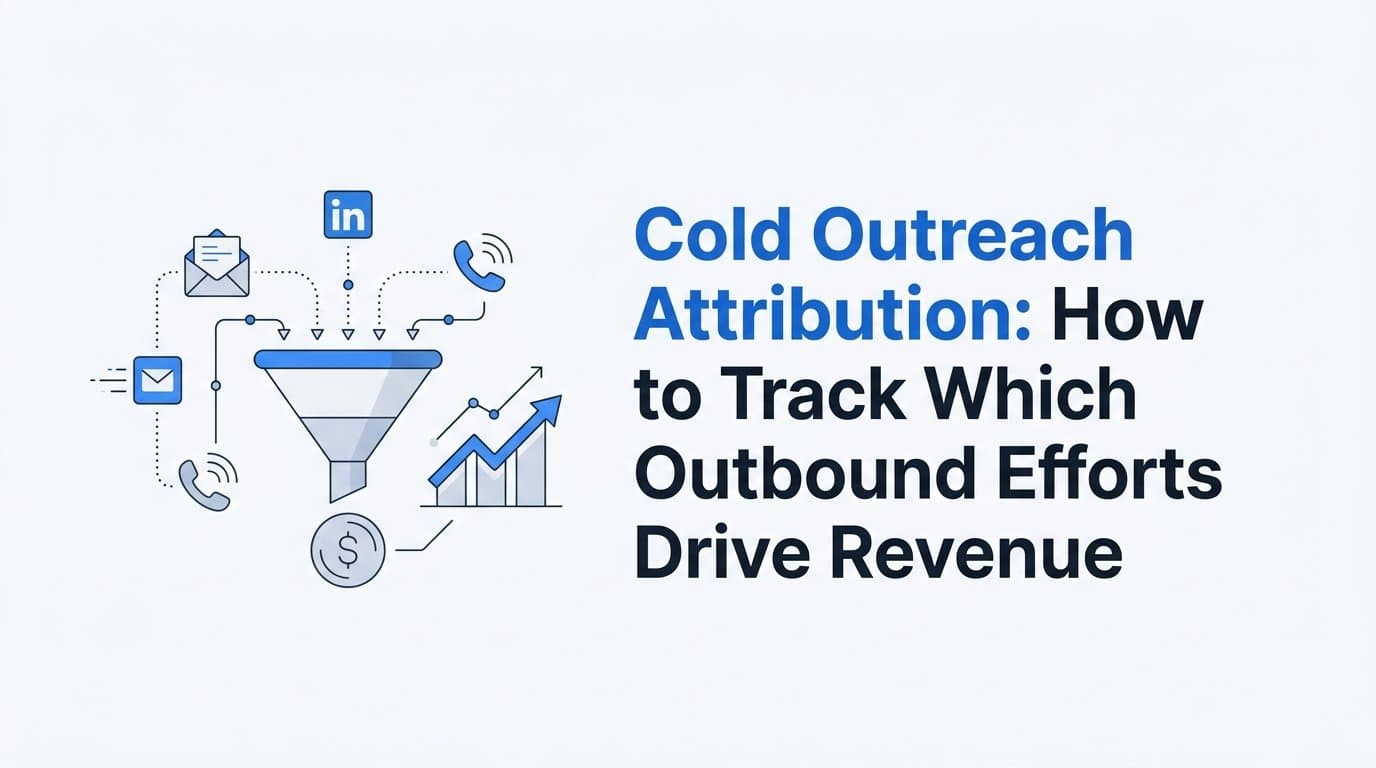
Your team sends hundreds of cold emails every week. Reps are running LinkedIn sequences, making calls, and following up with prospects across multiple touchpoints. It is a significant investment of time, budget, and energy. But when a deal closes, can you honestly say which outreach effort started the conversation?
For most B2B SaaS teams, the answer is no. Paid ads get granular attribution: click-through rates, cost-per-conversion, ROAS tracked to the dollar. But cold email sequences, LinkedIn outreach, and cold calling? They live in a measurement black box. The pipeline gets built, but the credit goes missing.
This is the cold outreach attribution problem, and it is more costly than most teams realize. Without knowing which outbound channels and sequences actually drive revenue, you are making budget and resource decisions based on gut feel rather than data. You end up doubling down on sequences that look busy but convert poorly, while the outreach that actually closes deals gets overlooked.
By the end of this article, you will understand exactly what cold outreach attribution means, why it is genuinely difficult to do well, and how to build a measurement framework that connects your outbound efforts to pipeline and closed revenue. Let's get into it.
The Attribution Gap in Outbound Sales
Marketing attribution has come a long way. Ad platforms offer impression-level tracking. Analytics tools reconstruct multi-session journeys. Revenue attribution software connects ad spend to CRM opportunities. But almost all of this infrastructure was built with inbound and paid acquisition in mind. Cold outreach sits entirely outside of it.
When a prospect fills out a form after clicking a Google ad, that journey is trackable end to end. The click is logged, the session is captured, the form submission fires a conversion event, and the CRM contact is created with a source field populated automatically. Attribution is baked into the workflow.
Cold outreach works in the opposite direction. You identify a prospect, add them to a sequence, send emails, make calls, and connect on LinkedIn. None of those touchpoints generate a pixel event. There is no click to track at the start of the journey. The prospect did not raise their hand; you reached out to them. And most sequencing tools store that outreach data internally, completely disconnected from your ad platform, your analytics stack, and often even your CRM.
This creates a data blind spot at the handoff between outbound sales and marketing. When a rep books a meeting with a prospect who was in a cold email sequence, that meeting might get logged in the CRM. But was the source field filled in correctly? Does it reference the specific sequence, the channel, or the rep? In most organizations, that data is inconsistent at best and missing at worst.
The downstream consequences are significant. Without visibility into which outbound channels and sequences contribute to pipeline, teams over-invest in low-performing sequences because they look active, and under-invest in the ones that actually work because the connection to revenue is invisible. Leadership cannot make confident decisions about whether to scale outbound, hire more SDRs, or reallocate budget to paid. The entire function operates on assumption rather than evidence.
Solving this problem starts with understanding what cold outreach attribution actually means in practice.
Defining Cold Outreach Attribution
Cold outreach attribution is the practice of assigning measurable credit to specific outbound touchpoints when those touchpoints contribute to a conversion event. The touchpoints might include a cold email sequence, a LinkedIn connection message, a direct message, or a cold call. The conversion events might include a first positive reply, a booked meeting, an opportunity created in the CRM, or a closed-won deal.
The key distinction from inbound attribution is that there is rarely a trackable click or pixel event at the start of the outbound journey. The prospect did not come to you. You went to them. That means the attribution logic cannot rely on session data or ad platform click IDs to anchor the journey. Instead, it has to rely on CRM-logged interactions, sequence tool records, and tracked links to reconstruct what happened.
Think of it this way. In inbound attribution, the customer journey starts when the prospect takes an action that generates a data point: a click, a page visit, a form fill. In outbound attribution, the journey starts when your rep takes an action, and you have to ensure that action is recorded with enough detail to trace it forward to revenue.
The key conversion events in outbound that need to be mapped and measured include several distinct milestones. First positive reply is the moment a prospect engages with your outreach for the first time. Meeting booked is when the prospect agrees to a discovery or demo call. Opportunity created is when the CRM record is promoted to an active deal. And closed-won is the final revenue event that attribution ultimately needs to connect back to the originating outreach.
Each of these events can and should be mapped back to the specific sequence, channel, and rep that initiated contact. That mapping is what cold outreach attribution makes possible. Without it, you have activity data. With it, you have revenue intelligence.
Why Tracking Outbound Touchpoints Is Genuinely Hard
Understanding the concept is one thing. Building the measurement infrastructure is another. Cold outreach attribution is difficult for several interconnected reasons, and each one requires a deliberate solution.
The first challenge is the blended customer journey. Outbound prospects rarely convert in a straight line from cold email to booked meeting. A more common scenario in B2B SaaS looks like this: a prospect receives a cold email, does not reply, searches your company name on Google a few days later, clicks a retargeting ad, reads a blog post, and then books a demo through a landing page form. In a standard last-touch or ad-platform-only attribution setup, that closed deal gets credited entirely to the Google ad. The cold email that initiated the entire journey receives zero credit. This misattribution is not a minor rounding error. It systematically inflates the perceived value of paid channels and deflates the perceived value of outbound.
The second challenge is data silos. Most sequencing tools and CRMs store outreach data in environments that do not communicate with each other or with your analytics stack. Your cold email tool knows which sequences a prospect received. Your CRM knows which opportunities closed. Your ad platform knows which ads the prospect clicked. But none of these systems talk to each other by default, which makes it nearly impossible to see the full customer journey without a dedicated attribution layer connecting them.
The third challenge is attribution model selection. A last-touch model may credit a demo request form submission while ignoring the cold email that started the conversation three weeks earlier. A first-touch model might credit the cold email but ignore the retargeting ad that re-engaged a prospect who had gone cold. For outbound-influenced journeys that often span weeks or months and involve multiple touchpoints across channels, linear, time-decay, or position-based attribution models are significantly more appropriate. But choosing the right model requires understanding how outbound fits into your broader acquisition mix, and that understanding requires data you probably do not have yet.
These challenges are solvable. But solving them requires building a framework from the ground up rather than bolting outbound data onto an existing inbound attribution stack.
Building a Cold Outreach Attribution Framework
A practical cold outreach attribution framework has three foundational layers: conversion event definition, instrumentation, and data unification. Getting all three right is what separates teams that have outbound attribution from teams that just have outbound activity reports.
Define your conversion events first. Before you instrument anything, decide which events in the outbound funnel you want to measure and ensure they are logged consistently in your CRM. At minimum, you want to capture first positive reply, meeting booked, meeting held, opportunity created, and closed-won. For each event, the CRM record should include a source field that captures the originating outreach channel, the specific sequence name, and the rep who initiated contact. Without consistent source field hygiene, attribution data becomes unreliable as soon as it scales.
Instrument your sequences with trackable links. Include UTM-tagged links in your cold email sequences so that when a prospect clicks through to your website, that session is tied back to the specific sequence and campaign. A well-structured UTM might use the source field for the outreach channel, the medium for the sequence name, and the campaign for the specific email step. When that prospect later books a demo or fills out a form, the session data connects their web behavior to the outreach that brought them there. This bridges the gap between your sequencing tool and your analytics or attribution platform.
Unify your CRM data with your attribution platform. This is where the framework comes together. When outreach-sourced contacts are matched against ad impressions, website sessions, and revenue events inside a single attribution layer, you can build a complete multi-touch picture of how outbound interacts with the rest of your marketing mix. Outreach-sourced contacts who later clicked a paid ad before converting no longer get siloed into separate data sets. Their full journey becomes visible, and credit can be distributed across the touchpoints that actually influenced the outcome.
This framework is not technically complex, but it does require discipline. The CRM source fields have to be filled in consistently. UTM parameters have to follow a naming convention. And the attribution platform has to be connected to both the CRM and the ad platforms. When those conditions are met, the data starts to tell a coherent story.
How Cold Outreach Fits Into Multi-Touch Attribution
Once you have the framework in place, multi-touch attribution transforms cold outreach from a cost center with fuzzy ROI into a measurable channel with a defined role in the customer journey.
In a multi-touch attribution model, cold outreach can be assigned credit as a first touch if it is the first recorded interaction with a prospect. This is the most common scenario in pure outbound plays where the prospect had no prior relationship with your brand. But outreach can also function as an assist touch, contributing to a conversion that ultimately closed through a different channel. Both roles matter, and both deserve credit in a model that reflects how acquisition actually works.
Here is where it gets interesting. Understanding the interplay between outbound and paid channels reveals which ad campaigns are warming up prospects who were already in an outreach sequence. If a significant portion of your paid conversions involve prospects who were also in an active cold email sequence, that is not a coincidence. It means your outbound and paid channels are working together, and optimizing them in isolation means you are missing the compound effect they create together.
Multi-touch attribution makes this visible. You can see that a prospect received a cold email sequence, engaged with a LinkedIn ad three days later, visited your pricing page, and then booked a demo. Each touchpoint contributed to the outcome. A linear model distributes credit equally across all of them. A position-based model gives more weight to the first touch and the converting touch. A time-decay model weights the most recent touchpoints more heavily. The right model depends on your sales cycle and how you want to value different stages of the journey.
The most valuable output of this analysis is a true cost-per-acquisition for outbound. When revenue attribution spans from the originating outreach sequence to the closed-won deal, you can calculate what it actually costs to acquire a customer through outbound and compare that directly against your paid acquisition costs. That comparison is what gives revenue and marketing leaders the data they need to make confident budget allocation decisions.
Using Attribution Data to Optimize Outbound Performance
Attribution data is only valuable if it changes how you operate. Once the data flows cleanly from outreach sequence to CRM to attribution platform, several high-leverage optimization opportunities become visible.
Sequence and channel performance analysis. With attribution connected to revenue, you can identify which specific sequences produce the highest meeting-to-opportunity rates and which channels drive the fastest time-to-close. Cold email and LinkedIn outreach often perform differently across prospect segments and industries. Attribution data makes those differences visible so you can concentrate effort on what works rather than spreading resources evenly across everything.
ICP tightening through conversion data. Attribution data reveals which prospect segments respond best to outbound. When you can see which job titles, company sizes, industries, or tech stacks convert from outreach to closed revenue most efficiently, you can tighten your ideal customer profile and build sequences targeted specifically at high-converting segments. This shifts outbound from a volume play to a precision play, which tends to improve conversion rates while reducing the cost and effort required to generate pipeline.
Feeding outbound intelligence back into paid channels. This is one of the most powerful and underutilized applications of cold outreach attribution. When enriched conversion data from outbound-sourced deals is fed back into ad platforms through server-side tracking, the ad platform algorithms can improve targeting based on the characteristics of prospects who responded to outreach and converted to revenue. The result is a reinforcement loop where your outbound intelligence makes your paid targeting smarter, and your paid targeting re-engages prospects who are already in outreach sequences. The two channels stop competing for credit and start amplifying each other.
Platforms like Cometly are built specifically to enable this kind of closed-loop optimization. By connecting your ad platforms, CRM events, and website behavior into a single attribution layer, Cometly gives marketing and sales teams the visibility to see how outbound interacts with every other channel in the mix and to feed enriched conversion data back into Meta, Google, and other ad platforms to improve targeting and ROI.
Putting It All Together: From Outreach to Revenue Clarity
Cold outreach attribution is not a single tool or a one-time configuration. It is a measurement practice built on four interconnected foundations: defining outbound conversion events clearly, instrumenting sequences with trackable links and consistent CRM source data, unifying that data inside an attribution platform, and applying multi-touch models that reflect how outbound actually contributes to revenue.
When those foundations are in place, the picture that emerges is genuinely different from what most B2B SaaS teams are used to seeing. You stop asking whether outbound is working and start asking which outbound efforts work best, for which segments, in combination with which other channels. The conversation shifts from activity to impact.
It is also worth emphasizing that attribution data improves over time. The more conversion events flow through the system, the more patterns become visible. Early on, you might have enough data to identify which channels drive meetings. With more data, you can identify which sequences drive closed revenue. With even more data, you can model the interaction effects between outbound and paid and optimize both channels together.
Cometly provides the attribution infrastructure to make this possible for B2B SaaS teams. It connects ad platforms, CRM events, and website behavior into a single source of truth, so you can see exactly how cold outreach interacts with paid media, organic, and every other channel in your marketing mix. It also enables server-side conversion tracking that sends enriched data back to Meta, Google, and other ad platforms, closing the loop between outbound intelligence and paid performance.
If your team is investing in cold outreach but cannot connect those efforts to pipeline and revenue, you are making resource allocation decisions without the data to back them up. That is a solvable problem. Get your free demo and see how Cometly brings outbound and paid attribution together in one platform, so every touchpoint from the first cold email to closed-won revenue finally gets the credit it deserves.