
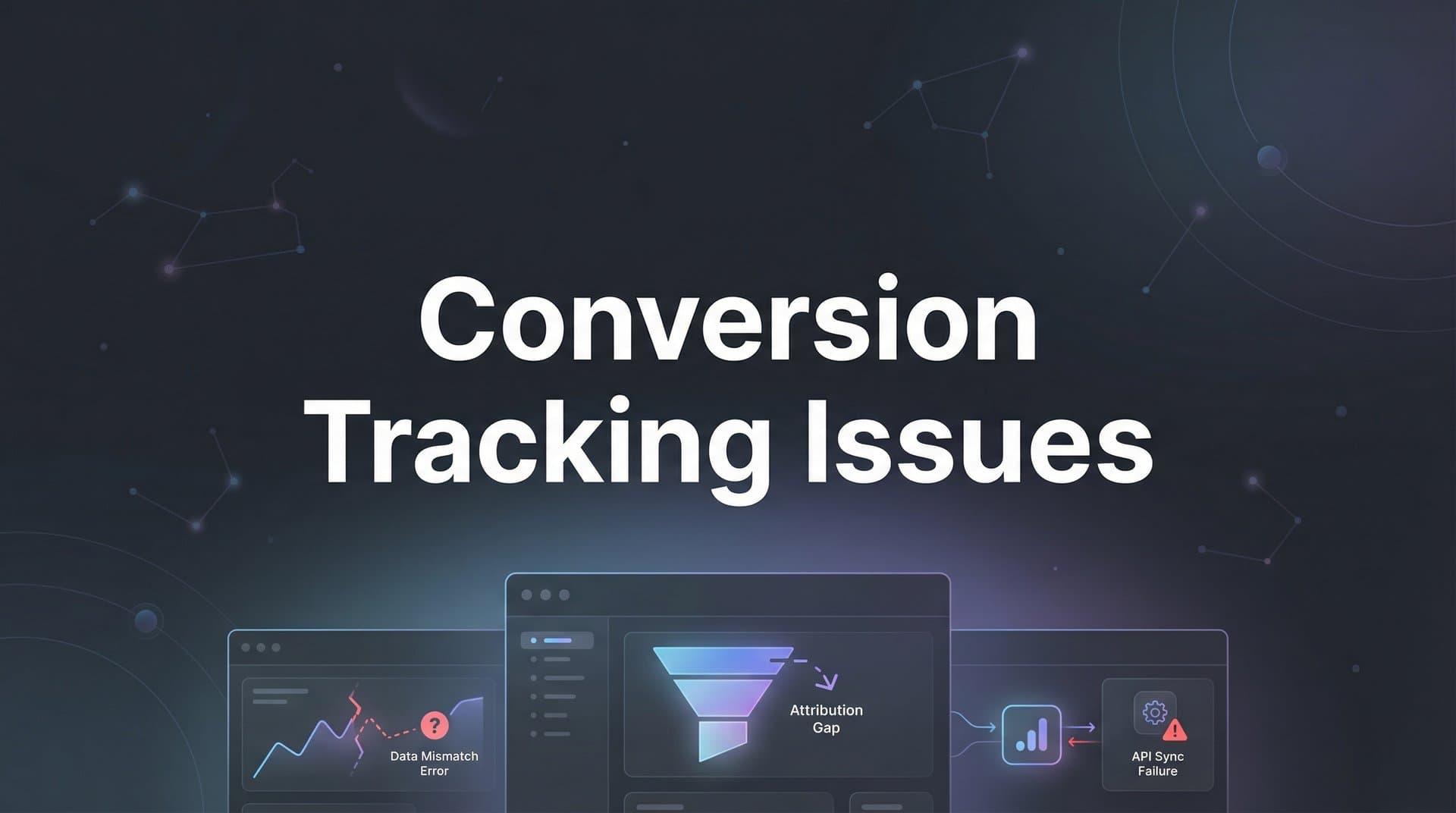
Your Meta dashboard shows 47 conversions. Google Analytics reports 52. Your CRM logged 39. And your backend database confirms 61 actual purchases. When your conversion tracking tells four different stories, you're not just dealing with a technical headache—you're making budget decisions in the dark. Every optimization, every scaling choice, every "winning" campaign could be built on fundamentally broken data.
Conversion tracking issues affect marketers across every platform. Pixels fail to fire. Cross-domain tracking drops parameters. iOS privacy restrictions block attribution data. Ad blockers eliminate visibility. Cookie deprecation breaks user journeys. The result? You're potentially wasting thousands in ad spend on channels that aren't actually converting while starving the campaigns that drive real revenue.
The good news: most tracking problems follow predictable patterns with systematic fixes. You don't need to be a developer or data engineer to diagnose and resolve the majority of conversion tracking issues. You just need a structured troubleshooting process.
This guide walks you through exactly that—a proven methodology to identify, diagnose, and resolve the most common conversion tracking issues affecting your campaigns. Whether you're dealing with missing conversions, duplicate tracking, or frustrating data discrepancies between platforms, you'll have a clear action plan by the end. Let's fix your tracking so you can finally trust your data.
Step 1: Audit Your Current Tracking Setup for Gaps
Before you can fix tracking issues, you need to know exactly what you're tracking and where the gaps exist. Most marketers discover their tracking problems only when they systematically map every conversion point—and that's where we start.
Begin by creating a complete inventory of every conversion action in your funnel. This means documenting every meaningful user action: form submissions, purchase completions, newsletter signups, phone calls, demo requests, free trial activations, and any other events that matter to your business. Don't assume you know where all your tracking lives—actually audit it.
For each conversion point, document which tracking methods you're using. Are you relying on Meta Pixel? Google Ads conversion tags? Google Analytics events? TikTok Pixel? LinkedIn Insight Tag? Server-side tracking? Google Tag Manager containers? Native platform tags embedded directly in your code? Most businesses discover they're using a patchwork of different tracking approaches across different conversion points, creating inconsistencies.
Now comes the critical part: identify where your data flows break. The most common culprit? Missing pixels on thank-you pages or confirmation screens. Your pixel might fire perfectly on your landing page and form page, but if it's not installed on the post-conversion confirmation page, you're missing the actual conversion event. Understanding fixing conversion tracking gaps starts with checking every step of your conversion path.
Use your browser's developer tools to verify pixel firing in real time. In Chrome, open Developer Tools (F12), navigate to the Network tab, and filter by "XHR" or search for specific tracking domains like "facebook.com/tr" or "google-analytics.com/collect". Complete a test conversion while watching the Network tab—you should see tracking requests fire at each step, especially on your confirmation page.
For Meta specifically, use the Meta Pixel Helper Chrome extension. For Google, use Google Tag Assistant. These browser tools show you exactly which pixels are firing, which events they're sending, and whether any errors are occurring. Run through your entire conversion funnel with these tools active and document what fires at each step.
Your success indicator for this step: a complete spreadsheet or document listing every conversion point, which tracking methods are installed on each, and their current status—working correctly, broken, or unknown. This inventory becomes your diagnostic roadmap for the remaining steps.
Step 2: Diagnose Platform-Specific Tracking Failures
With your tracking inventory complete, it's time to dig into platform-specific diagnostic tools to identify exactly what's failing and why. Every major ad platform provides diagnostic dashboards—most marketers just don't know where to look or what the error messages mean.
Start with Meta Events Manager, accessible through your Business Manager. Navigate to your pixel and examine three critical metrics: event match quality score, error rates, and the volume of events received over time. Event match quality measures how well your events include customer information parameters that improve attribution. A score below 6.0 typically indicates missing parameters like email, phone, or external ID that would strengthen your tracking.
Look for sudden drops in event volume or spikes in error rates. Meta's diagnostic panel shows specific error messages—common ones include "Pixel not found on page," "Event sent from incorrect domain," or "Duplicate pixel installation." Each error message points to a specific fix. If you see browser-based events but no server-side events, that's a red flag that you're vulnerable to iOS and ad blocker limitations.
For Google Ads, check your conversion tracking status in the Tools & Settings menu under Measurement > Conversions. Google flags issues like "No recent conversions," "Tag inactive," or "Duplicate conversions." If you're experiencing Google Ads conversion tracking problems, use Google Tag Assistant to verify your Google tag fires correctly—install the Chrome extension, visit your conversion pages, and check for any warning or error messages about tag configuration.
If you're running TikTok, LinkedIn, or other platform campaigns, examine their equivalent event managers. TikTok Events Manager shows pixel health and event quality. LinkedIn Campaign Manager includes conversion tracking status under Account Assets > Insight Tag. The diagnostic patterns are similar across platforms: look for missing events, error messages, and data quality scores.
Don't overlook common external culprits during diagnosis. Ad blockers affect your test data—if you're testing conversions with ad blocking extensions enabled, you'll see failures that real users might not experience (though many users do run ad blockers). Consent management platforms like OneTrust or Cookiebot can block tracking scripts until users accept cookies, creating gaps in your data. Check if your consent banner is properly configured to allow tracking after user consent.
Redirect chains also break tracking parameters. If your conversion path includes multiple redirects—through link shorteners, affiliate networks, or tracking domains—UTM parameters and click IDs can get stripped along the way. Test your full conversion path and verify parameters survive every redirect.
Your success indicator: a specific list of which platforms have tracking issues, what error messages appear in their diagnostic tools, and which conversion events are affected. This diagnosis turns vague "tracking isn't working" frustration into actionable problems you can systematically fix.
Step 3: Fix Cross-Domain and Cookie-Based Tracking Problems
If your conversion path spans multiple domains—checkout on a different domain, payment processor on a third-party site, or subdomain transitions—cross-domain tracking gaps are likely destroying your attribution data. This step addresses those breaks and the growing challenge of cookie-based tracking limitations.
Configure cross-domain tracking in Google Analytics and Google Tag Manager if users traverse multiple domains during conversion. In GA4, add all your domains to the "Configure your domains" setting under Data Streams > Configure tag settings. In GTM, enable cross-domain tracking in your GA4 configuration tag and list all domains in the "Domains to Configure" field. This ensures Google Analytics maintains the same client ID as users move between domains.
For ad platform pixels, cross-domain tracking requires passing click IDs and parameters across domain boundaries. Facebook's fbclid, Google's gclid, and similar platform identifiers must survive domain transitions. Check your links between domains—if you're using redirects, ensure they preserve query parameters. Implementing effective cross-device conversion tracking solutions requires testing by clicking through your conversion path and verifying these parameters remain in the URL at each step.
Cookie-based tracking faces increasing challenges from third-party cookie deprecation and browser privacy restrictions. Implement first-party cookie strategies to combat these limitations. This means serving your tracking cookies from your own domain rather than third-party tracking domains. Many tag management solutions and server-side tracking platforms enable first-party cookie setups that survive browser restrictions better than third-party cookies.
iOS 14+ and Safari's Intelligent Tracking Prevention create specific attribution challenges. Safari limits client-side cookie lifespan to seven days for first-party cookies and immediately deletes third-party cookies. iOS App Tracking Transparency requires user permission for cross-app tracking. Learning how to fix iOS 14 tracking issues is essential because these restrictions mean browser-based pixels alone will miss a significant portion of conversions from Apple users—often 30-40% of your mobile traffic.
Address these limitations by implementing server-side tracking (covered in detail in Step 4) and by shortening your attribution windows to match realistic cookie lifespans. If Safari deletes cookies after seven days, a 28-day attribution window becomes meaningless for Safari users. Consider whether your attribution settings match the technical reality of cookie persistence.
Test your tracking across different browsers and devices to identify platform-specific failures. Use Chrome, Safari, Firefox, and mobile browsers to complete test conversions. Check if conversions track consistently across all browsers or if specific browsers show gaps. Safari-specific failures usually indicate cookie or tracking prevention issues. Mobile-specific failures often point to app-to-web transitions or mobile redirect problems.
Your success indicator: consistent tracking data across all domains in your conversion path, with parameters and cookies surviving domain transitions. When you complete a test conversion that spans multiple domains, your analytics should maintain the same session and properly attribute the conversion to the original traffic source.
Step 4: Implement Server-Side Tracking for Reliable Data
Browser-based pixels alone can't deliver reliable conversion tracking in the current privacy-focused environment. Ad blockers, browser privacy settings, iOS restrictions, and third-party cookie deprecation create blind spots in your data. Server-side tracking solves these problems by capturing conversions directly from your backend rather than relying on browser-based pixels.
Understanding the fundamental difference helps clarify why server-side matters. Browser-based tracking depends on JavaScript code executing in the user's browser and sending data to tracking platforms. This approach is vulnerable to anything that blocks JavaScript execution—ad blockers, privacy extensions, disabled JavaScript, aggressive browser settings, and iOS App Tracking Transparency restrictions. Server-side tracking captures conversion events on your server and sends them directly to ad platforms, bypassing browser-level restrictions entirely.
Set up server-side tracking through your backend or a platform like Cometly that specializes in capturing and routing conversion data. The basic architecture involves detecting conversion events in your application code or CRM, then sending those events to ad platforms via their server-side APIs. For e-commerce platforms, this might mean triggering tracking calls when orders are confirmed in your database. For SaaS businesses, it could mean sending events when users complete signup or subscription purchases.
Configure Conversion APIs for Meta, Google Ads, and other platforms to send server-side events. Meta's Conversions API (CAPI) allows you to send purchase, lead, and custom events directly from your server to Meta's systems. Understanding Conversion API vs pixel tracking helps you leverage both methods effectively. Google Ads Enhanced Conversions enables server-side conversion tracking with first-party customer data. TikTok, Snapchat, Pinterest, and LinkedIn all offer similar server-side conversion APIs.
The implementation typically requires including customer information parameters with your conversion events—hashed email addresses, phone numbers, and first-party identifiers that help platforms match conversions to users. These parameters dramatically improve attribution accuracy and event match quality scores. When implementing, ensure you're hashing personally identifiable information according to each platform's specifications before transmission.
Deduplication becomes critical when running both pixel and server-side tracking simultaneously—and you should run both. Browser pixels provide real-time data and enable features like dynamic ads, while server-side tracking ensures you don't miss conversions. Configure event deduplication by assigning unique event IDs to each conversion and sending the same ID through both pixel and server-side methods. Platforms use these IDs to recognize duplicate events and count them only once.
Platforms like Cometly simplify this entire process by capturing conversion events from your website, CRM, and backend, then automatically routing enriched data to Meta CAPI, Google Ads Enhanced Conversions, and other platform APIs. For a deeper understanding of this approach, explore what is server-side conversion tracking and how it eliminates the need to build custom server-side integrations for each ad platform while ensuring proper deduplication and data enrichment.
Your success indicator: higher event match quality scores in Meta Events Manager (typically 8.0+ with proper server-side implementation), fewer "unknown" or "unattributed" conversions in your ad platforms, and consistent conversion tracking even for users with ad blockers or strict privacy settings. When you test conversions with ad blocking enabled, server-side tracking should still capture the events.
Step 5: Validate and Test Your Tracking Fixes
Implementing fixes means nothing if you don't validate they actually work. This step focuses on systematic testing to confirm your tracking improvements are capturing accurate conversion data across all systems.
Run test conversions through your entire funnel while monitoring real-time event logs. Use different devices, browsers, and traffic sources to simulate real user behavior. Start from an actual ad click (even if it's your own test ad), proceed through your landing page, complete the conversion action, and land on your confirmation page. While doing this, keep multiple monitoring tools open: Meta Events Manager in Test Events mode, Google Tag Assistant, your analytics real-time reports, and your CRM or backend admin panel.
Watch for the conversion event to appear in each system within their expected timeframes. Meta typically shows events in Test Events mode within seconds. Google Analytics shows conversions in real-time reports within minutes. Your CRM should log the conversion immediately. If any system misses the test conversion, you've identified a remaining gap to address.
Compare conversion counts across ad platforms, analytics tools, and your CRM or backend over a longer timeframe—ideally several days or a week. Perfect alignment is impossible due to different attribution windows, counting methodologies, and technical limitations, but the numbers should be reasonably close. Check your conversion totals in Meta Ads Manager, Google Ads, Google Analytics, and your source-of-truth system (usually your CRM or backend database).
Acceptable variance typically falls within 5-10% between systems. If Meta reports 100 conversions and your backend shows 107, that's normal variation. If Meta reports 100 and your backend shows 150, you have a significant conversion tracking accuracy issue to investigate. Large discrepancies usually indicate missing pixels, attribution window mismatches, or conversion definition differences between platforms.
Check that attribution windows and conversion counting settings match your business model across all platforms. If your sales cycle typically takes 14 days, but your Google Ads attribution window is set to 7 days, you're systematically undercounting conversions. Review each platform's conversion settings: click-through attribution window, view-through attribution window, and conversion counting method (one per click vs. many per click).
Set up ongoing monitoring alerts for tracking failures or sudden drops in conversion volume. Most analytics platforms allow you to configure custom alerts. Create alerts for: daily conversion volume dropping below a threshold, event match quality scores falling below 6.0, pixel error rates exceeding normal levels, or significant discrepancies between platform reporting and backend data. These alerts catch tracking breaks before they cost you thousands in wasted spend.
Your success indicator: test conversions appear consistently across all systems within expected timeframes, conversion counts align within 5-10% variance across platforms and your backend, and you have monitoring in place to catch future tracking issues quickly. When you can confidently say "my tracking is working correctly," you're ready to optimize data flow.
Step 6: Optimize Data Flow Back to Ad Platforms
Fixing broken tracking is just the foundation. The real opportunity lies in sending enriched conversion data back to ad platforms to improve their optimization algorithms. Better data in means better campaign performance out.
Send enriched conversion data back to Meta, Google, and other platforms to improve their optimization algorithms. Don't just send a basic "Purchase" event—include customer lifetime value, product categories, subscription tier, lead quality scores, or any other business data that indicates conversion quality. Ad platforms use this enriched data to identify patterns in high-value conversions and optimize toward similar users.
Include offline conversions, CRM events, and revenue data for more accurate ROAS reporting. Many businesses complete conversions offline—sales calls that close, in-store purchases influenced by online ads, or enterprise deals that take months to close. Configure offline conversion imports to send these events back to your ad platforms. Understanding tracking offline to online conversions closes the loop between online ad exposure and offline revenue, giving platforms complete visibility into actual business outcomes.
For businesses with longer sales cycles, CRM integration becomes essential. When a lead converts to a customer weeks after the initial ad click, send that conversion event back to the ad platform with the original click ID. This teaches platform algorithms which early-stage leads eventually become customers, improving lead quality over time. Platforms like Cometly automate this by connecting your CRM to ad platforms and sending conversion events with proper attribution data.
Configure proper event parameters for dynamic optimization. Include value (purchase amount), currency, content IDs (product SKUs), content type, and any custom parameters relevant to your business. For e-commerce, send product IDs so platforms can optimize for specific products. For lead generation, implementing conversion tracking for lead generation means sending lead quality indicators. For SaaS, send subscription tier or plan type. These parameters enable advanced optimization features like value-based bidding and dynamic creative optimization.
Monitor platform recommendations and optimization scores to verify data quality improvements. Meta's Account Quality score and Google Ads Optimization Score both reflect data quality. As you implement better tracking and send enriched data, these scores should improve. Meta may show recommendations like "Improve event match quality" or "Add more conversion events"—address these to unlock better algorithm performance.
Watch for improvements in campaign performance metrics that indicate better optimization. Better data typically leads to: more efficient automated bidding, improved audience targeting accuracy, better Lookalike Audience quality, more relevant dynamic ad delivery, and ultimately lower cost per conversion. If you've fixed tracking but aren't seeing performance improvements within a few weeks, the algorithms may need more time to learn from the better data, or you may have other campaign issues to address.
Your success indicator: ad platforms show high event match quality scores, your CRM conversions flow back to ad platforms with proper attribution, and you see platform recommendations confirming good data quality. Over time, you should notice improved campaign efficiency as algorithms leverage your enriched conversion data for better optimization decisions.
Putting It All Together
Fixing conversion tracking issues requires systematic diagnosis rather than random troubleshooting. Start with a complete audit to map every conversion point and identify gaps. Diagnose platform-specific failures using each platform's diagnostic tools to pinpoint exact errors. Address cross-domain and cookie limitations that break attribution across your conversion path. Implement server-side tracking for reliability that survives ad blockers and privacy restrictions. Validate your fixes with thorough testing across systems. Then optimize data flow back to ad platforms with enriched conversion information.
Your tracking health checklist: All conversion points mapped and verified across your funnel. Platform-specific errors identified and resolved in diagnostic dashboards. Cross-domain tracking configured to maintain attribution across domain transitions. Server-side tracking implemented to capture conversions browser pixels miss. Test conversions validated across all systems with acceptable variance. Enriched data flowing to ad platforms to improve optimization algorithms.
With accurate tracking in place, you can finally trust your attribution data and make confident decisions about where to invest your marketing budget. You'll know which campaigns actually drive revenue, which channels deserve more investment, and which optimization changes create real business impact. That confidence transforms how you scale—no more flying blind, no more budget decisions based on incomplete data.
The difference between broken tracking and reliable attribution isn't just technical—it's the difference between guessing and knowing. Between wasting budget on campaigns that look good but don't convert, and confidently scaling the channels that drive real business results. Between fragmented data across platforms and a unified view of what's actually working.
Ready to elevate your marketing game with precision and confidence? Discover how Cometly's AI-driven recommendations can transform your ad strategy—Get your free demo today and start capturing every touchpoint to maximize your conversions.