
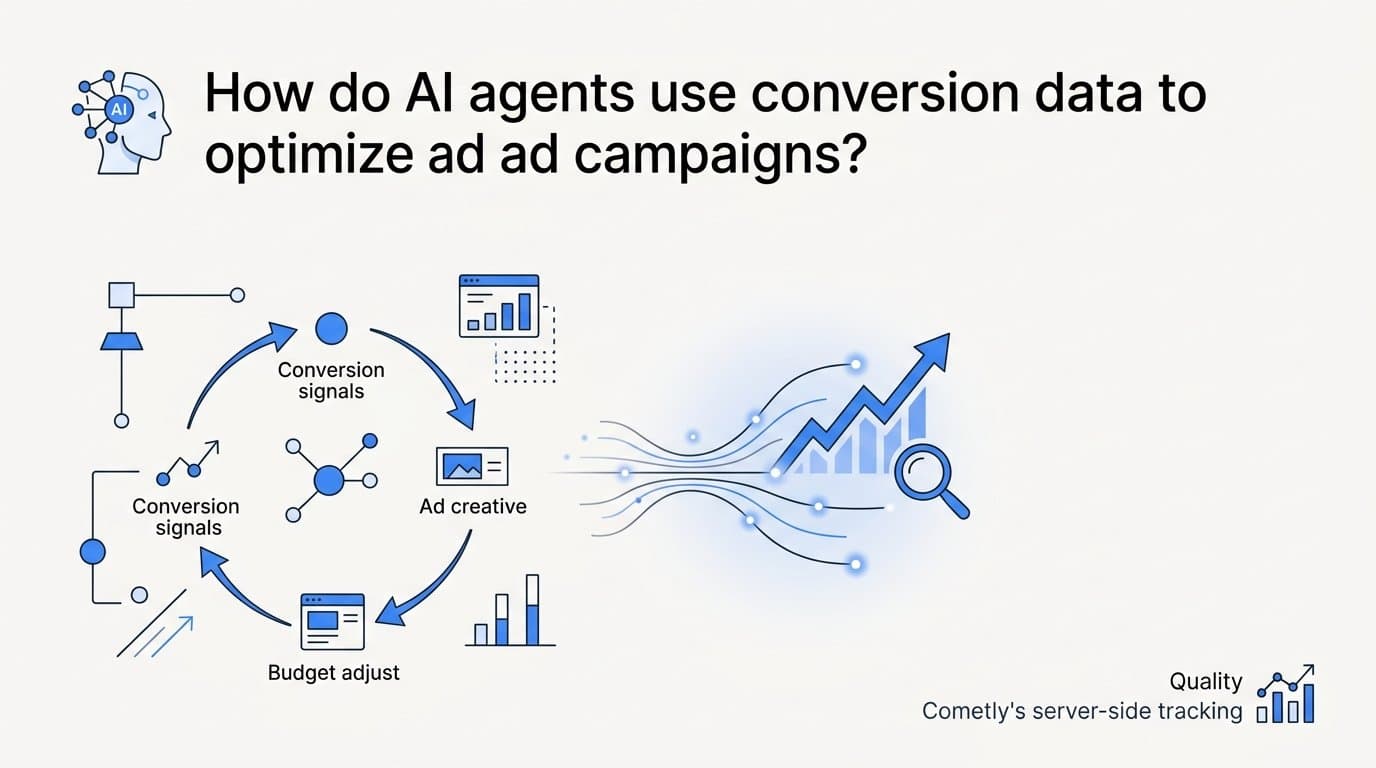
AI agents use conversion data to optimize ad campaigns by continuously analyzing which clicks, touchpoints, and audience segments produce actual revenue, then automatically adjusting bids, budgets, and creative delivery based on those signals. Every conversion event becomes a training input, and the feedback loop tightens with each cycle.
For B2B SaaS marketing teams, this process depends entirely on data quality. Platforms like Cometly feed AI agents enriched, server-side conversion events that connect ad clicks to pipeline and closed-won revenue, giving the AI accurate signals rather than surface-level click data. Without that foundation, AI optimization works against you, spending more on traffic that looks good in dashboards but never converts to paying customers.
This article breaks down the specific strategies AI agents use to turn conversion data into campaign performance gains. Each section explains the mechanism, what good data looks like, and how to implement it in your stack.
1. Bid Optimization Using Conversion Value Signals
The Challenge It Solves
Most B2B teams pass binary conversion signals to their ad platforms: a form fill happened or it did not. The problem is that a $500 MRR deal and a $50,000 MRR deal look identical to the AI. When every lead carries the same weight, the algorithm optimizes for volume, not value, and your best customers become invisible to the bidding system.
The Strategy Explained
AI agents on platforms like Google Smart Bidding and Meta's Value Optimization use conversion value data to set bids at the individual auction level. When you pass revenue-weighted values from your CRM, such as deal size or contract value tied to each conversion event, the AI can distinguish between a high-value customer and a low-quality lead. It then bids more aggressively in auctions where high-value customers are likely to appear and pulls back where they are not.
This shift from lead-count optimization to revenue optimization is one of the highest-leverage changes a B2B SaaS team can make. Google Ads and Meta both publicly document support for dynamic conversion values in their Smart Bidding and Value Optimization products.
Implementation Steps
1. Map your CRM deal stages to conversion events and assign a revenue value to each stage, starting with closed-won as your primary signal.
2. Use server-side event tracking to pass those deal values back to your ad platforms in real time, rather than relying on static conversion values set at the campaign level.
3. Allow the bidding algorithm a sufficient learning period after switching to value-based bidding before evaluating performance changes.
Pro Tips
If your sales cycle is long, pass intermediate signals with weighted values, such as qualified opportunity created or demo scheduled, to give the AI enough data to optimize before closed-won events accumulate. Cometly's pipeline attribution connects these CRM milestones directly to the originating ad click, making it straightforward to assign meaningful values at each stage.
2. Audience Modeling From First-Party Conversion Events
The Challenge It Solves
Lookalike and similar audiences are only as good as the seed data behind them. When audience models are built from pixel-based conversion data, browser limitations, ad blockers, and iOS privacy changes create gaps in the event stream. The AI ends up modeling from an incomplete picture of your best customers, which dilutes the quality of the audiences it generates.
The Strategy Explained
AI agents build audience models by identifying patterns in the profiles of people who converted. Server-side conversion events sent through Meta's Conversion API or Google's Enhanced Conversions bypass browser-based limitations entirely, delivering a more complete and accurate record of who converted and when. This improves the event match quality score that Meta uses to determine how well a conversion event can be matched to a user profile, which directly affects audience model quality.
For B2B SaaS teams, the most valuable seed audiences come from closed-won customers, not just leads. Uploading a customer list or sending closed-won CRM events as custom conversions gives the AI a precise profile of your highest-value customers to model from.
Implementation Steps
1. Implement server-side event tracking via Conversion API to ensure your conversion events reach the platform with minimal data loss.
2. Create separate conversion events for different customer segments, such as enterprise customers versus SMB customers, so the AI can build distinct audience models for each.
3. Refresh your seed audiences regularly as new customers close, keeping the model current with your actual customer base.
Pro Tips
Avoid using top-of-funnel events like page views as seed audiences for lookalikes. The more downstream the conversion event, the more accurately the AI can model the profile of someone likely to become a paying customer rather than just a curious visitor.
3. Multi-Touch Attribution to Identify the Highest-Impact Touchpoints
The Challenge It Solves
Last-click attribution tells the AI that only the final touchpoint before conversion matters. In B2B SaaS, where buying cycles can span weeks or months across multiple stakeholders, this is a significant distortion. The AI systematically underinvests in top-of-funnel channels that initiate the buying journey because those channels never receive credit for the conversions they helped create.
The Strategy Explained
Multi-touch attribution distributes conversion credit across every touchpoint in the customer journey, from the first ad click to the final demo request. Models like linear, time-decay, and data-driven attribution each weight touchpoints differently, but all of them give the AI a more complete picture than last-click alone provides.
When AI agents receive multi-touch attribution data, they can identify which channels assist conversions versus which channels close them. This distinction is critical for budget allocation decisions. A LinkedIn ad that consistently appears early in the journeys of customers who eventually close is valuable even if it never appears as the last click.
Implementation Steps
1. Map your full customer journey by tracking every ad interaction from first touch to closed-won, not just the final click before a form fill.
2. Choose an attribution model that reflects your sales cycle. Time-decay models often work well for B2B SaaS because they give more credit to touchpoints closer to conversion while still recognizing earlier interactions.
3. Use your attribution data to inform channel-level budget decisions, increasing investment in channels that consistently appear in the journeys of high-value customers.
Pro Tips
Cometly's multi-touch attribution lets you compare models side by side so you can see how credit shifts across channels depending on the model you apply. This makes it easier to have data-backed conversations about budget allocation without relying on gut instinct or last-click defaults.
4. Creative Scoring and Ad Rotation Based on Conversion Patterns
The Challenge It Solves
Click-through rate and cost-per-click are easy to measure, which is why many teams use them to evaluate creative performance. The problem is that high CTR does not equal high conversion rate, and high conversion rate does not always equal high revenue. Ads that drive cheap clicks from unqualified audiences can look like winners in surface-level dashboards while quietly draining budget.
The Strategy Explained
AI agents score creatives by downstream conversion outcomes when they have access to revenue-level data. Instead of rotating toward the ad with the best CTR, the AI favors the ad that produces the highest quality leads, the most pipeline, or the most closed-won revenue. This changes which ads get suppressed and which get scaled.
For this to work, your creative testing framework needs to connect ad-level data to revenue outcomes. That means tagging each ad with a consistent UTM structure, passing those parameters through your CRM, and surfacing revenue attribution at the ad creative level rather than just the campaign level.
Implementation Steps
1. Establish a consistent UTM tagging convention across all ad creatives so you can trace each click through to a CRM record and eventual revenue outcome.
2. Define your creative success metric as revenue contribution or pipeline generated, not CTR or ROAS alone.
3. Give each creative variant enough impressions to accumulate statistically meaningful conversion data before drawing conclusions, especially in B2B where conversion volumes are often lower than in B2C.
Pro Tips
Separate your creative testing from your audience testing. Running both simultaneously makes it difficult to isolate which variable drove the performance difference. Test one element at a time and use revenue-level data to score the winner before moving to the next variable.
5. Budget Allocation Across Channels Using Pipeline Attribution
The Challenge It Solves
Many B2B SaaS teams allocate budget based on cost-per-lead by channel, which creates a systematic bias toward channels that generate cheap leads regardless of whether those leads convert to revenue. The AI receives the same distorted signal and doubles down on high-volume, low-quality traffic sources while underinvesting in channels that actually drive pipeline.
The Strategy Explained
AI agents can shift budget in real time when they receive accurate cross-channel attribution data that connects ad spend to pipeline and closed revenue. Connecting Stripe revenue data to your ad spend, for example, allows the AI to see that a channel generating fewer but larger deals produces better ROI than a channel generating many small or stalled opportunities.
This requires a unified data layer where ad platform spend, CRM pipeline data, and payment or billing data are connected at the customer level. Once that connection exists, the AI has the inputs it needs to make budget decisions based on revenue impact rather than lead volume.
Implementation Steps
1. Connect your Stripe or billing data to your attribution platform so that closed revenue is tied back to the originating ad channel and campaign.
2. Build a cross-channel view that shows cost-per-pipeline-dollar and cost-per-closed-won-customer by channel, not just cost-per-lead.
3. Use that data to set channel-level budget targets based on revenue efficiency, then let the AI optimize within each channel toward your highest-value conversion events.
Pro Tips
Cometly's Stripe integration connects payment data directly to ad spend, giving you a clear view of which channels generate revenue rather than just activity. This is particularly useful for B2B SaaS teams where the gap between a lead and a paying customer can span multiple months and involve several decision-makers.
6. Conversion Event Deduplication to Prevent AI Overspending
The Challenge It Solves
Running both a browser pixel and a server-side Conversion API event for the same conversion is best practice for data completeness. But without proper deduplication, the ad platform counts that single conversion twice. The AI sees inflated conversion volume, reports artificially high ROAS, and bids more aggressively than the actual results justify. This is one of the most common and costly data quality issues in paid acquisition.
The Strategy Explained
Meta and Google both require event deduplication using a shared event ID that is passed through both the browser pixel and the server-side event. When both events carry the same ID, the platform recognizes them as duplicates of the same conversion and counts only one. Without this, the AI is training on inflated signals and making bidding decisions based on data that does not reflect reality.
Deduplication is not optional at scale. As server-side tracking adoption increases and more events are sent through both channels simultaneously, the deduplication logic becomes increasingly important for maintaining accurate AI optimization. Both Meta's Business Help Center and Google's developer documentation explicitly address this requirement.
Implementation Steps
1. Generate a unique event ID for each conversion event at the point of occurrence, typically in your server-side code or tracking platform.
2. Pass that same event ID through both your browser pixel and your server-side Conversion API call for every event.
3. Audit your reported conversion volumes periodically by comparing platform-reported conversions to CRM records to identify signs of double-counting.
Pro Tips
If your reported ROAS looks significantly higher than your actual revenue data suggests, duplicate conversion events are often the cause. Fixing deduplication frequently reveals that campaigns which appeared highly profitable were actually breaking even or underperforming. Accurate data is uncomfortable in the short term but essential for AI optimization that actually scales.
Putting It All Together
The six strategies above work as a system. Bid optimization, audience modeling, creative scoring, and budget allocation all depend on the same underlying foundation: accurate, complete, revenue-weighted conversion data flowing from your CRM and billing systems back to your ad platforms.
Start with the infrastructure. Implement server-side tracking, set up proper deduplication, and connect your CRM deal values to your conversion events. Once those inputs are clean, every AI optimization layer above them improves automatically. The AI is not the constraint in most B2B SaaS paid acquisition programs. The data quality feeding it is.
Cometly is built specifically for this workflow. It captures every touchpoint from first ad click to closed-won revenue, sends enriched conversion events back to Meta, Google, and other platforms, and gives your team a single dashboard to see which channels actually drive pipeline. For B2B SaaS teams running paid acquisition, that level of accuracy is what separates AI optimization that scales from AI optimization that wastes budget on the wrong signals.
Ready to give your AI agents better data to work with? Get your free demo and start connecting your ad platforms, CRM, and Stripe in one place.