You've invested months into building out your inbound marketing engine. Blog posts are ranking. Traffic is growing. Form fills are coming in. And yet, when leadership asks which inbound investments are actually driving revenue, the honest answer is: you're not entirely sure.
This is the central tension for B2B SaaS marketing teams. Inbound marketing works. But connecting the dots between a blog post someone read three months ago and a deal that closed last week is genuinely hard. Most teams default to reporting on what's easy to measure: sessions, MQLs, email open rates. These numbers look good in a slide deck, but they don't answer the question that actually matters: what is our inbound marketing ROI?
The gap between top-of-funnel activity and closed revenue is where most attribution breaks down. Without a clear line from content touchpoints to pipeline and deals, marketing teams are making budget decisions based on incomplete information. This article is a practical guide to understanding what inbound marketing ROI really means, which metrics and attribution models give you the clearest picture, and how to build the tracking infrastructure that makes revenue-connected measurement possible.
Why Inbound ROI Is Harder to Measure Than It Looks
Inbound marketing is inherently a long game. A prospect might discover your brand through an organic search result, read two or three blog posts over a few weeks, download a guide, attend a webinar, and then convert after seeing a retargeting ad. By the time they become a customer, months may have passed and dozens of touchpoints may have contributed to that decision.
This creates a fundamental measurement problem. Simple attribution models, particularly last-click, give all the credit to the final touchpoint before conversion. In the scenario above, that might be the retargeting ad, which means your blog content, your webinar, and your gated asset receive zero credit for a deal they clearly influenced. The ROI picture you get from last-click attribution is not just incomplete. It's actively misleading.
The gap between a marketing qualified lead and closed revenue is where most attribution falls apart in B2B SaaS. Sales cycles often stretch across multiple months, involve multiple stakeholders, and include touchpoints that happen entirely offline or inside a CRM rather than in a browser session. When marketing hands a lead to sales, the visibility trail often goes cold. Marketing sees the MQL. Finance sees the closed deal. Nobody has a clean view of what happened in between.
Platform-native reporting makes this worse. Your ad platform reports conversions based on its own attribution window. Your CRM tracks pipeline based on how reps log activity. Your analytics tool measures sessions and goals. None of these systems talk to each other by default, which means you end up with three different numbers for the same campaign and no reliable way to reconcile them.
The result is a reporting environment where marketing teams are measuring activity rather than impact. Traffic goes up, so the content strategy must be working. Lead volume increases, so the campaign is a success. But whether any of that activity translated into revenue remains unclear. This is the core challenge that makes inbound marketing ROI so difficult to measure and why getting it right requires more than just better dashboards.
The Core Metrics That Define Inbound Marketing ROI
Before you can improve your inbound ROI, you need to define it precisely. The basic formula is straightforward: revenue generated from inbound efforts minus the cost of those efforts, divided by the cost, expressed as a percentage. But both sides of that equation are more complex than they appear.
On the cost side, most teams undercount. Content production includes writers, designers, video editors, and the internal time spent briefing, reviewing, and publishing. Tools include your CMS, SEO platform, marketing automation software, and analytics stack. Distribution includes any paid amplification you use to promote organic content, social media promotion, and email costs. Team time, including strategists, managers, and analysts, is often the largest cost that goes untracked. If you exclude any of these inputs, your ROI figure will be inflated in ways that won't hold up under scrutiny.
On the revenue side, the challenge is attribution. Which deals can you honestly credit to inbound? This is where the measurement infrastructure you build will either give you confidence or leave you guessing.
It helps to separate your metrics into two categories: leading indicators and lagging indicators. Leading indicators include organic traffic growth, content engagement metrics like time on page and scroll depth, email open and click rates, and MQL volume. These metrics are useful for diagnosing whether your inbound engine is healthy and whether individual assets are resonating. They are the early signals that tell you whether your strategy is moving in the right direction.
Lagging indicators are where ROI actually lives. These include pipeline influenced by inbound, deal velocity for inbound-sourced opportunities, and closed-won revenue connected to inbound touchpoints. These metrics take longer to appear, but they are the ones that answer the question leadership is actually asking.
Two additional metrics contextualize whether your inbound ROI is sustainable at scale. Customer acquisition cost, calculated by dividing total inbound investment by the number of customers acquired through inbound, tells you how efficiently your engine converts spend into customers. Customer lifetime value tells you whether the customers inbound attracts are worth what you spent to acquire them. In B2B SaaS, where expansion revenue and retention are critical, a high CAC can still represent strong ROI if the LTV is significantly higher. The ratio between these two numbers is one of the clearest signals of whether your inbound strategy is building a durable business or just generating activity.
How Attribution Models Change the ROI Story
The attribution model you choose doesn't just affect how you report results. It affects which channels you invest in, which content you produce, and ultimately how you allocate your entire inbound budget. Getting this choice right is one of the highest-leverage decisions in B2B SaaS marketing.
Here's how the major models work in practice. First-touch attribution gives all the credit to the first interaction a prospect had with your brand. This tends to favor awareness content: top-of-funnel blog posts, organic search, and social content that introduces your brand to new audiences. Last-click attribution gives all the credit to the final touchpoint before conversion, which typically favors demo request pages, branded search, and bottom-of-funnel assets. Linear attribution distributes credit evenly across every touchpoint in the journey. Data-driven attribution uses algorithmic weighting based on actual conversion patterns to assign credit proportionally to the touchpoints that most consistently appear in the journeys of customers who convert.
To see why this matters, consider a realistic B2B SaaS buyer journey. A prospect discovers your brand by finding a blog post in organic search. Two weeks later, they return to read a second post. They download a comparison guide, attend a live webinar, and then convert after clicking a retargeting ad. The deal closes three months later.
Under first-touch attribution, the blog post gets full credit. Under last-click, the retargeting ad gets full credit. Under linear, credit is split evenly across all five touchpoints. Under data-driven attribution, the model might determine that the webinar and the comparison guide consistently appear in high-value customer journeys and weight them more heavily, even though neither was the first or last touch.
Each model tells a different story about which inbound investments are working. If you're using last-click, you might conclude that paid retargeting is your highest-ROI channel and increase that budget while cutting content. In reality, without the blog posts and the webinar, the retargeting ad would have had nobody to reach. The content created the context that made the ad effective.
This is why multi-touch attribution is the most accurate approach for measuring inbound marketing ROI in B2B SaaS. It reflects the reality that buyers interact with multiple pieces of content and multiple channels before making a decision. No single touchpoint tells the full story, and a model that pretends otherwise will lead you to systematically underinvest in the content that builds the foundation of your inbound engine.
Tracking the Full Customer Journey From Content to Closed Deal
Knowing which attribution model to use is only half the challenge. The other half is building the technical infrastructure to capture every touchpoint accurately and connect them to revenue. Without this foundation, even the best attribution model is working with incomplete data.
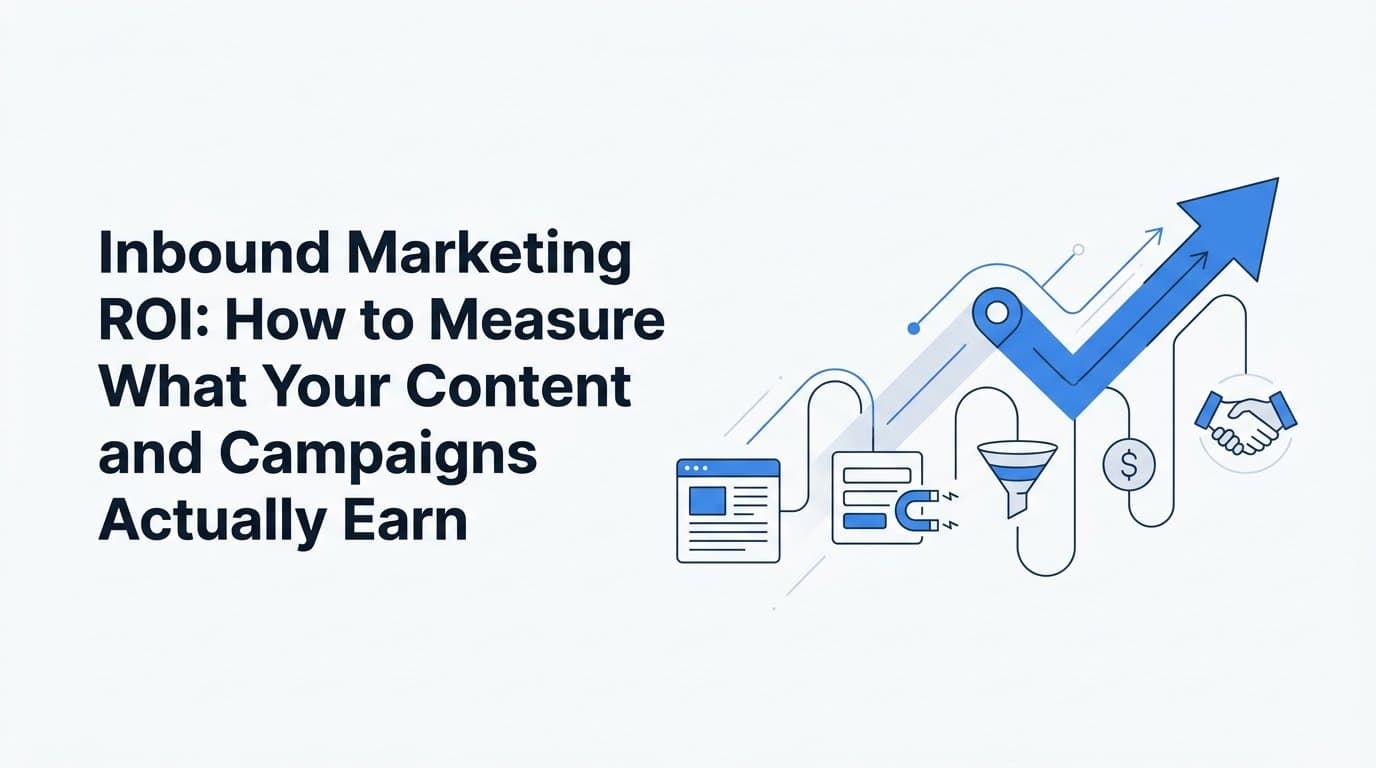
End-to-end tracking requires connecting several systems that typically operate in silos: your ad platforms, your website analytics, your marketing automation tool, your CRM, and your revenue data. Each of these captures a different slice of the customer journey. The goal is to stitch them together into a unified view where every touchpoint from first ad click to closed deal is visible in one place.
This is harder than it sounds, particularly as browser privacy changes have eroded the reliability of pixel-based tracking. Intelligent Tracking Prevention in Safari and the ongoing deprecation of third-party cookies mean that browser-level pixels are increasingly dropping touchpoints, especially for users who visit your site multiple times across different sessions or devices. If your attribution relies entirely on client-side pixels, you are likely undercounting inbound touchpoints and misattributing revenue as a result.
Server-side tracking and first-party data collection have become essential tools for maintaining measurement accuracy. Rather than relying on a browser pixel to fire correctly, server-side tracking sends conversion events directly from your server to your attribution platform and to ad platforms via their Conversion APIs. This approach is more reliable, less affected by browser restrictions, and captures a higher percentage of actual conversions. For B2B SaaS companies running inbound programs across multiple channels, the difference in data quality can be significant.
The final piece is syncing CRM pipeline and revenue data back into your attribution platform. This is what closes the loop between marketing activity and business outcomes. When a lead progresses to an opportunity, when an opportunity becomes a closed deal, and when a customer expands their subscription, those events need to flow back into your attribution view. Only then can you see which inbound content and campaigns influenced not just lead volume but actual pipeline and revenue. Platforms like Cometly are built specifically to handle this connection, integrating with CRMs and revenue tools so that marketing teams can see the full journey from first touch to closed-won in a single dashboard.
Practical Steps to Improve Your Inbound Marketing ROI
Once you have the measurement infrastructure in place, the real work begins: using that data to make better decisions. Here's where many teams stop short. They build the attribution system, generate the reports, and then continue making the same investments they always made. The data only creates value when it changes how you act.
Audit your content and channel mix with attribution data: Start by pulling a report that shows which inbound assets appear most frequently in the journeys of customers who actually closed. This is a fundamentally different question than which content gets the most traffic. You may find that a mid-funnel guide with modest traffic numbers consistently appears in high-value customer journeys, while a high-traffic blog post rarely shows up in deals that close. That insight should directly inform your content roadmap and distribution priorities.
Identify patterns across high-value customer journeys: AI-driven attribution tools can surface patterns across large datasets that would be difficult to spot manually. Which content types consistently appear in the journeys of your highest-LTV customers? Which channels contribute to shorter sales cycles? Which combinations of touchpoints correlate with faster deal velocity? These patterns are the strategic insights that allow you to optimize not just for lead volume but for revenue quality. Cometly's AI-driven insights are designed to surface exactly these kinds of patterns, helping marketing teams move from reporting on what happened to understanding why it happened and what to do next.
Feed enriched conversion data back to ad platforms: One of the most underutilized levers for improving inbound ROI is using your attribution data to improve ad platform targeting. When you send enriched, conversion-ready events back to Meta, Google, and other ad platforms via their Conversion APIs, you give their algorithms a much clearer signal of what a valuable conversion looks like. Instead of optimizing for form fills, you're optimizing for leads that become pipeline and revenue. Over time, this improves the quality of traffic your paid amplification drives to your inbound content, which means more of your budget reaches audiences that are likely to become customers rather than just visitors.
The compounding effect of these three steps is significant. Better attribution data leads to smarter content investment. Smarter content investment improves the quality of leads entering the funnel. Better conversion signals improve ad platform targeting. Each improvement reinforces the others, creating a flywheel that raises inbound ROI progressively over time.
Putting Inbound ROI Measurement Into Practice
The shift from vanity metric reporting to revenue-connected attribution is the defining upgrade for any B2B SaaS marketing team that wants to prove and scale its inbound program. Traffic and lead counts are not irrelevant, but they are not the answer to the question leadership is asking. The teams that win are the ones that can point to specific inbound investments and show, with confidence, how they contributed to pipeline and closed revenue.
Accurate measurement is not just a reporting exercise. It is a strategic advantage. When you know which inbound investments drive revenue, you can allocate budget with conviction. You can defend your content strategy with data rather than intuition. You can scale what works and stop investing in what doesn't. That kind of clarity is rare in marketing, and it compounds over time as your attribution data grows richer and your models become more accurate.
Cometly is built to be the attribution layer that makes this possible for B2B SaaS marketing teams. It connects every inbound touchpoint, from ad clicks and content interactions to CRM pipeline stages and closed revenue, into a single source of truth. With multi-touch attribution, server-side tracking, AI-driven insights, and integrations with ad platforms, CRMs, and revenue tools like Stripe, Cometly gives marketing teams the complete picture they need to make faster, smarter decisions about their inbound programs.
Inbound marketing ROI is measurable. But measuring it accurately requires the right infrastructure, the right attribution model, and a commitment to connecting marketing activity to business outcomes rather than stopping at the lead.
If your team is ready to move beyond traffic reports and start measuring what your inbound efforts actually earn, Get your free demo and see how Cometly connects every inbound touchpoint to the revenue that proves your strategy is working.