Every marketing leader has been in that meeting. The one where the CFO asks how much revenue marketing actually drove last quarter, and the best answer you can offer is a slide full of impressions, MQLs, and click-through rates. The room goes quiet. The budget conversation gets uncomfortable.
This is the core tension in modern B2B SaaS marketing: teams are generating real activity, running campaigns, filling the top of the funnel, and nurturing prospects, but they cannot reliably connect that activity to pipeline stages and closed revenue. The result is a credibility gap that follows marketing teams into every budget cycle and every board meeting.
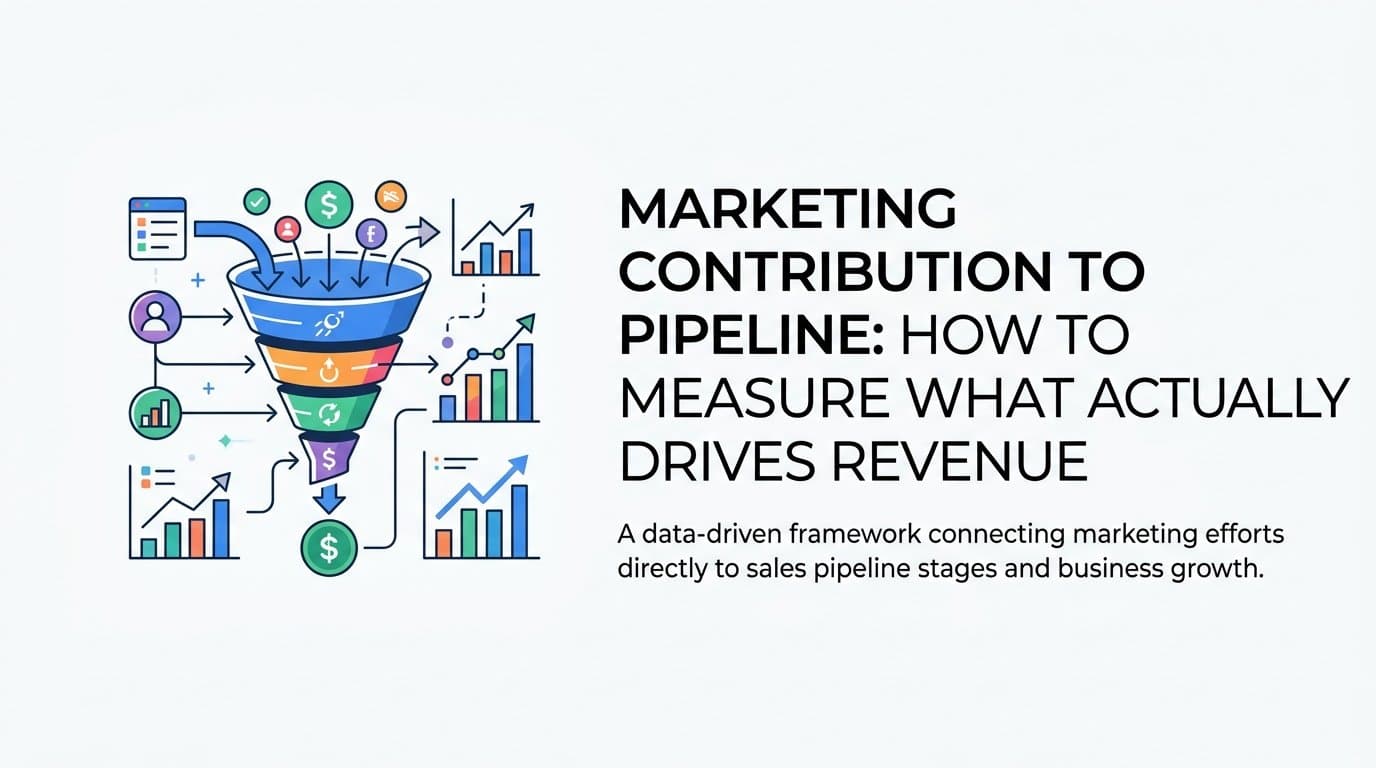
Understanding marketing contribution to pipeline is how you close that gap. It is the bridge between what marketing does and what the business actually cares about: opportunities created, deals advanced, and revenue generated. When you can speak that language fluently, marketing stops being a cost center and starts being a growth engine with a defensible return on investment.
This guide is written for B2B SaaS marketers who are done with vanity metrics and ready to build a measurement framework that connects campaigns directly to pipeline and revenue. We will cover what pipeline contribution actually means, how attribution models shape the numbers, what data connections you need to make it work, and how to turn those insights into smarter decisions.
The Gap Between Marketing Activity and Pipeline Reality
Most B2B SaaS marketing teams have no shortage of data. They track clicks, impressions, form fills, MQL volume, cost per lead, and email open rates. The dashboards look busy and the numbers trend upward. But when sales leadership asks which campaigns are actually filling the pipeline, the honest answer is often: we are not entirely sure.
This is not a failure of effort. It is a structural problem rooted in how marketing data is collected and where it lives.
Ad platforms like Meta, Google, and LinkedIn each report conversions using their own attribution logic, which typically credits themselves generously. Your CRM tracks opportunities and pipeline stages but rarely knows which ad a prospect clicked three months before they booked a demo. Your website analytics captures sessions and events but does not natively connect anonymous traffic to named accounts in your CRM. These three systems, which together tell the complete story of how a prospect becomes a pipeline opportunity, operate in silos.
The downstream consequence is significant. When marketing cannot produce a clear, data-backed answer to "how much pipeline did we create last quarter," budget conversations default to gut feel and political capital. Marketing budgets are often the first to get cut during downturns precisely because the team cannot defend their contribution using the financial language that CEOs and CFOs recognize. Pipeline value, revenue influenced, and cost per pipeline dollar are the metrics that protect budgets. Impressions and MQLs are not.
There is also a relationship cost. When sales and marketing operate with different definitions of success, friction builds. Sales sees marketing as generating leads that do not convert. Marketing sees sales as failing to work the leads they send over. Both teams are measuring different things and calling it performance. The pipeline becomes a contested territory rather than a shared objective.
The path forward requires connecting the dots between marketing activity and pipeline outcomes in a way that is systematic, repeatable, and credible to everyone in the room. That starts with getting clear on what marketing contribution to pipeline actually means.
Defining the Metric: Sourced, Influenced, and Everything In Between
Before you can measure marketing contribution to pipeline, you need to agree on what you are measuring. Two terms get used interchangeably in most organizations, but they describe meaningfully different things: marketing-sourced pipeline and marketing-influenced pipeline.
Marketing-sourced pipeline means marketing originated the opportunity. The first touchpoint that brought this prospect into your world was a marketing channel: a paid ad, an organic search result, a content download, a webinar registration. Marketing created the relationship before sales ever touched it. This is the purest measure of marketing's independent contribution to pipeline creation.
Marketing-influenced pipeline takes a broader view. It counts any opportunity where marketing touched the deal at any point in the journey, even if sales prospected the account first or if the deal was already in the pipeline when a marketing campaign reached the prospect. A sales rep may have cold-called an account, but if that prospect later attended a webinar, downloaded a case study, or clicked a retargeting ad before signing, marketing influenced that deal.
Both metrics are legitimate and useful, but they answer different questions. Marketing-sourced pipeline answers: how much new pipeline is marketing independently generating? Marketing-influenced pipeline answers: how broadly is marketing supporting the entire revenue motion, including deals sales is already working?
Reporting only one of these creates blind spots. If you only track sourced pipeline, you undervalue the role marketing plays in nurturing and accelerating deals that sales initiated. If you only track influenced pipeline, you can inflate marketing's apparent contribution by claiming credit for deals that would have closed regardless of any marketing touchpoint.
At a high level, calculating pipeline contribution involves mapping marketing touchpoints, captured through your tracking layer, to opportunities in your CRM, and then applying an attribution model to assign credit. The output is a view of how much pipeline value can be traced back to marketing activity, broken down by channel, campaign, or content type.
For B2B SaaS companies with sales cycles that span weeks or months and buying committees that include multiple stakeholders, this metric is far more meaningful than MQL volume or cost per lead. A lead that converts to MQL but never becomes an opportunity is noise. A touchpoint that contributed to a $50,000 ARR deal is signal. Marketing contribution to pipeline forces you to measure signal.
Attribution Models and How They Shape the Numbers
Here is something worth understanding early: the attribution model you choose will significantly change your pipeline contribution numbers. Not because the underlying data changes, but because different models assign credit differently across the customer journey. Choosing a model is not a neutral technical decision. It is a statement about what you believe matters most in your marketing motion.
First-touch attribution gives all the credit to the first marketing touchpoint a prospect ever had with your brand. If someone first found you through a Google search ad, that channel gets 100% of the credit for any pipeline that eventually results from that relationship. This model is useful for understanding which channels are best at creating awareness and bringing new prospects into your world, but it ignores everything that happened between that first click and the deal.
Last-touch attribution flips the logic entirely, crediting the final touchpoint before a conversion event. This tells you which channels are effective at closing or converting, but it systematically undervalues the awareness and nurture activities that made the final touchpoint possible in the first place.
Linear attribution distributes credit equally across every touchpoint in the journey. If a prospect had six marketing interactions before becoming an opportunity, each touchpoint gets one-sixth of the credit. This model respects the full journey but treats a quick ad impression the same as a high-intent demo request, which may not reflect reality.
Time-decay attribution gives more credit to touchpoints that happened closer to the conversion event, on the logic that recent interactions had more influence on the decision. For B2B SaaS with long sales cycles, this model often makes intuitive sense: the content a prospect consumed in the final weeks before requesting a demo probably mattered more than the awareness ad they saw eight months ago.
For most B2B SaaS teams, linear and time-decay multi-touch models tend to provide the most balanced view of how marketing contributes across complex, multi-stakeholder buying journeys. They avoid the distortion of single-touch models while still acknowledging that not all touchpoints are equal.
The most important principle here is alignment. Your attribution model should reflect how your sales team defines pipeline stages and how leadership wants to evaluate marketing performance. If your CEO cares most about what drives net-new pipeline creation, first-touch data is worth tracking alongside your primary model. If your VP of Sales wants to understand which marketing activities accelerate deals already in the pipeline, time-decay or position-based models will be more useful. Choose the model that answers the questions your business is actually asking, not the one that makes marketing look best in isolation.
The Data Connections You Need to Track Pipeline Contribution
Understanding attribution models is the conceptual foundation. But accurate marketing contribution to pipeline measurement lives or dies on the quality of your data connections. Three systems need to talk to each other: your ad platforms, your CRM, and your website tracking layer. When all three are integrated, you can trace a customer journey from the first ad impression to a closed-won opportunity. When they are not, you are filling gaps with assumptions.
Your ad platforms, whether Meta, Google, LinkedIn, or others, capture the earliest touchpoints in the journey. They know which ads were seen and clicked, which audiences were reached, and which campaigns drove traffic. But out of the box, they do not know what happened after the click, whether that visitor became a lead, whether that lead became an opportunity, or whether that opportunity became revenue.
Your CRM is where pipeline lives. It holds the opportunity records, the deal stages, the close dates, and the revenue values. But most CRMs do not natively capture which marketing touchpoints preceded the creation of each opportunity. Without enrichment, your pipeline data is effectively anonymous from a marketing perspective.
Your website tracking layer sits in the middle, capturing behavioral data as prospects move through your site. When properly configured, it can connect anonymous sessions to known contacts and pass that data into your CRM and back to your ad platforms.
One of the most important technical shifts happening in marketing measurement is the move toward server-side tracking and Conversion API integrations. Browser-based pixels, the traditional method for tracking conversions, are increasingly unreliable. Ad blockers, browser privacy restrictions, and the effects of iOS privacy updates mean that a meaningful share of conversions simply go unrecorded when you rely solely on client-side tracking. The result is that marketing's contribution to pipeline gets systematically underreported.
Server-side tracking moves the data collection from the visitor's browser to your own server, bypassing many of the restrictions that cause data loss. Conversion API integrations, available through Meta, Google, and other platforms, allow you to send conversion data directly from your server to the ad platform, closing the loop between what happens on your site and what the platform uses to optimize campaigns.
First-party data enrichment takes this a step further. When you pass lead and customer data, including CRM pipeline stages and revenue outcomes, back to your ad platforms, you enable those platforms to optimize toward the outcomes that actually matter to your business, not just surface-level conversion events like form fills. This closes the measurement loop and improves both attribution accuracy and the performance of your paid campaigns over time.
Key Metrics to Report Marketing's Pipeline Impact
Once your data systems are connected and your attribution model is defined, you need a small set of metrics that translate the data into business language. These are the numbers that belong in leadership reports, budget conversations, and pipeline reviews.
Marketing-sourced pipeline percentage: This is the headline metric. It represents the share of total pipeline value that originated from a marketing touchpoint. If your company has $5 million in open pipeline and $2 million of that can be traced back to a marketing-sourced first touchpoint, your marketing-sourced pipeline percentage is 40%. This number gives leadership a direct answer to the question of how much of the pipeline marketing is independently generating, expressed in the revenue language that finance and the CEO recognize.
Pipeline velocity by channel: Not all pipeline is created equal. A channel that generates a high volume of opportunities may look impressive until you realize those deals take twice as long to close as opportunities from other channels. Pipeline velocity measures how quickly leads from a given channel move through the pipeline stages. Tracking this by channel helps you identify which sources are generating high-quality, fast-moving pipeline versus which are producing volume that stalls or churns. This is especially important for B2B SaaS teams managing long sales cycles where deal momentum matters as much as deal creation.
Cost per pipeline dollar: This metric connects marketing spend directly to pipeline outcomes. Divide the marketing investment in a channel or campaign by the pipeline value attributed to that investment. The result is a ratio that finance teams immediately understand: for every dollar we spend on this channel, we generate X dollars in pipeline. This framing shifts the budget conversation from "how much does marketing cost" to "what return does marketing generate," which is a much stronger position for any marketing leader to be in.
Tracking these three metrics consistently, and being able to show how they change in response to campaign decisions, is what separates a marketing team that reports on activity from one that manages pipeline as a business outcome.
From Attribution Data to Smarter Campaign Decisions
Measuring marketing contribution to pipeline is not the end goal. The real value is in what you do with the data once you have it. Pipeline attribution insights should actively drive how you allocate budget, prioritize campaigns, and collaborate with the sales team.
The most immediate application is budget reallocation. When you can see which channels and campaigns are contributing the most pipeline value, and which are generating top-of-funnel activity that never converts to opportunities, you have a clear basis for shifting spend. Many marketing teams discover that their highest-volume traffic sources are not their highest-value pipeline sources. Moving budget toward what actually moves deals forward, rather than what generates the most clicks or impressions, often produces better pipeline outcomes without increasing total spend.
AI-driven analysis of pipeline attribution data can surface patterns that manual reporting misses. When you have enough data flowing through a connected system, you can start to identify which ad creative formats correlate with higher pipeline conversion rates, which channel combinations tend to appear together in the journeys of your fastest-closing deals, and which audience segments generate pipeline that progresses further through the funnel. These are insights that would take weeks to uncover through manual analysis but can emerge quickly when AI is applied to a clean, unified data set.
Pipeline attribution data also creates a foundation for better sales and marketing alignment. When marketing can show the sales team which campaigns are actively warming up prospects already in the pipeline, sales can prioritize outreach accordingly. A prospect who just attended a webinar or downloaded a technical comparison guide is signaling buying intent. Marketing can surface that signal to sales in real time, making the sales team's outreach more timely and more relevant. This kind of collaboration turns pipeline attribution from a reporting exercise into a live operational tool.
Building a Marketing Function That Speaks Revenue
Marketing contribution to pipeline is not just a metric to add to your dashboard. It is a strategic capability that changes how your team makes decisions and how marketing is perceived across the organization. When you can walk into a budget review with clear data showing which campaigns generated pipeline, how much that pipeline is worth, and what it cost to generate it, the conversation shifts from justifying marketing's existence to planning marketing's expansion.
The path to getting there involves four concrete steps. First, define your pipeline contribution metrics and align on the distinction between sourced and influenced pipeline with your sales and finance teams. Second, connect your data systems so that ad platform data, CRM pipeline records, and website tracking are integrated into a single view of the customer journey. Third, choose an attribution model that reflects how your business actually evaluates pipeline and stick with it consistently enough to build a reliable trend line. Fourth, use the insights to make active campaign decisions, reallocating spend toward what drives pipeline and using attribution data to improve both marketing and sales execution.
Cometly is built specifically to help B2B SaaS marketing teams do exactly this. It connects your ad platforms, CRM, and website tracking into a single source of truth, supports multi-touch attribution models designed for complex sales cycles, and uses server-side tracking and Conversion API integrations to capture the conversions that browser-based pixels miss. The AI-driven insights layer helps you identify which campaigns and channels are genuinely driving pipeline, so you can scale what works with confidence.
If you are ready to move beyond activity metrics and start measuring marketing the way your business measures success, Get your free demo and see how Cometly connects every touchpoint to the pipeline and revenue outcomes that matter most.