
Your outbound team has been busy. Hundreds of emails sent, sequences running across multiple personas, reps making calls and connecting on LinkedIn. Then a deal closes, and someone in the room asks the obvious question: what actually worked? Silence. Maybe someone points to the initial cold email. Maybe the AE credits the follow-up call. The CRM shows a meeting was booked, but nobody can trace it back to the specific sequence that started the conversation.
This is the outbound attribution problem, and it costs B2B SaaS companies more than they realize. Not just in wasted budget on sequences that underperform, but in strategic clarity. When you cannot connect outbound activity to closed revenue, you are essentially running your sales engine on intuition rather than data.
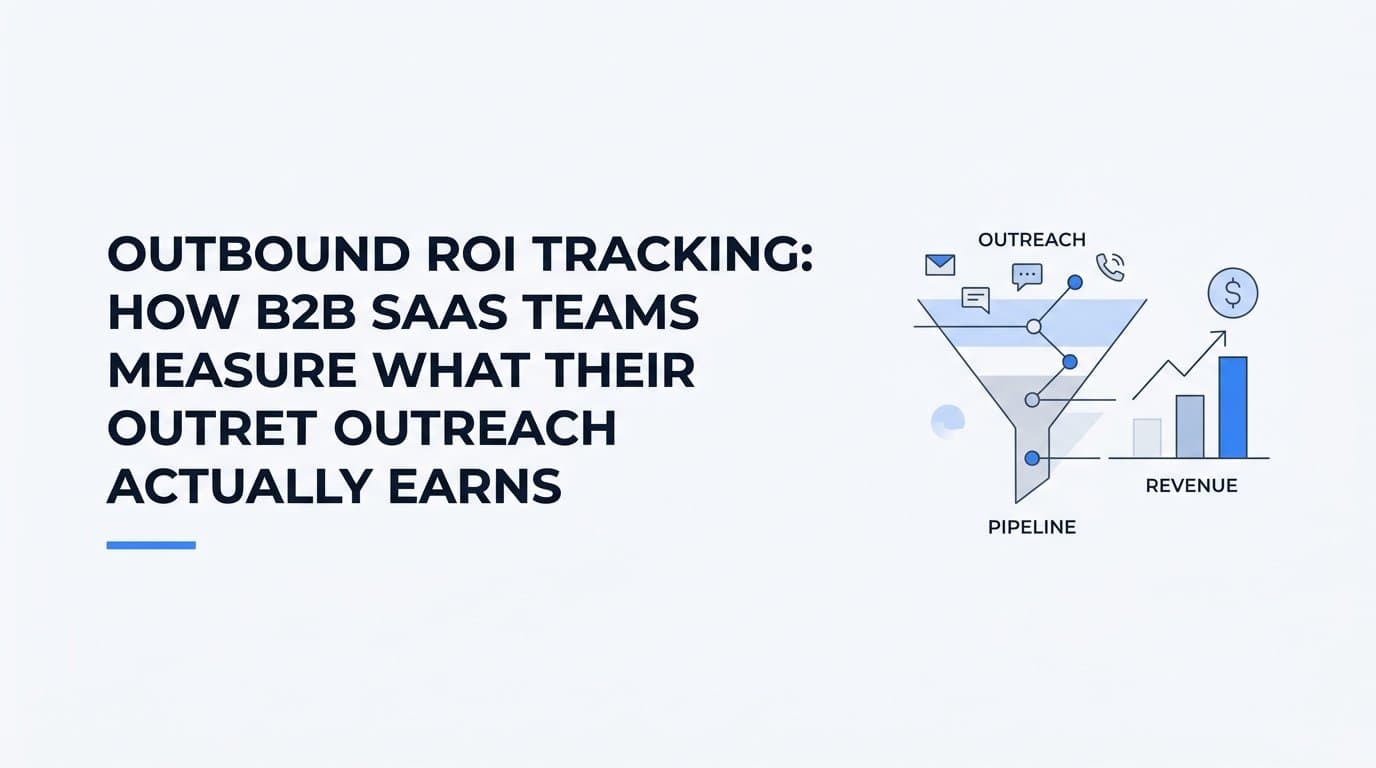
Outbound ROI tracking is not about obsessing over open rates or reply rates. Those are activity metrics, and while they have their place, they tell you almost nothing about whether your outbound investment is generating real returns. True outbound ROI tracking means connecting every sequence, every touch, and every rep interaction to pipeline created, deals influenced, and revenue closed. It means knowing your cost per qualified opportunity and your revenue per sequence, not just your response rate.
This article breaks down how to build that connection systematically. From the right metrics to track, to the infrastructure required to capture them, to the attribution models that make sense for outbound-influenced deals, you will walk away with a clear framework for measuring what your outreach actually earns.
Why Outbound ROI Is Harder to Measure Than It Looks
On the surface, outbound seems like it should be easy to measure. You send emails, you make calls, you book meetings. But the moment you try to connect those activities to closed revenue, the picture gets complicated fast.
The first challenge is the multi-step, multi-channel nature of modern outbound. A typical B2B SaaS outbound motion might involve a cold email, a LinkedIn connection request, a follow-up call, a retargeting ad on LinkedIn or Google, and then another email sequence after the prospect visits your pricing page. Each of those touches happens in a different system: your sequencing tool, LinkedIn, your dialer, your ad platform, your website. Without a structured tracking framework that spans all of these, assigning credit to any single touchpoint is guesswork.
The second challenge is the gap between activity metrics and revenue metrics. Most outbound teams have solid visibility into their activity: emails sent, open rates, reply rates, calls made, meetings booked. What they lack is visibility into what happens after the meeting. Does the opportunity progress? Does it stall? Does it close? And when it does close, which outbound touches actually influenced that outcome? This gap is where most teams lose the plot. They optimize for reply rates while remaining blind to which sequences actually generate revenue.
The third challenge is how outbound costs are typically accounted for. In many B2B SaaS companies, outbound expenses, including rep salaries, sequencing software subscriptions, data enrichment tools, dialer costs, and supporting paid channels, are treated as fixed overhead rather than a measurable investment. When costs are not tied to outcomes, there is no mechanism to evaluate efficiency. You cannot justify increasing the outbound budget if you cannot show what the current budget is returning. And you cannot cut underperforming sequences if you do not know which ones are underperforming relative to revenue, not just engagement.
There is also a structural reason outbound attribution lags behind paid channel attribution. Paid ads generate clicks, and clicks generate trackable data. Outbound touches like phone calls and LinkedIn direct messages do not create a digital trail the way a Google Ad click does. This means outbound attribution depends heavily on CRM logging and manual tagging practices, which are only as reliable as the discipline of the team maintaining them.
The result is a false picture of outbound performance. Teams that look great on activity metrics may be generating minimal pipeline. Teams that look average on engagement may be closing the highest-value deals. Without the infrastructure to connect outbound touches to revenue outcomes, you simply cannot tell the difference.
The Core Metrics That Define Outbound ROI
If you want to move beyond vanity metrics, you need to agree on what outbound ROI actually measures. The formula itself is straightforward: outbound ROI equals the revenue generated from outbound minus the cost of outbound, divided by the cost of outbound. But the real work is in defining what counts as revenue generated from outbound and what belongs in the cost calculation.
On the cost side, include everything: rep time (calculated against their fully-loaded compensation), sequencing software, data enrichment tools, dialer subscriptions, and any paid channels running in support of outbound sequences, such as LinkedIn ads or retargeting campaigns targeting outbound prospect lists. Many teams undercount their outbound costs by leaving out tooling and paid support, which inflates their apparent ROI.
Cost per qualified opportunity (CPO): This is one of the two most actionable outbound ROI metrics. CPO divides your total outbound spend by the number of qualified opportunities generated. It gives you a clear signal of efficiency: how much does it cost to produce one real sales opportunity? When you track CPO by sequence, by persona, and by rep, you can identify which combinations are most efficient and which are draining budget without generating pipeline.
Cost per closed deal: This takes CPO a step further by connecting outbound spend to actual closed-won revenue. It is the clearest expression of outbound ROI because it eliminates the noise of opportunities that stall or churn before closing. Tracking cost per closed deal by sequence type or target segment reveals where your outbound investment is producing real business outcomes versus where it is generating meetings that never convert.
Pipeline influence rate: This metric captures how much of your active pipeline was touched by an outbound sequence at any point in the buyer journey. It is important to distinguish pipeline influence from pipeline sourced. Outbound may not have been the first touchpoint for a deal that originated through inbound, but if a rep reached out at a critical moment in the buying process, that touch influenced the outcome. Pipeline influence rate gives outbound credit for its role in the full journey, not just the deals it originated.
Revenue per sequence: This is where outbound analysis gets genuinely strategic. When you can calculate the revenue generated by each sequence type, you can compare the return on different outbound plays. A cold email sequence targeting mid-market SaaS companies in a specific vertical might generate significantly more revenue per dollar spent than a broad prospecting sequence targeting mixed industries. Revenue per sequence makes that comparison possible, so you can double down on what works and retire what does not.
Tracking these metrics requires connecting data from your sequencing tool, your CRM, and your revenue system. It is not a simple pull from any single platform, which is exactly why most teams default to activity metrics. But the teams that build this connection gain a durable competitive advantage: they can scale outbound with confidence because they know what they are buying with every dollar they invest.
Building a Tracking Infrastructure That Connects Outbound to Revenue
Knowing which metrics matter is only half the equation. The other half is building the infrastructure to capture them reliably. Without the right tracking foundation, even the best-designed outbound program will generate data that is incomplete, inconsistent, or impossible to connect to revenue.
UTM parameters and source tagging: Every link inside an outbound email should carry UTM parameters that identify the source, medium, campaign, and sequence. When a prospect clicks through to your landing page, books a demo, or starts a trial, that action gets attributed to the specific outbound sequence that drove it. This seems basic, but it is frequently overlooked. Without UTM tagging on outbound links, those conversions show up as direct traffic or get misattributed to other channels, making outbound look less effective than it actually is.
Go beyond standard UTMs by adding campaign-level source tags that align with how your CRM organizes outbound activity. If your sequences are named by persona and vertical, your UTM campaign names should match, so the data flows cleanly from your analytics platform into your CRM records.
CRM hygiene as the backbone of attribution: UTM tracking captures what happens when a prospect clicks a link, but it does not capture phone calls, LinkedIn messages, or any other outbound touch that does not involve a trackable click. For those interactions, the CRM is your attribution system. Every outbound touch must be logged against the contact record and the associated opportunity, with enough detail to reconstruct the sequence of events that led to a deal.
This requires discipline from your sales team and, ideally, automation from your sequencing tool. Most modern sales engagement platforms can sync activity logs to the CRM automatically, but the sync is only useful if the opportunity and contact records are properly structured to receive that data. Invest time in CRM architecture before you invest in more outbound volume.
Server-side conversion tracking: When outbound sequences drive prospects to landing pages or sign-up flows, browser-based tracking pixels often miss conversions. Ad blockers, cookie restrictions, and browser privacy settings can prevent client-side pixels from firing, creating gaps in your conversion data. Server-side tracking solves this by capturing conversion events at the server level, independent of what is happening in the user's browser.
For B2B SaaS teams running outbound alongside paid acquisition, server-side tracking ensures that demo bookings, trial signups, and form submissions originating from outbound sequences are captured accurately. This matters not just for measuring outbound ROI directly, but also for feeding clean conversion data back into your ad platforms, which improves the performance of any paid channels running in support of your outbound motion.
First-party data collection is the connective tissue here. When you own the conversion data at the server level, you are not dependent on third-party cookies or platform-reported conversions that may be incomplete. You have a reliable, durable record of what happened, which makes attribution analysis significantly more accurate.
Attribution Models and How They Apply to Outbound Sequences
Once you have the tracking infrastructure in place, you need to decide how to distribute credit across the multiple touchpoints that typically precede a closed deal. This is where attribution models come in, and choosing the right one for outbound-influenced deals requires understanding what each model is designed to reveal.
First-touch attribution gives full credit to the outbound touchpoint that initiated contact. If a cold email was the first interaction a prospect had with your company, first-touch attribution assigns all the revenue credit to that email and the sequence it belonged to. This model is useful for understanding which sequences generate net-new pipeline and which outbound plays are best at opening doors with cold prospects.
The limitation of first-touch for outbound is that it undervalues everything that happens after the initial contact. In B2B SaaS, the initial cold email rarely closes the deal on its own. Follow-up calls, retargeting ads, content interactions, and direct sales conversations all contribute to moving the deal forward. First-touch attribution credits none of that, which can lead to overinvesting in top-of-funnel outbound while underinvesting in the nurturing and follow-up that actually converts opportunities.
Multi-touch attribution distributes credit across all touchpoints in the buyer journey, which is more accurate for outbound-influenced deals where the path from first contact to closed-won involves multiple channels and interactions. A linear multi-touch model, for example, assigns equal credit to every touchpoint. A time-decay model gives more credit to touchpoints that occurred closer to the conversion event, reflecting the assumption that later touches had more influence on the final decision.
For most B2B SaaS outbound programs, multi-touch attribution is the right default. It acknowledges that a cold email opened the door, a follow-up call qualified the interest, a retargeting ad kept the company top of mind, and a product demo closed the deal. Each of those touches contributed, and a model that captures all of them gives you a more accurate picture of your outbound ROI.
Choosing the right model for your sales cycle: The appropriate attribution model depends on your deal complexity and sales cycle length. If your outbound motion drives relatively fast conversions, such as a self-serve trial signup that converts within days of the first outbound touch, first-touch or last-touch models may be sufficient. If your sales cycle spans weeks or months and involves multiple stakeholders and channels, a linear or time-decay multi-touch model will give you a more honest view of what is driving revenue.
The key is consistency. Pick a model, apply it uniformly, and compare performance over time using the same methodology. Switching attribution models mid-analysis makes it impossible to identify trends or measure the impact of sequence optimizations.
How to Analyze and Act on Outbound ROI Data
Collecting outbound ROI data is only valuable if you use it to make better decisions. The analysis layer is where the investment in tracking infrastructure pays off, and it requires a more structured approach than simply pulling a monthly report.
Segment your ROI analysis: Do not look at outbound ROI as a single number. Break it down by sequence type, target persona, industry vertical, and individual rep. This level of segmentation reveals which combinations of outbound variables produce the highest return. You might find that a specific sequence targeting VP-level buyers in a particular vertical generates three times the pipeline per dollar spent compared to a broader prospecting sequence. That insight is only visible when you segment the data.
Persona-level analysis is particularly valuable for B2B SaaS teams because the same outbound play can perform very differently depending on who it is targeting. A sequence that resonates with growth-stage startup founders may fall flat with enterprise procurement teams. Segmented ROI data tells you where to concentrate your outbound investment and where to rethink your approach.
Track outbound ROI over time, not just in snapshots: A single quarter of outbound ROI data is a data point. Multiple quarters of data is a trend. Comparing cost-per-opportunity across quarters reveals whether your outbound efficiency is improving as sequences are optimized, or whether market saturation and increased competition are driving up acquisition costs. Trend analysis also helps you anticipate when a sequence is losing effectiveness before it becomes a budget drain.
Set a cadence for reviewing outbound ROI metrics, whether monthly or quarterly, and make it a structured review rather than an ad hoc pull. Bring together your sales leadership, marketing team, and revenue operations to look at the data together and agree on what it means for the next period's investment decisions.
Feed outbound data back into your paid channels: One of the most powerful and underutilized applications of outbound ROI data is using it to improve paid channel performance. When you identify the characteristics of your highest-converting outbound prospects, including job titles, company sizes, industries, and behavioral signals, you can use that profile to build lookalike audiences in Meta and Google Ads.
This creates a data feedback loop where outbound intelligence makes your paid targeting more precise, and paid channel data reveals new prospect segments worth adding to your outbound sequences. Platforms like Cometly make this loop easier to close by connecting CRM conversion data with ad platform audiences, so the insights from your outbound program directly improve the efficiency of your paid acquisition spend.
From Outbound Activity to Measurable Revenue
The framework for outbound ROI tracking comes down to four connected steps. Tag outbound touches at the source using UTM parameters and CRM logging. Capture every interaction against the contact and opportunity record so the full buyer journey is visible. Apply a multi-touch attribution model that reflects the complexity of your sales cycle. And report on revenue-level metrics, cost per opportunity, cost per closed deal, revenue per sequence, rather than activity metrics that tell you how busy your team is without telling you how effective it is.
This is not a one-time setup. It requires ongoing discipline from your sales team, clean data practices in your CRM, and an attribution layer that connects your outbound sequences, your ad channels, and your revenue data in a single view. That is exactly what Cometly is built to provide.
Cometly connects your ad platform data, CRM events, and website conversion data into a unified attribution view. For outbound ROI tracking, that means you can see how outbound-initiated contacts interact with paid retargeting, organic content, and other channels before converting. You get a complete picture of the revenue journey rather than a partial one. You can compare attribution models, analyze performance by sequence and segment, and feed enriched conversion data back into your ad platforms to improve targeting efficiency.
For B2B SaaS teams that want to scale outbound predictably, that kind of visibility is not a nice-to-have. It is the foundation of every intelligent budget decision you will make.
Outbound ROI tracking is a growth lever, not a reporting exercise. The teams that invest in building this measurement capability gain the ability to allocate budget with confidence, retire underperforming sequences quickly, and scale the plays that actually drive revenue. Get your free demo and see exactly which outbound efforts are driving pipeline and closed-won revenue, so you can stop guessing and start scaling.