
The marketing tracking landscape has fundamentally changed. Browsers are blocking cookies, operating systems are demanding explicit user consent before sharing behavioral data, and the persistent identifiers that ad platforms relied on for years are disappearing. If your measurement strategy still depends on third-party pixels and cross-site cookies, you are already working with incomplete data.
This is not a future problem to prepare for. It is an active reality shaping campaign performance right now. The marketers who recognize this shift and adapt their infrastructure accordingly are the ones maintaining accurate attribution and scaling with confidence. Those who do not are optimizing blind, often without realizing it.
This article breaks down the key privacy updates affecting tracking, explains exactly how they degrade traditional measurement methods, and walks through the modern approaches that data-mature marketing teams are using to stay ahead. From server-side tracking to first-party data infrastructure to attribution models built for an incomplete-signal world, here is what you need to know.
The Privacy Shift That Rewrote the Rules of Ad Tracking
The movement toward user privacy in digital advertising did not happen overnight. It has been building for nearly a decade through a combination of browser-level changes, operating system restrictions, and regulatory frameworks that have collectively dismantled the third-party tracking infrastructure that digital advertising was built on.
Safari's Intelligent Tracking Prevention (ITP) was one of the earliest and most consequential changes. Introduced by Apple in 2017, ITP has been progressively tightened over subsequent years. In its current form, it can reduce the lifespan of cookies set by third-party JavaScript to as little as seven days, and in certain scenarios, as little as 24 hours. For marketers running campaigns with longer consideration cycles, this means a user who clicks an ad on Monday may be completely unrecognizable to your pixel by the following week.
Firefox's Enhanced Tracking Protection (ETP) takes a similar approach, blocking known third-party trackers by default using block lists maintained by organizations like Disconnect. While Firefox commands a smaller share of browser usage than Chrome or Safari, its protections have influenced the broader direction of the industry.
Apple's App Tracking Transparency (ATT) framework, launched with iOS 14.5 in April 2021, introduced a new requirement for mobile apps: explicit user opt-in before any cross-app tracking can occur. The impact was immediate and significant. Opt-in rates across markets have generally been low, which dramatically reduced the pool of identifiable users available for ad targeting and measurement on platforms like Meta. Understanding how to prepare for iOS link tracking changes has become essential for any mobile-focused marketing team.
Then there is Google Chrome. With the dominant share of browser usage globally, Chrome's approach to third-party cookie deprecation represents the single largest structural change to web tracking. Google has been working on its Privacy Sandbox as an alternative framework, but the direction is clear: the persistent cross-site identifiers that ad platforms relied on for attribution are being phased out.
Layered on top of these technical changes are regulatory frameworks. GDPR in Europe and CCPA in California have established legal requirements around user consent for data collection. These regulations do not just add compliance overhead. They reflect a genuine shift in user expectations about how their data is used.
The combined effect of these changes is not theoretical. Attribution windows are shrinking, conversion counts are being underreported, and ad platform algorithms are being fed incomplete signals. For marketers still relying on legacy tracking methods, the gap between reported performance and actual performance is widening every day.
Why Browser Pixels No Longer Tell the Full Story
To understand why privacy updates are so disruptive, it helps to understand how pixel-based tracking works and why it became the default in the first place.
A tracking pixel is a small JavaScript snippet placed on a website. When a user lands on a page or completes an action, the pixel fires an event back to the ad platform, such as Meta or Google, along with a cookie that identifies the user. That cookie is what allows the platform to connect a conversion on your website back to an ad click that happened days or weeks earlier. If you want a deeper understanding of how tracking pixels work, the mechanics behind them reveal exactly why they are so vulnerable to modern browser restrictions.
This system worked reasonably well when cookies were persistent, browsers did not restrict third-party scripts, and most users accessed the internet from a single device. None of those conditions reliably hold today.
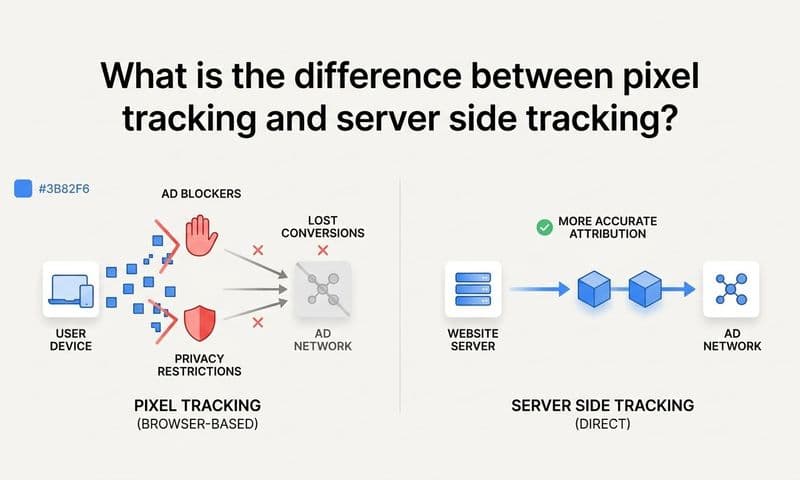
The first failure point is ad blockers. A significant portion of web users have ad blockers installed, and most of them block third-party tracking scripts before they even load. The pixel never fires. The conversion never gets reported. From the ad platform's perspective, that user does not exist.
The second failure point is browser-level restrictions. ITP's shortened cookie lifespans mean that for Safari users, the window in which a conversion can be attributed back to an ad click is dramatically compressed. A user who clicks a LinkedIn ad, spends two weeks evaluating your product, and then converts will often show up as unattributed because the cookie that connected them to that original click has already expired.
The third failure point is cross-device journeys. Browser cookies are specific to a device and browser combination. A user who clicks an ad on their phone and converts on their laptop is effectively invisible to pixel-based tracking. The two sessions look like entirely different users.
The downstream consequences for marketing teams are serious. Cost-per-acquisition figures become inflated because conversions are undercounted. Revenue attribution gets misaligned because the platform credits the wrong touchpoints or no touchpoints at all. Perhaps most damaging, ad platform algorithms that rely on conversion signals to optimize delivery are working with incomplete data, which means they are targeting less efficiently and spending budget less effectively. Teams dealing with these issues should explore fixing conversion tracking gaps as a priority before optimizing any further.
This is not a minor reporting inconvenience. It is a structural breakdown in the feedback loop that makes paid advertising work. And it is why the industry has been moving toward a fundamentally different approach to tracking.
Server-Side Tracking and Conversion APIs: Bypassing the Browser
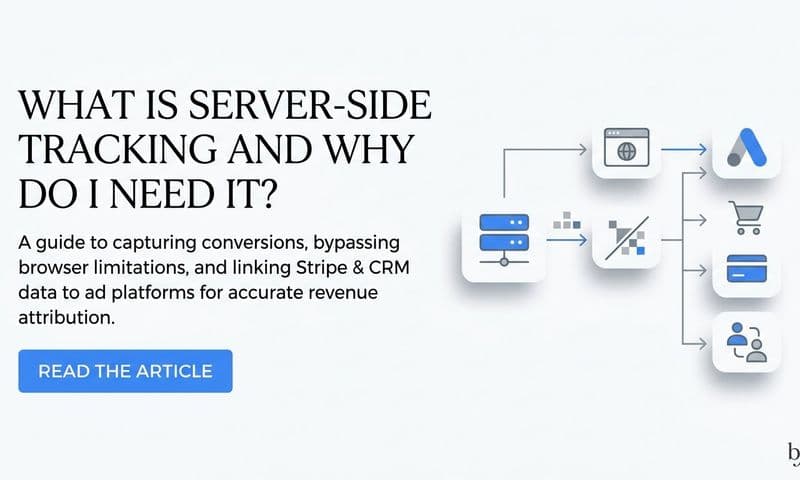
Server-side tracking solves the core problem with pixel-based tracking by removing the browser from the equation entirely. Instead of relying on a JavaScript snippet in the user's browser to fire a conversion event, the server sends that data directly to the ad platform via an API connection. Browser restrictions, ad blockers, and cookie expiration windows simply do not apply.
Meta's Conversion API (CAPI) and Google's Enhanced Conversions are the two most widely used implementations of this approach. Both work on the same fundamental principle: first-party data collected on your server is hashed and sent to the ad platform, where it is matched against user profiles using privacy-preserving techniques. The ad platform gets the conversion signal it needs to optimize campaigns without depending on a cookie to make the match. The benefits of server-side tracking extend well beyond just bypassing ad blockers — they fundamentally improve the quality of every signal your campaigns receive.
The practical impact on data quality is meaningful. Server-side events are not blocked by ad blockers. They are not subject to ITP's cookie expiration windows. They carry richer first-party data, including email addresses, phone numbers, and other identifiers that improve match rates. And because they originate from your server rather than a user's browser, they are more consistent and reliable as a signal.
Meta specifically uses a metric called Event Match Quality to indicate how well server-sent events are being matched to user profiles. Higher match quality scores generally correlate with better algorithm performance, which translates to lower cost per result and more efficient ad delivery. Sending enriched, server-side conversion data is one of the most direct ways to improve that score.
One critical implementation detail to get right is event deduplication. In most setups, both a browser pixel and a server-side event will fire for the same conversion. Without deduplication logic, the ad platform counts both and inflates your conversion numbers. The solution is to assign a shared event ID to both the browser event and the server event, which tells the platform they represent the same action and should only be counted once. Following a thorough server-side tracking implementation guide ensures these details are handled correctly from the start.
Server-side tracking is not a plug-and-play solution. It requires technical implementation and ongoing maintenance. But for marketing teams serious about measurement accuracy, it is no longer optional. It is the foundation of a tracking stack that can hold up against the next round of privacy changes, whatever form they take.
First-Party Data: The Asset That Privacy Changes Cannot Touch
While server-side tracking addresses the mechanics of how conversion events are sent to ad platforms, first-party data addresses the underlying question of what data you actually own and control.
First-party data is information collected directly from your own website, CRM, product, and customer interactions. In the context of B2B SaaS marketing, this includes form submissions, email engagement records, CRM lead and opportunity data, product usage events, and payment data from tools like Stripe. This data is collected with user consent, stored on your own infrastructure, and not subject to the browser and platform restrictions that are degrading third-party signals.
This is why first-party data has become the most valuable asset in a privacy-first marketing environment. It does not expire because a browser updates its cookie policy. It does not disappear because a user installs an ad blocker. And it does not get restricted because a platform changes its data sharing rules. Marketers looking for privacy-compliant tracking alternatives consistently find that first-party data infrastructure is the most durable foundation available.
For B2B SaaS companies specifically, the most valuable first-party data often lives in places that are not automatically connected to ad spend. Your CRM holds records of every lead, every opportunity, and every closed deal. Your product tracks usage events that signal intent and engagement. Your Stripe account holds the actual revenue data that tells you which customers generated real business value.
The challenge is connecting these data sources to your ad spend in a way that produces meaningful attribution. A lead that came from a Google Search campaign and converted to a paying customer three months later represents a complete revenue story, but only if you can trace the thread from the original ad click through the CRM pipeline to the Stripe payment. Most marketing teams have the data. The gap is in connecting it.
Building first-party data infrastructure is not just a response to privacy changes. It is a strategic investment that makes your marketing measurement more accurate, more durable, and more directly tied to business outcomes regardless of what the next privacy update brings.
Choosing Attribution Models for an Incomplete-Signal World
Even with server-side tracking and a strong first-party data foundation, some tracking gaps are inevitable. Cross-device journeys, dark social referrals, and users who never consent to any tracking will always represent a portion of your customer base that is difficult or impossible to measure directly. This makes attribution model selection more important than ever.
Last-click attribution is the most common default, and it is also the most misleading in a privacy-constrained environment. By crediting only the final touchpoint visible to the platform, it amplifies whatever bias already exists in your incomplete data. If early-funnel touchpoints are being underreported due to privacy restrictions, last-click attribution makes that problem worse by ignoring them entirely.
Multi-touch attribution distributes credit across the full customer journey, which makes it inherently more resilient to partial data loss. If some touchpoints are missing from the record, the model still has a broader set of signals to work with. Linear, time-decay, and position-based multi-touch models all represent improvements over last-click in environments where data completeness cannot be guaranteed. Exploring the leading marketing attribution platforms for revenue tracking can help teams identify which tools support the multi-touch models best suited to their sales cycle.
Data-driven attribution is the most adaptive approach available to marketers with sufficient conversion volume. Rather than applying a fixed rule for distributing credit, it uses statistical modeling to infer which touchpoints are actually contributing to conversions based on patterns across all available data. Because it works with probabilities and patterns rather than requiring a complete record for every journey, it can produce meaningful results even when individual signals are noisy or missing.
The natural question is which model to choose. The honest answer is that the right model depends on your data volume, your sales cycle length, and your ability to implement the underlying tracking infrastructure. What matters most is moving away from single-touch models that amplify data gaps and toward approaches that distribute credit across the journey and can handle incomplete information with some degree of statistical resilience.
Building a Tracking Stack That Survives What Comes Next
Understanding the individual components of privacy-resilient tracking is useful. Knowing how to put them together into a cohesive architecture is what actually moves the needle for marketing teams.
The foundation is server-side event collection. This means implementing Meta's Conversion API, Google's Enhanced Conversions, and equivalent server-side integrations for any other ad platforms you use. These connections ensure that conversion signals reach the ad platforms reliably, regardless of what happens at the browser level. Reviewing the top server-side tracking tools available today can help you identify which integrations are best suited to your existing stack.
On top of that foundation, you need consistent UTM parameters and campaign naming conventions. Server-side tracking improves signal quality, but it does not automatically tell you which campaign, ad set, or creative drove a conversion. UTM tracking and how it helps your marketing is a foundational concept here — without properly structured UTMs, you lose campaign-level visibility even when the conversion itself is being tracked correctly.
Event deduplication, as mentioned earlier, is a non-negotiable part of the implementation. When both a browser pixel and a server event are firing for the same conversion, you need a shared event ID in place to prevent double-counting. Getting this wrong does not just inflate your conversion numbers. It corrupts the signals you are sending to ad platform algorithms, which leads to worse optimization outcomes.
The layer that ties everything together is a centralized attribution platform that can ingest data from ad platforms, your CRM, and revenue systems like Stripe, and surface a single source of truth for what is actually driving pipeline and closed revenue. This is where Cometly fits into the architecture.
Cometly connects your ad spend data with CRM records and Stripe revenue data to give you end-to-end attribution from the first ad click to closed-won revenue. It ingests server-side events, tracks the full customer journey across touchpoints, and surfaces AI-driven insights about which campaigns and channels are actually generating business value. Rather than relying on ad platform dashboards that only show you the portion of the funnel they can see, Cometly gives you a complete picture built from your own first-party data.
For B2B SaaS marketing teams dealing with long sales cycles and multi-touch journeys, this kind of unified attribution is what separates confident budget decisions from guesswork. When you can see which campaigns are driving qualified pipeline and which ones are generating leads that never convert, you can allocate spend with a level of precision that pixel-based tracking alone could never provide.
Moving Forward in a Privacy-First World
Privacy updates affecting tracking are not a temporary disruption. They reflect a structural shift in how users, platforms, and regulators think about data, and the changes will continue. Marketers who keep waiting for the landscape to stabilize before investing in better infrastructure will keep falling further behind.
The teams winning in this environment share a common approach. They have moved to server-side tracking as the foundation of their measurement stack. They are building first-party data systems that connect ad spend to CRM records and actual revenue. They are using attribution models that distribute credit across the full journey rather than relying on the last visible click. And they are using platforms that give them a unified view of performance rather than relying on siloed ad platform dashboards.
None of this requires abandoning paid advertising or accepting permanent blind spots in your data. It requires building the infrastructure that makes accurate measurement possible in the environment that actually exists today.
If you are ready to close the gap between your reported performance and your actual revenue, explore how Cometly helps B2B SaaS marketing teams maintain full-funnel visibility despite ongoing privacy changes. Get your free demo today and start capturing every touchpoint to understand what is truly driving your pipeline and revenue.