Picture this: your retargeting campaign is showing a 6x ROAS on the dashboard. Your team is celebrating. Then someone suggests pausing it for two weeks to test something new, and to everyone's surprise, revenue barely moves. The leads keep coming. The pipeline stays full. The only thing that changed is you stopped paying for those clicks.
This scenario plays out more often than most marketing teams want to admit. And it points to a fundamental problem with relying on ROAS as your primary measure of advertising effectiveness. ROAS tells you how much revenue was attributed to your ads. It does not tell you how much revenue your ads actually caused.
That distinction is where incremental lift comes in. Incremental lift answers the question ROAS cannot: would this revenue have happened anyway, even without the ad? For B2B SaaS marketing teams managing real budget decisions, the difference between correlation and causation is not a philosophical debate. It is the difference between scaling a channel that builds pipeline and doubling down on spend that is mostly taking credit for organic demand.
This article breaks down both metrics clearly: how each one works, where each one misleads, when to use which, and how to combine them into a measurement approach that actually informs smarter budget decisions.
The Metric That Dominates Ad Dashboards (And Its Hidden Blind Spot)
ROAS is straightforward on the surface. Take the revenue attributed to a campaign, divide it by what you spent, and you get a ratio. A 4x ROAS means for every dollar spent, four dollars in attributed revenue came back. Simple, fast, and easy to compare across campaigns. It is no surprise ROAS became the default efficiency metric for performance marketing teams.
The complexity hides in that word: attributed. Every ad platform uses its own attribution model to decide which conversions it gets credit for. Google Ads claims credit for conversions that happened after someone clicked a Google ad. Meta claims credit for conversions that happened after someone viewed or clicked a Meta ad. Each platform is essentially grading its own homework, and the results are predictably optimistic.
This creates what is sometimes called attribution inflation. When you add up the revenue each platform claims across your entire ad mix, the total frequently exceeds your actual business revenue. Every platform is counting the same conversion, just from a different angle. The ROAS figures look strong in isolation, but they are measuring overlap and credit assignment, not real causal impact.
The deeper limitation is that ROAS captures attributed revenue, not caused revenue. It cannot distinguish between a customer who converted because of the ad and a customer who would have converted regardless. That distinction matters enormously when you are trying to decide where to allocate budget.
This is where the high ROAS trap becomes a real strategic risk. Branded search campaigns and retargeting campaigns consistently score the highest ROAS figures in most accounts. They target users who are already close to converting: people searching for your brand by name, people who visited your pricing page, people who started a trial and did not finish. These audiences have a high baseline conversion probability. They were probably going to convert anyway.
When an ad intercepts that conversion and claims credit, ROAS looks excellent. But the incremental contribution of that ad spend may be minimal. You are paying to capture intent that already existed, not to generate new demand. The campaign looks like a top performer in your dashboard while potentially delivering far less business value than a prospecting campaign with a more modest ROAS figure.
ROAS is a useful efficiency signal. But used in isolation, it systematically rewards bottom-funnel channels that capture existing intent and penalizes top-of-funnel channels that create new demand. Understanding this blind spot is the first step toward building a measurement approach that reflects reality.
Incremental Lift: Measuring What Your Ads Actually Cause
Incremental lift is rooted in experimental design. The core idea is borrowed from the same logic behind clinical trials and A/B testing: if you want to know whether something caused an outcome, you need a control group that did not receive the treatment.
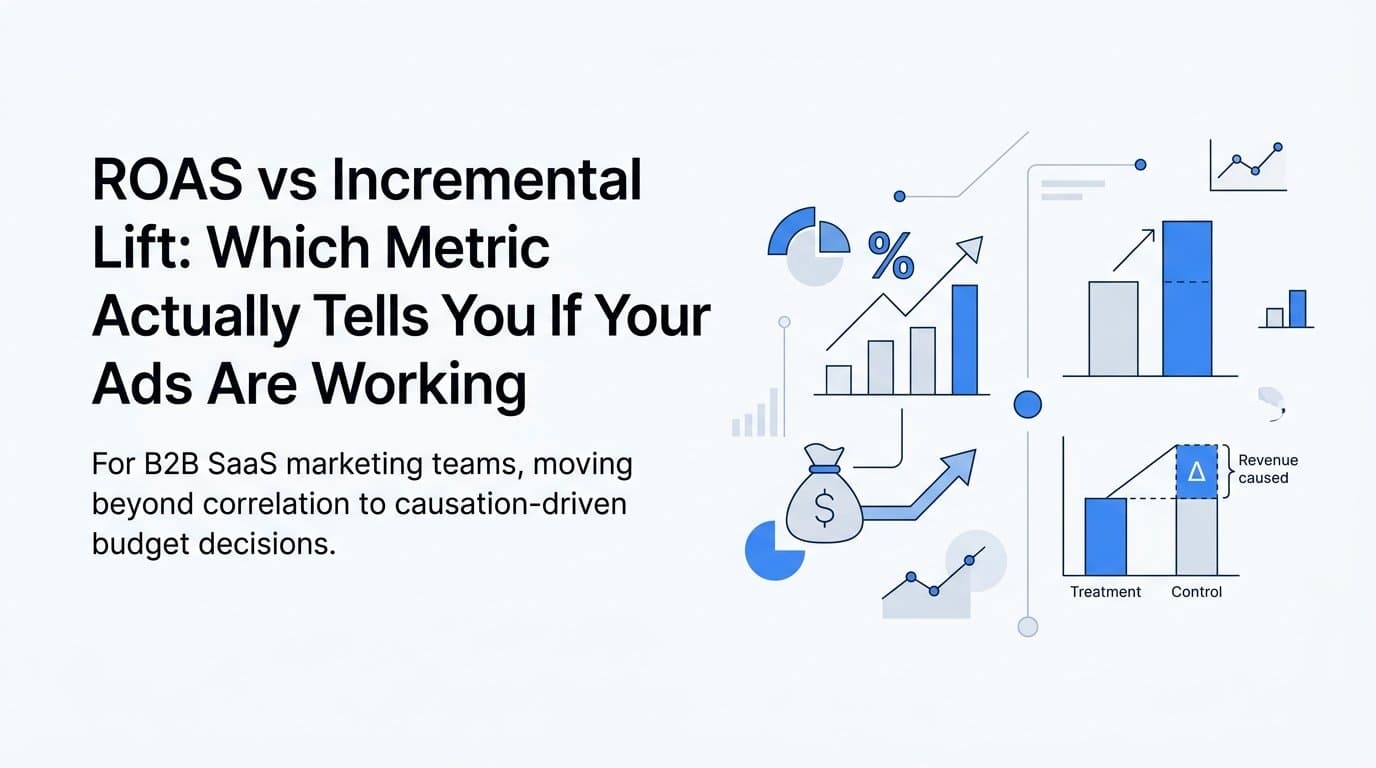
In advertising, that means splitting your audience randomly into two groups. One group sees your ads as normal. The other group, the holdout, is withheld from seeing those ads entirely. After the test period, you compare conversion rates or revenue between the two groups. The difference is your incremental lift: the additional conversions or revenue that would not have occurred without the advertising.
The mechanics matter here. The key word is randomly. If the holdout group is not a true random sample of the same audience, the comparison is meaningless. Users who are naturally more likely to convert might cluster in one group, skewing the results. Proper lift testing requires careful audience segmentation and a holdout group that mirrors the exposed group in every meaningful way except ad exposure.
What incremental lift reveals is causality, not just correlation. A campaign might show strong ROAS because it is capturing conversions from users who were already going to buy. A lift test would reveal that the conversion rate in the holdout group is nearly as high as in the exposed group, meaning the ads are generating very little additional revenue. The attributed revenue in ROAS looks real, but the incremental revenue is modest.
A low incremental lift score is not always a reason to cut a campaign immediately. Context matters. But it is a signal that a meaningful portion of attributed conversions would have happened organically, and that the ad spend may be less efficient than ROAS suggests. For B2B SaaS companies with longer sales cycles and tighter budgets, that distinction shapes how you allocate resources.
The flip side is equally important. A campaign with modest ROAS might show strong incremental lift, meaning it is genuinely generating new conversions that would not have happened otherwise. These are the campaigns that are actually building pipeline, even if the attribution model does not give them full credit. Lift testing surfaces this impact in a way that ROAS simply cannot.
The practical challenge is that running rigorous lift tests requires planning, patience, and a sufficient audience size to produce statistically meaningful results. It is not a metric you check every morning. But used strategically, it becomes the most honest signal available for understanding whether your advertising is actually moving the business forward.
Where ROAS and Incremental Lift Tell Completely Different Stories
The gap between these two metrics is most visible in specific campaign types. Understanding where they diverge helps you interpret both signals more accurately.
The retargeting scenario: Retargeting campaigns are designed to reach users who have already engaged with your brand. They visited your site, viewed a demo page, or started a free trial. These users are warm. They already know what you do, and they are actively evaluating your product. Their baseline conversion probability is high regardless of whether they see another ad.
Because retargeting campaigns intercept these high-intent users right before conversion, they routinely show strong ROAS. The attribution model sees a click or a view followed by a conversion and assigns credit. But when lift tests are run on retargeting campaigns, incrementality scores are often lower than ROAS would suggest. Many of those users were going to convert through organic search, direct traffic, or a sales follow-up anyway. The ad spend accelerated the timeline slightly, perhaps, but did not fundamentally cause the conversion.
This does not mean retargeting has no value. It means the value is frequently overstated by ROAS, and budget decisions based purely on ROAS will over-invest in retargeting relative to its actual causal impact.
The prospecting scenario: Top-of-funnel campaigns targeting cold audiences face the opposite problem. These campaigns introduce your brand to people who have never heard of you. The customer journey from first impression to conversion is longer, often spanning weeks or months in B2B SaaS. Standard attribution windows on most ad platforms, typically seven-day click and one-day view, miss a significant portion of this journey.
A user who sees a prospecting ad, then returns to your site via organic search two weeks later, gets attributed to organic in a last-click model. The prospecting campaign that created the initial awareness gets no credit, and its ROAS looks weak as a result. But a lift test on that same campaign might reveal strong incremental impact, because users in the exposed group are converting at meaningfully higher rates than the holdout group over a longer measurement window.
The channel-level distortion: When ROAS is the only metric guiding budget decisions, the natural outcome is a gradual shift toward bottom-funnel and retargeting channels. They score well. They look efficient. Budget flows toward them.
Over time, this creates a compounding problem. Top-of-funnel channels that build awareness and generate new demand get starved of investment. The pipeline of new prospects entering the funnel shrinks. Eventually, the retargeting pool shrinks too, because fewer new users are being introduced to the brand. ROAS may stay strong in the short term while the overall business trajectory weakens. This is the channel-level distortion that only becomes visible when you layer in incrementality data alongside ROAS.
When to Rely on ROAS, When to Run a Lift Test, and When to Use Both
ROAS and incremental lift are not competing metrics. They answer different questions, and knowing when to reach for each one is what separates reactive campaign management from strategic measurement.
When ROAS is the right primary signal: For day-to-day campaign management, ROAS remains a practical and valuable metric. When you are comparing two ad creatives within the same campaign, monitoring budget pacing against efficiency targets, or evaluating audience segments within a single channel, ROAS gives you fast, directional feedback. The attribution bias affects all options within that comparison equally, so relative performance is still meaningful even if absolute figures are inflated.
ROAS is also useful for identifying clear underperformers. A campaign with consistently weak ROAS across an extended period, in a context where other campaigns in the same channel are performing well, is a reasonable candidate for investigation or reallocation. You do not need a lift test to act on obvious inefficiency.
When lift testing is essential: Lift testing becomes critical when you are making major budget allocation decisions across channels. If you are deciding whether to increase investment in paid social versus paid search, or whether to add a new channel to the mix, ROAS alone will not give you the right answer because attribution models treat different channels differently.
Lift testing is also the right tool when your ROAS numbers seem disconnected from overall business performance. If campaigns are showing strong ROAS but pipeline is flat or revenue growth is sluggish, that gap is a signal worth investigating. A lift test can reveal whether your attributed conversions reflect real incremental revenue or mostly captured organic demand.
The combined approach: The most effective measurement strategy uses both metrics in their appropriate roles. ROAS drives daily and weekly optimization decisions: which creatives to scale, which audiences to adjust, which campaigns to pause. Lift testing runs periodically, perhaps quarterly for major channels, to validate whether the campaigns you have been optimizing for ROAS are actually generating incremental business outcomes.
When lift test results contradict what ROAS has been suggesting, that is valuable information. It may indicate that a high-ROAS channel is mostly capturing organic demand and deserves a budget reduction. Or it may confirm that a modest-ROAS channel is genuinely driving new pipeline and deserves more investment. Either way, the combination produces decisions that are grounded in both efficiency data and causal evidence.
Building a Measurement Stack That Supports Both Metrics
Getting accurate readings from either metric starts with data quality. Garbage in, garbage out applies here more than almost anywhere else in marketing analytics.
Clean conversion data for accurate ROAS: Platform-reported ROAS is only as good as the conversion signals flowing back to those platforms. Browser-based tracking has become increasingly unreliable due to cookie restrictions, ad blockers, and privacy-related browser changes. When conversion signals are incomplete, platforms undercount attributed revenue, which distorts ROAS figures and degrades the quality of platform optimization algorithms.
Server-side tracking addresses this directly. By sending conversion data from your server to ad platforms through Conversion API integrations, rather than relying on browser-based pixels, you bypass the signal loss that comes from browser restrictions. The result is more complete conversion data reaching the platforms, which improves both the accuracy of ROAS calculations and the quality of the platform's own bidding and targeting optimization.
Unified data for lift testing: Incremental lift testing requires more than clean conversion data. It requires a unified view of customer touchpoints across channels. If your data is siloed by platform, you cannot properly segment holdout groups or measure outcomes across the full customer journey. A user in your holdout group might convert through organic search, direct traffic, or a sales email. Without a cross-channel view, you cannot accurately measure the conversion rate difference between exposed and holdout groups.
This is why lift testing works best when it is built on a foundation of cross-channel attribution data rather than platform-native reporting. Platform-native reports show you what happened within that platform's ecosystem. Cross-channel attribution shows you what happened across the entire customer journey, which is the data you need to run meaningful lift experiments.
Multi-touch attribution as the connective layer: Multi-touch attribution distributes credit across every touchpoint in the customer journey rather than assigning all credit to a single interaction. For B2B SaaS companies with longer sales cycles and multiple touchpoints spanning weeks or months, this provides a far more complete picture of which channels are contributing to pipeline at each stage.
Multi-touch attribution does not replace lift testing. It complements it. Attribution data shows you which channels are present in the customer journey and at what stages. Lift testing tells you which of those channels are actually causing conversions rather than just appearing in the path. Together, they give you both the map and the causal interpretation of the map.
Platforms like Cometly connect your ad platforms, CRM, and website to track the entire customer journey in real time, providing the cross-channel data foundation that makes both accurate ROAS analysis and lift-informed decision making possible from a single source of truth.
Turning Measurement Clarity Into Budget Decisions That Scale
Understanding both metrics is valuable. Knowing how to translate that understanding into actual budget decisions is where it becomes transformational.
The practical workflow starts with ROAS as a filter. Review campaign-level ROAS to identify where efficiency is clearly breaking down. Campaigns with consistently weak ROAS across sufficient spend and time are candidates for deeper investigation. Campaigns with strong ROAS get flagged for lift testing to validate whether that attributed performance reflects real incremental impact.
When lift data comes back on a high-ROAS campaign and reveals low incrementality, the decision framework becomes clearer. Rather than cutting the campaign entirely, you can right-size the budget to a level that captures the genuine incremental value without overpaying to intercept organic conversions. The savings can be redirected toward channels that show stronger lift, even if their ROAS looks more modest.
Making the case for brand and top-of-funnel investment: One of the most practically valuable applications of combining both metrics is the conversation about brand awareness and prospecting campaigns. These campaigns are consistently difficult to defend with ROAS data alone. Their attributed efficiency looks weak because attribution models undercount their contribution to longer customer journeys.
But when you run a lift test on a prospecting campaign and find strong incremental impact, you have causal evidence that the campaign is generating new demand that would not have existed otherwise. That evidence changes the budget conversation entirely. You are no longer arguing that a low-ROAS campaign deserves investment based on intuition or brand principles. You are presenting data that shows it is actually causing revenue, even if the attribution model does not reflect that.
This is the kind of measurement clarity that allows marketing teams to scale with confidence rather than optimize their way into a shrinking pipeline. Cometly is built specifically for this challenge: connecting ad spend to pipeline and revenue with multi-touch attribution across every channel, giving B2B SaaS marketing teams the complete data foundation they need to run both ROAS analysis and lift-based decision making without switching between disconnected tools or reconciling conflicting reports.
With Cometly, you can capture every touchpoint from first ad click to closed-won revenue, feed enriched conversion data back to ad platforms to improve their optimization, and use AI-driven recommendations to identify which campaigns are genuinely driving results. That complete picture is what makes the difference between optimizing for dashboard metrics and optimizing for actual business growth.
The Bottom Line on ROAS and Incremental Lift
ROAS tells you what your ads claimed credit for. Incremental lift tells you what your ads actually caused. Neither metric alone gives a complete picture, and relying exclusively on either one leads to budget decisions that look rational on a spreadsheet but underperform in reality.
The strongest marketing teams treat ROAS as a real-time efficiency signal and lift testing as a periodic strategic validator. ROAS guides daily optimization. Lift testing confirms whether those optimizations are producing genuine business outcomes or just moving attribution credit around. Together, they form a measurement approach that is both operationally practical and strategically rigorous.
Accurate measurement starts with clean, complete data across every touchpoint. Without it, both ROAS figures and lift test results are built on a shaky foundation. Server-side tracking, Conversion API integrations, and cross-channel attribution are not optional infrastructure for teams that want to make confident budget decisions. They are the baseline.
If your current measurement stack is leaving gaps in your customer journey data, or if your ROAS figures and overall revenue trends are telling different stories, it is worth examining what data you are actually working with. Ready to elevate your marketing game with precision and confidence? Discover how Cometly's AI-driven recommendations can transform your ad strategy. Get your free demo today and start capturing every touchpoint to maximize your conversions.