
You are running paid search, LinkedIn ads, content marketing, and outbound sequences at the same time. Deals are closing. Pipeline is growing. But when someone asks which channel is actually driving revenue, the honest answer is: you are not entirely sure. Sound familiar?
This is the central tension facing almost every SaaS marketing leader today. The modern go-to-market motion is inherently multi-channel, but the tools most teams rely on for attribution were built for a simpler world. When your buyer touches six different channels over three months before signing a contract, last-click attribution does not just give you an incomplete picture. It gives you a misleading one.
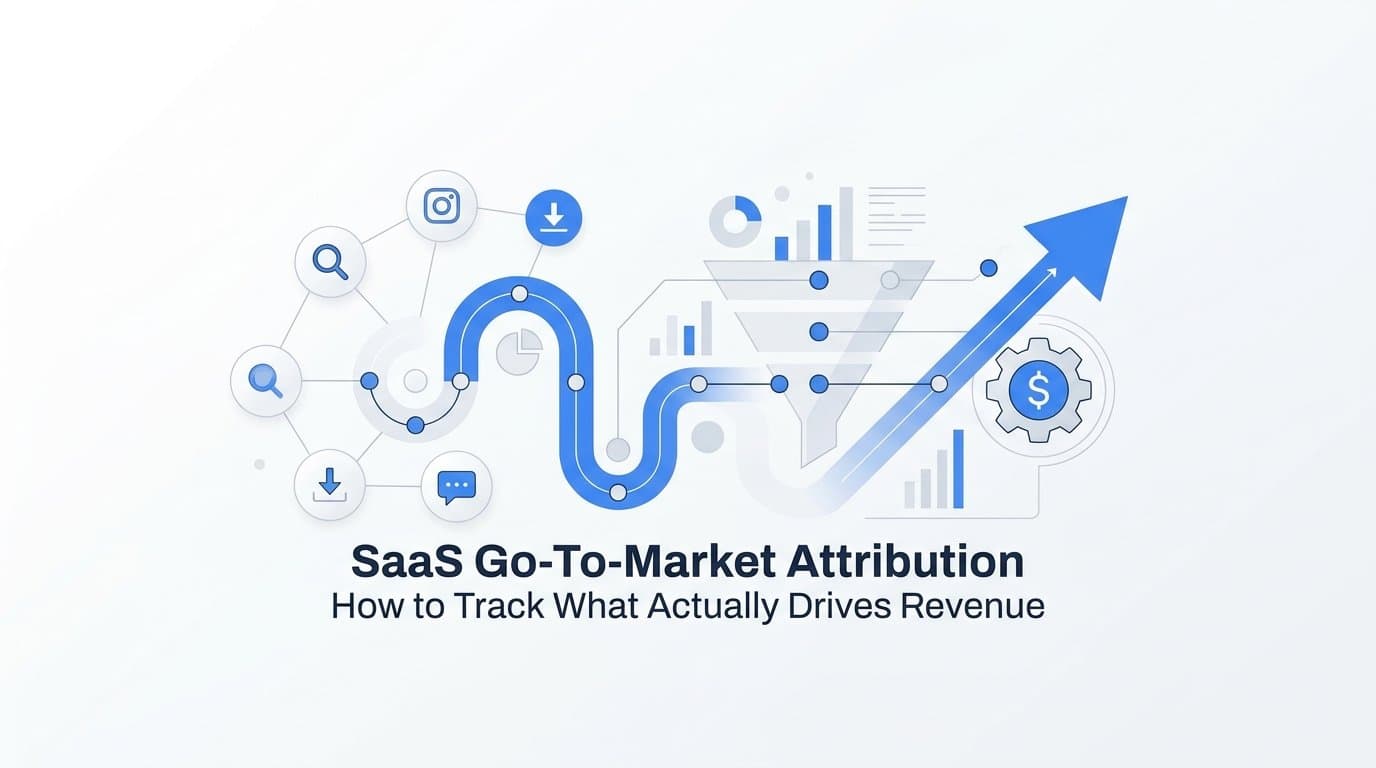
SaaS go-to-market attribution is the discipline that solves this problem. It connects every marketing and sales touchpoint, from the first ad impression to the closed-won deal, to actual pipeline and revenue. Done well, it transforms budget decisions from educated guesses into data-backed convictions.
This article covers what GTM attribution actually means in a SaaS context, why it is structurally different from the attribution models borrowed from e-commerce, the key measurement frameworks your team needs to understand, the technical foundation required to make it work, the mistakes that quietly distort your data, and how modern attribution platforms bring it all together. If you have ever allocated budget based on instinct rather than evidence, keep reading.
Why SaaS Go-To-Market Attribution Is a Different Problem Entirely
Ask any e-commerce marketer how they measure attribution and they will describe a relatively contained problem. A shopper sees an ad, clicks it, lands on a product page, and buys within the same session or within a few days. The conversion window is short, the decision-maker is usually one person, and the transaction happens online with a clear digital fingerprint.
SaaS is nothing like this.
In a typical B2B SaaS buying cycle, a prospect might first encounter your brand through a LinkedIn sponsored post. A week later, they read a blog post after searching for a solution to a specific problem. They attend a webinar. A colleague forwards them a case study. An SDR reaches out with a personalized sequence. Three months after that first LinkedIn impression, they sign a contract. Which channel gets credit?
The structural challenge here is not just the length of the buying cycle. It is the fact that multiple decision-makers are often involved. The person who first sees your ad may not be the person who champions the deal internally, and neither of them may be the economic buyer who signs the contract. Traditional attribution models, built around a single user journey, simply cannot account for this reality.
The GTM motion in SaaS also blurs the line between marketing and sales in ways that complicate attribution further. A prospect might be sourced by a paid ad, nurtured by content, and then converted through direct SDR outreach. Marketing claims the source. Sales claims the close. Neither team has full visibility into the complete journey, and without a unified attribution framework, both are working from partial data.
Last-click attribution is particularly dangerous in this environment. If your CRM records the last touchpoint before a deal was created as a direct visit or an SDR email, every awareness and nurture channel that warmed the prospect up over months gets zero credit. Teams using last-click data systematically underinvest in top-of-funnel channels because those channels appear not to produce results, when in reality they are producing the pipeline that sales is closing.
The implication is important: SaaS go-to-market attribution requires a fundamentally different approach. It needs to span longer time windows, account for multiple stakeholders, integrate both marketing and sales touchpoints, and connect all the way to closed revenue rather than stopping at lead generation. That is a more complex problem, but it is a solvable one when the right framework and tooling are in place.
The Attribution Models Every SaaS GTM Team Should Understand
Before you can build an accurate attribution framework, you need to understand the models available and what each one is actually telling you. No single model is universally correct. The goal is to use the right model for the right question.
First-Touch Attribution: This model gives 100% of the credit to the first channel or campaign that a prospect ever interacted with. It is useful for understanding what is filling the top of your funnel and which channels are creating initial awareness. If you want to know what is introducing new prospects to your brand, first-touch gives you a clear answer. The limitation is that it completely ignores everything that happens after that initial contact, which in a long SaaS buying cycle is often where most of the value is created.
Last-Click Attribution: The inverse of first-touch, last-click credits the final touchpoint before a conversion event. This is the default model in most ad platforms and many CRMs. It tells you what is closing deals or driving form submissions, which has some value. But in a multi-touch B2B journey, it systematically undervalues every channel that contributed earlier in the process. Content marketing, social advertising, and brand campaigns all tend to look ineffective under last-click because they rarely appear as the final touch.
Linear Attribution: This model distributes credit equally across every touchpoint in the customer journey. If a prospect had six interactions before converting, each gets one-sixth of the credit. It is more honest than single-touch models because it acknowledges that multiple channels contributed, but it treats a brief ad impression the same as a high-intent product demo request, which is not always accurate.
Time-Decay Attribution: This model gives more credit to touchpoints that occurred closer to the conversion event, on the assumption that recent interactions had more influence on the final decision. It is a reasonable heuristic for shorter sales cycles but can unfairly penalize awareness channels in longer SaaS buying cycles where the initial touchpoint may have been critical even if it happened months ago.
Data-Driven Attribution: This is the most sophisticated approach available. Rather than applying a fixed rule, data-driven models use algorithmic analysis of your actual conversion path data to assign credit based on observed patterns. Touchpoints that appear more frequently in paths that lead to conversions receive more credit. This approach reflects reality more accurately than rule-based models, though it requires sufficient conversion volume to produce statistically meaningful results.
The practical recommendation for most SaaS GTM teams is to use multiple models in parallel. First-touch tells you what is building awareness. Multi-touch models tell you how channels work together. Data-driven attribution, when your volume supports it, tells you what is actually influencing conversions. Comparing these views side by side is where the real insight lives.
What to Actually Measure in a SaaS GTM Attribution Framework
Knowing which attribution model to apply is only half the equation. The other half is knowing which metrics actually matter for a SaaS GTM team. Lead volume is the most commonly tracked metric, and it is also one of the weakest proxies for revenue impact.
Pipeline Attribution: This is the first level of measurement that actually connects marketing to business outcomes. Pipeline attribution tracks which channels and campaigns are responsible for generating qualified opportunities in your CRM, not just leads or signups. When you can see that a specific LinkedIn campaign contributed to a certain amount of pipeline value, you have a meaningful basis for evaluating that campaign's performance. The question shifts from "how many leads did this generate?" to "how much pipeline did this create?" That is a fundamentally more useful question for a GTM team.
Revenue Attribution: This goes one step further by tying marketing touchpoints to closed-won deals. Revenue attribution allows you to calculate true return on ad spend by channel, true cost per acquired customer, and the actual revenue contribution of every campaign you are running. This is the metric that CFOs and revenue leaders care about, and it is the one that justifies marketing budget at the executive level. Without revenue attribution, marketing is always defending spend with proxy metrics rather than direct business impact.
Velocity and Conversion Rate by Source: This is one of the most underutilized dimensions of GTM attribution. Not all leads are created equal, and not all pipeline is created equal. A channel that generates a high volume of leads at low cost may look attractive until you examine how those leads move through the funnel. If they stall at the discovery stage, convert to opportunities at a low rate, or take twice as long to close, the economics look very different. Measuring deal velocity and stage-by-stage conversion rates by traffic source reveals which channels are generating leads that actually match your ideal customer profile and move efficiently through your sales process.
Combining these three measurement layers gives you a complete picture. Pipeline attribution tells you what is working at the top of the funnel. Revenue attribution tells you what is working all the way to the bottom. Velocity and conversion rate by source tell you which channels are generating the highest-quality pipeline, not just the most pipeline. Together, they give GTM leaders the data they need to make confident budget decisions rather than relying on intuition or platform-reported vanity metrics.
The Technical Foundation: Tracking the Full Customer Journey
Understanding what to measure is straightforward. The harder problem is actually capturing the data accurately across a long, multi-channel, multi-stakeholder buying journey. This is where many SaaS teams hit a wall, and where the gap between good attribution intentions and reliable attribution data tends to appear.
Accurate GTM attribution depends on connecting ad platform data, website behavior, form submissions, and CRM events into a unified data layer. Think of this as building a continuous thread from the first ad click all the way through to the closed deal in your CRM. Every time that thread breaks, attribution breaks with it. The most common break point is the handoff between marketing systems and the CRM. A lead fills out a form, gets created as a contact in the CRM, and the original ad click data that brought them there gets lost in the transfer. From that point forward, the deal has no marketing attribution attached to it.
Server-side tracking and Conversion API integrations address a different but equally important problem: data loss at the browser level. Browser-based pixels, the traditional mechanism for tracking conversions and sending data back to ad platforms, have become increasingly unreliable. Ad blockers prevent pixels from firing. iOS privacy changes limit the data that can be collected client-side. Browser privacy settings strip out the identifiers that allow platforms to match website visitors to ad clicks. The result is that a meaningful portion of your conversions are simply not being reported back to the ad platforms, which degrades their optimization algorithms and gives you an incomplete picture of campaign performance.
Server-side tracking bypasses these limitations by sending conversion data directly from your server to ad platforms like Meta and Google, rather than relying on the browser to do it. This approach is more reliable, more complete, and more accurate. For SaaS companies where form submissions and trial signups are primary conversion events, this is not a nice-to-have. It is foundational to accurate attribution.
First-party data enrichment is the third technical layer that makes revenue-level attribution possible. This is the process of matching lead and customer data from your CRM back to the original ad click data that brought them in. When a prospect who clicked a LinkedIn ad six months ago closes as a customer today, enrichment is what allows you to trace that closed deal back to the original campaign. Without it, attribution stops at the lead level and you lose visibility into the full revenue impact of your campaigns.
Common GTM Attribution Mistakes That Distort Your Data
Even teams that invest in attribution infrastructure often end up with data they cannot fully trust. The reason is usually one of a small number of structural mistakes that quietly introduce noise and bias into attribution reporting.
Relying on Native Ad Platform Attribution: Meta, Google, and LinkedIn each have their own attribution windows and their own logic for claiming credit for conversions. When the same buyer touches all three platforms during their journey, each platform independently claims credit for the resulting conversion. The sum of conversions reported across platforms often exceeds your actual number of customers acquired by a significant margin. Teams that make budget decisions based on platform-native reporting are working with systematically inflated data, and they typically end up over-investing in the channels with the most aggressive attribution windows rather than the ones actually driving revenue.
Ignoring the Time Lag Between First Touch and Closed Revenue: In a SaaS buying cycle that spans weeks or months, there is a natural delay between when a channel influences a prospect and when that influence shows up as closed revenue. Teams that evaluate channel performance over short windows often conclude that certain channels are underperforming, when in reality those channels are filling a pipeline that will close in the next quarter. This mistake leads to premature budget cuts on channels that are working but whose results have not yet materialized in the data.
Failing to Deduplicate Conversion Events: When multiple tracking systems are running simultaneously, such as a pixel, a server-side integration, a CRM workflow, and a form tracking tool, the same conversion can be recorded multiple times across different systems. Without deduplication logic, this results in inflated lead counts, distorted cost-per-acquisition figures, and attribution data that does not reflect reality. Making budget allocation decisions on top of deduplicated data is difficult enough. Making them on top of double-counted data is essentially impossible.
The common thread across all three mistakes is that they produce data that feels actionable but is actually misleading. The solution is not more data. It is cleaner, better-structured data that flows through a single attribution system with consistent logic applied across every channel and every conversion event.
Building a Single Source of Truth for GTM Attribution
Here is where it all comes together. The goal of a mature SaaS go-to-market attribution practice is not to have a perfect model. It is to have a single, trusted source of truth that every team, marketing, sales, and finance, can reference when making decisions about where to invest and where to pull back.
A centralized attribution platform that integrates ad channels, your website, your CRM, and your billing data creates this single source of truth. When every touchpoint from first ad click to closed-won revenue is visible in one place, with consistent attribution logic applied across all of it, the conversations about budget allocation change fundamentally. Instead of debating whose numbers are right, teams can focus on what the data is telling them to do.
AI-driven attribution analysis adds another layer of value on top of this foundation. Rather than requiring analysts to manually sift through campaign data looking for patterns, AI can surface which campaigns and ad creatives are generating the highest-quality pipeline, not just the most clicks or the most leads. It can identify which channels are producing deals that close faster, at higher contract values, or with lower churn. These are insights that are technically present in the data but practically invisible without the right analytical layer on top of it.
There is also a compounding benefit to getting attribution right that is easy to overlook. When you feed enriched, attribution-ready conversion data back to ad platforms like Meta and Google, you are improving the quality of the signal those platforms use to optimize their algorithms. Better input data means better targeting, better lookalike audiences, and more efficient ad delivery. Accurate attribution does not just tell you what worked in the past. It makes your future campaigns more effective by giving the platforms better data to learn from.
This is the full picture of what a modern SaaS GTM attribution practice looks like: a unified data layer connecting ads to pipeline to revenue, multi-touch attribution models that reflect how buyers actually behave, AI-powered insights that surface what is working and why, and a feedback loop that continuously improves campaign performance. It is not a reporting function. It is a strategic capability.
Putting It All Together
SaaS go-to-market attribution is not about producing better reports. It is about making better decisions with confidence. The teams that get this right are the ones who can walk into a budget review and say, with evidence, exactly which channels are driving pipeline and revenue, which ones are not earning their spend, and where the next dollar should go to maximize growth.
The path to that level of clarity runs through the fundamentals covered in this article: understanding why SaaS attribution is structurally different from simpler models, applying the right attribution frameworks for your questions, measuring what actually matters at the pipeline and revenue level, building the technical foundation to capture data reliably, and avoiding the common mistakes that introduce noise into your reporting.
Cometly is built specifically for this challenge. It connects your ad platforms, CRM, and website into a single attribution system that tracks every touchpoint from first ad click to closed-won revenue. With multi-touch attribution, server-side tracking, Conversion API integration, and AI-powered campaign insights, Cometly gives SaaS GTM teams the single source of truth they need to allocate budget with confidence and scale what is actually working.
If your team is still making budget decisions based on platform-reported conversions or last-click data, there is a better way. Get your free demo today and start tracking your full GTM funnel with the clarity your revenue decisions deserve.