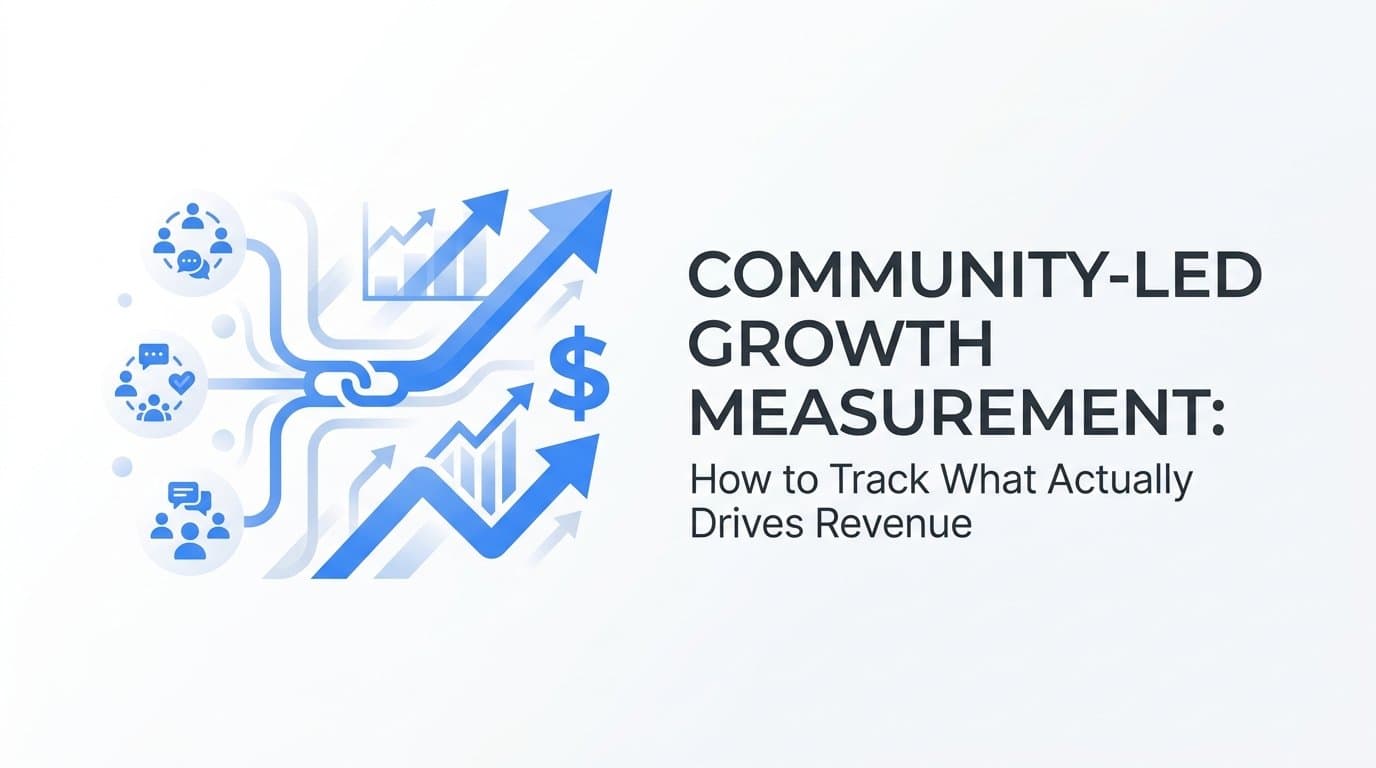
Community-led growth is one of the most celebrated strategies in B2B SaaS right now. Slack communities, user forums, ambassador programs, and peer-driven events are filling pipelines at companies that have figured out how to make them work. But here is the uncomfortable truth that most growth teams face: they cannot actually prove it.
You invest months building a thriving community. Members are engaged, conversations are happening, and your product advocates are genuinely enthusiastic. Then someone in a budget meeting asks what the community is contributing to revenue, and you are left pointing at member counts and engagement rates while struggling to connect any of it to closed deals.
This frustration is almost universal among teams running community-led growth programs. The problem is not that community does not drive revenue. In most cases, it does. The problem is structural: the attribution infrastructure most marketing teams rely on was never built to capture how community actually influences buying decisions. Community touchpoints are distributed, non-linear, and often invisible to standard tracking setups, which makes community look like a cost center even when it is doing significant work.
This article is a practical guide to fixing that. We will walk through why community creates a measurement gap in the first place, which metrics actually reflect community's impact on revenue, how to build a tracking framework that captures community touchpoints, and how to connect all of that data to pipeline and closed-won revenue. By the end, you will have a clear picture of what a community-led growth measurement system looks like and how to start building one.
The companies winning with community are not necessarily the ones with the largest communities. They are the ones that can prove what their community is doing to growth and optimize accordingly. That starts with getting the measurement right.
Why Community-Led Growth Creates a Measurement Gap
To understand why community is so hard to measure, you need to understand where community interactions actually happen. A prospect might discover your product through a peer recommendation in a private Slack workspace, then spend time reading your public forum before attending a community-hosted webinar, and finally convert weeks later after a sales call. Under a standard last-click attribution model, the sales call gets the credit. The community touchpoints that built the relationship and created intent are invisible.
This is the dark funnel problem. A significant portion of community-driven influence happens in spaces that traditional analytics tools simply cannot reach: private Discord servers, LinkedIn groups, in-person meetups, and peer-to-peer conversations that never touch a tracked URL. These interactions shape buying decisions without generating the kind of digital signals that browser-based pixels are designed to capture.
Last-click attribution was built for a world where the customer journey was relatively linear. Someone clicks an ad, lands on a page, and converts. You track the click, you attribute the conversion, and you know what worked. Community-influenced journeys do not work this way. They are non-linear, multi-channel, and often span weeks or months. A user might engage with your community long before they are even in a buying cycle, and that early influence is precisely what makes community so valuable for pipeline quality. But it is also what makes it structurally incompatible with how most attribution is configured.
The other challenge is that community spans multiple channels simultaneously. It generates organic search traffic through forum content, email traffic through newsletters, direct traffic through bookmarked resources, and referral traffic through peer sharing. When you report at the channel level, community's contribution gets fragmented across multiple buckets and diluted to the point where no single channel report tells the full story.
What community measurement actually requires is touchpoint-level attribution: a system that tracks individual interactions across the entire customer journey, assigns them to specific community initiatives, and aggregates that data into a coherent picture of community's influence on revenue. That is a fundamentally different approach from the channel-level reporting most teams default to, and it requires a different kind of infrastructure to support it.
The good news is that this infrastructure exists. The gap is not a technology problem so much as a configuration and strategy problem. Most teams simply have not set up their tracking to capture community touchpoints, which means they are making investment decisions based on incomplete data.
The Metrics That Actually Reflect Community Impact
Before you can build a measurement system, you need to know what you are measuring. And here is where many teams go wrong: they default to the metrics that are easiest to pull, not the ones that actually connect to revenue.
Member count is a classic example. A growing community looks healthy on paper, but member count tells you nothing about whether community engagement is driving pipeline. Active members is marginally better, but it still does not answer the question that matters: are community members converting at higher rates, closing faster, and retaining longer than non-members?
The metrics worth tracking fall into a few distinct categories.
Community-sourced pipeline: This measures deals where at least one contact had a tracked community touchpoint before the opportunity was created. It is the most direct measure of community's contribution to acquisition and should be tracked as both a volume metric and a percentage of total pipeline.
Community-influenced pipeline: Broader than sourced pipeline, this captures deals where a community touchpoint occurred at any point in the journey, including mid-funnel and late-stage. A prospect who joins your community after a demo call and then becomes more engaged before signing is a community-influenced deal even if community was not the original source.
Trial-to-paid conversion rate by community engagement: Segmenting your trial users by whether they engaged with your community reveals one of the clearest signals of community ROI. If community members convert at a meaningfully higher rate than non-members, you have direct evidence that community participation accelerates the path to purchase.
Net Revenue Retention comparison: Comparing NRR between community members and non-members is one of the most powerful arguments for community investment because it speaks directly to expansion revenue. Community members who are active in peer discussions, learning from power users, and engaging with product education tend to adopt more features and expand their usage over time.
Product-qualified signals from community members: Feature adoption rates, support ticket deflection, and power user behavior among community members often predict expansion revenue before it shows up in billing data. These signals should be tracked alongside acquisition metrics because they tell a more complete story of community's value across the entire customer lifecycle.
The key shift is moving from activity metrics to outcome metrics. Activity metrics tell you what is happening inside the community. Outcome metrics tell you what the community is doing to your business. Both matter, but only outcome metrics will win budget conversations and justify continued investment.
Building a Touchpoint Tracking Framework for Community
Knowing which metrics to track is one thing. Actually capturing the data that feeds those metrics is another. This is where most community measurement efforts break down: the intent is there, but the infrastructure is not.
The starting point is mapping every community interaction that could plausibly influence a buying decision. Think through the full range of touchpoints: forum posts and replies, live event registrations and attendance, resource downloads, peer referral links, community newsletter clicks, in-app community feature engagement, and direct messages that lead to product conversations. Each of these is a potential signal that a prospect is deepening their relationship with your product and brand.
Once you have mapped those interactions, each one needs a trackable event. This means assigning UTM parameters to every community-generated link so that traffic from your community flows into your attribution platform with proper source and campaign tagging. A link shared in a community newsletter should carry UTM parameters that identify it as community-sourced. A resource linked from your forum should be tagged to capture which community initiative drove the click.
Custom event tracking takes this further by capturing actions that do not produce a URL click. Event registrations, forum post completions, and in-app community feature usage can all be tracked as custom conversion events if your tracking setup is configured to capture them. These events then flow into your attribution data alongside paid ad clicks and organic search visits, giving you a fuller picture of the customer journey.
Here is where server-side tracking becomes essential. Browser-based pixels are increasingly unreliable for capturing the full range of community-driven touchpoints. Ad blockers, browser privacy settings, and the simple fact that many community interactions happen in environments where a pixel cannot fire all create gaps in your data. Community touchpoints that originate from email newsletters, private Slack channels, or in-app features are particularly vulnerable to being missed by client-side tracking.
Server-side tracking and first-party data collection address this by capturing conversion events at the server level before they can be blocked or lost. This is especially important as third-party cookies continue to decline in availability. First-party data, collected directly from your users through authenticated sessions and CRM integrations, becomes the foundation of reliable community measurement.
The goal of this framework is to ensure that community-driven touchpoints enter your attribution data rather than getting lumped into direct traffic or left unattributed entirely. Every event that goes untracked is a vote that gets lost when you are trying to demonstrate community's contribution to revenue.
Think of it like this: if your paid campaigns had no UTM parameters and no conversion tracking, you would have no idea which ads were driving results. Community measurement requires the same level of intentional setup, applied to a different set of touchpoints.
Choosing the Right Attribution Model for Community Touchpoints
Even with a solid tracking framework in place, your measurement results will only be as good as the attribution model you use to interpret the data. And for community-led growth, model selection matters enormously.
Last-click attribution is the default for many marketing teams, and it is structurally problematic for community measurement. Community typically influences the early and middle stages of the buying journey: awareness, consideration, and trust-building. Last-click attribution gives all the credit to the final touchpoint before conversion, which is almost never a community interaction. Under last-click, community will consistently look like it is contributing nothing even when it is doing significant work earlier in the funnel.
First-touch attribution has the opposite problem. If a prospect's first tracked interaction was a community forum post, first-touch gives all the credit to that single touchpoint and ignores everything that followed. This can over-credit community in cases where it was an early awareness driver but not the primary conversion influence.
Multi-touch attribution models are far more appropriate for capturing community's contribution. Linear attribution distributes credit evenly across all touchpoints in the journey, which is a more honest representation of how community works alongside other channels. Time-decay attribution weights recent touchpoints more heavily, which can undervalue early community influence but is still more accurate than last-click for most community programs.
Data-driven attribution is the most sophisticated option when sufficient conversion data exists. Rather than applying a fixed credit rule, data-driven models algorithmically weight each touchpoint based on its actual correlation with closed revenue across your historical data. This means community touchpoints get credited in proportion to how much they actually contribute to conversion, not based on an arbitrary rule about position in the journey.
The most practical approach for most teams is to compare attribution model outputs side by side. Running first-touch, linear, and data-driven reports on the same dataset reveals where community sits in the customer journey and how its contribution changes depending on the model. This comparison is also useful for internal conversations: showing that community contributes meaningfully under multiple attribution frameworks is more persuasive than relying on a single model that might be questioned.
Platforms like Cometly are built for exactly this kind of multi-model analysis. The ability to switch between attribution models and compare outputs across the same conversion data gives growth teams the flexibility to tell a complete story about community's impact rather than being locked into a single, potentially misleading view.
Connecting Community Activity to Pipeline and Revenue
Attribution data only becomes actionable when it is connected to the systems where revenue decisions actually happen: your CRM, your sales pipeline, and your billing data. This is the integration layer that transforms community measurement from a reporting exercise into a genuine growth intelligence system.
The first step is integrating your community platform data with your CRM. When a contact engages with your community, that event should appear on their CRM record. Sales teams should be able to see, at a glance, which prospects are active community members before they reach out. A prospect who has been engaged in your community forum for three weeks is a fundamentally different conversation than a cold lead, and that context should be visible in the tools your sales team uses every day.
This integration also enables community-influenced pipeline reporting. Once community engagement events are attached to contact records, you can build a report that segments your pipeline by whether the contact had at least one community touchpoint. From there, you can compare average deal size, win rate, and sales cycle length between community-influenced deals and deals with no community involvement. This comparison, done consistently over time, builds the evidentiary case for community investment that budget conversations require.
The deeper integration connects ad platform data, website analytics, CRM activity, and billing data into a single attribution layer. This is where community measurement becomes truly powerful. Instead of knowing that community members convert at higher rates, you can see exactly which community touchpoints appeared in the journeys of your highest-value customers, which community initiatives correlated with the fastest sales cycles, and how community engagement interacts with paid channel touchpoints across the full funnel.
Closing this loop also means connecting community data back to revenue outcomes at the individual deal level. When a deal closes, the attribution data should reflect every touchpoint that contributed, including community interactions. Over time, this builds a dataset that reveals the actual revenue value of specific community programs, making it possible to compare the ROI of different community investments with the same rigor you would apply to paid campaigns.
Cometly's approach to this is worth noting. By connecting ad platforms, CRM data, and revenue data including Stripe billing into a unified attribution view, teams can see community-influenced pipeline alongside paid channel performance in a single dashboard. This is the kind of single source of truth that makes community measurement credible and actionable at the executive level.
Turning Community Data Into Scalable Growth Decisions
Measurement is only valuable if it drives better decisions. Once you have a functioning community attribution system, the question becomes: what do you do with the data?
One of the highest-leverage applications is using community engagement signals to improve your paid advertising. Prospects who have demonstrated community-level engagement, attending events, participating in forums, downloading resources, represent a high-intent audience that your ad platforms do not automatically know about. By feeding these signals back into ad platform audiences, you can build retargeting campaigns that reach community-engaged prospects with messaging that matches their stage in the journey. You can also use community members as the seed audience for lookalike modeling, building prospecting campaigns based on users who have demonstrated the behaviors most correlated with conversion.
Regular reporting cadences that surface community-sourced pipeline alongside paid channel performance change how growth teams make budget decisions. When community's contribution is visible in the same report as Google Ads and LinkedIn campaigns, it can be evaluated on the same terms. This is how community programs earn their budget allocation: not by making qualitative arguments about brand building, but by showing up in the data with concrete pipeline and revenue numbers.
AI-driven insights add another layer of value here. Manual analysis of community-to-revenue paths can surface some patterns, but the volume and complexity of multi-touch journey data quickly exceeds what a human analyst can process efficiently. AI can identify which community content types correlate most strongly with conversion, which event formats produce the highest-value pipeline, and which combinations of community and paid touchpoints are most predictive of closed-won deals. These insights enable continuous optimization of community programming based on what the data shows is actually working.
The practical implication is that community data should not live in a separate reporting silo. It should flow into the same growth intelligence layer as your paid channel data, your CRM activity, and your revenue outcomes. When community is measured with the same rigor as your other growth channels, it earns its place in the conversation and its share of the budget.
Growth teams that build this kind of integrated measurement system stop asking whether community is worth the investment. They start asking how to optimize it.