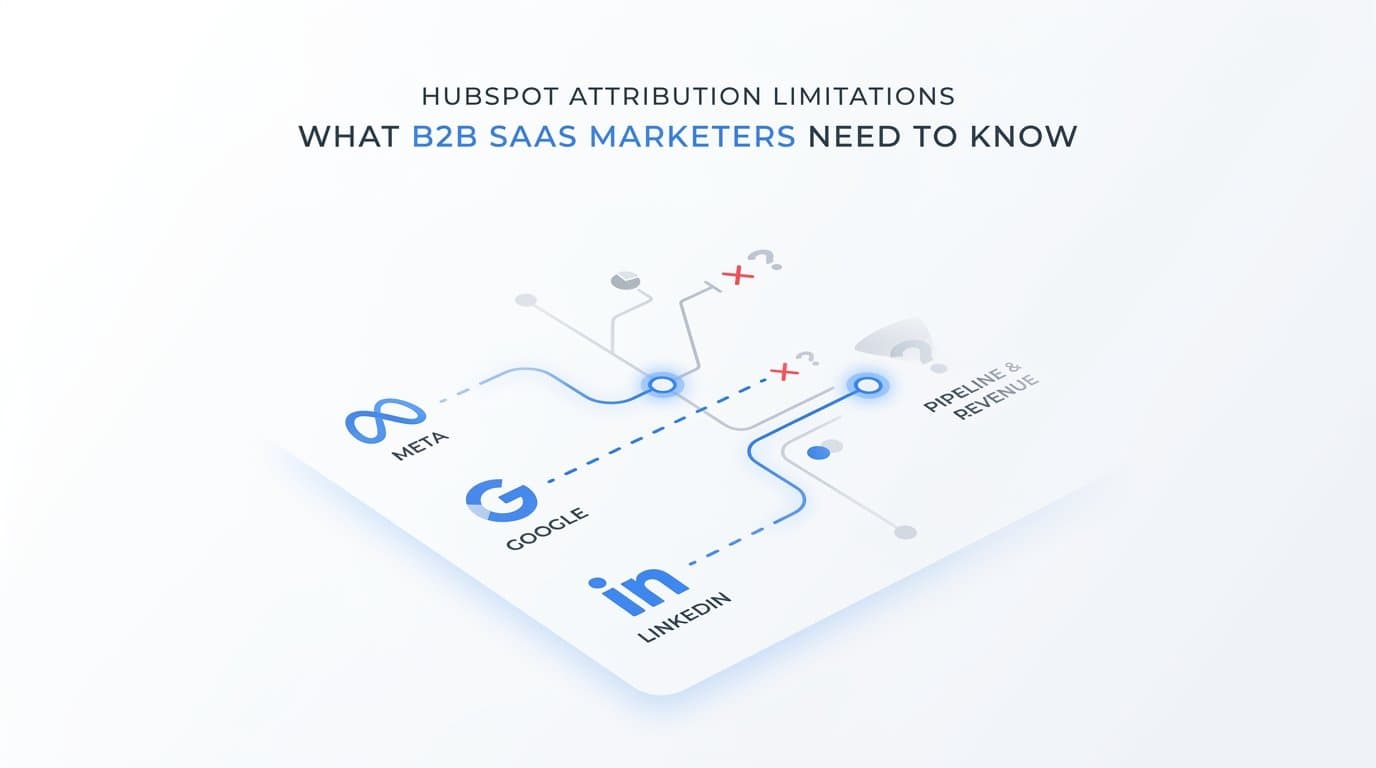
If you've spent any time running paid campaigns for a B2B SaaS company, you've probably felt this frustration: you know a campaign is working. Pipeline is moving. Sales is closing deals that clearly came from your LinkedIn or Google push. But when you pull the attribution report in HubSpot, the numbers just don't add up. Deals show as unattributed. Ad channels look underperforming. And you're left trying to explain a gap between what you know is true and what the data shows.
This is one of the most common pain points for growth teams that rely on HubSpot as their CRM and marketing hub. HubSpot is genuinely excellent at what it was built to do: manage contacts, automate nurture sequences, run email campaigns, and track inbound form submissions. For teams built around inbound marketing, it's a powerful platform.
But modern B2B SaaS marketing looks very different from the inbound-first world HubSpot was designed for. Today's growth teams run multi-channel paid programs across Meta, Google, and LinkedIn. They deal with long sales cycles, multiple stakeholders per account, and increasing pressure to connect every dollar of ad spend to pipeline and revenue. When you hold HubSpot's attribution capabilities up against those demands, the structural gaps become hard to ignore.
This article breaks down exactly where those gaps are, why they exist, and what accurate attribution actually requires for B2B SaaS teams running serious paid programs. If you've been frustrated by HubSpot's attribution reports, what follows will validate that frustration and give you a clearer picture of what to do about it.
Built for Inbound: Why HubSpot's Attribution Logic Has Structural Roots
To understand why HubSpot's attribution falls short for paid media and complex B2B journeys, it helps to understand where it came from. HubSpot was built around inbound marketing principles: attract visitors through content, convert them through forms, and nurture them through email. In that world, attribution is relatively straightforward. A contact fills out a form, HubSpot records the original source, and you know where they came from.
That architecture made sense in the early days of marketing automation. But it also means HubSpot's attribution logic is fundamentally tied to contact creation events, primarily form submissions and page visits tracked by its JavaScript cookie. The system was not designed to handle the complexity of a modern B2B SaaS buyer journey, where a prospect might see a LinkedIn ad, read a blog post, attend a webinar, get an outbound email from a sales rep, and then convert weeks later through a direct visit.
HubSpot's default attribution models reflect this origin. First-touch and last-touch are the most commonly used, and both assign 100% of credit to a single interaction. First-touch credits the very first recorded touchpoint. Last-touch credits the final one before conversion. Neither model accounts for the multiple channels and interactions that typically influence a B2B purchasing decision.
This is a significant structural limitation, not a minor reporting quirk. When you assign all credit to one touchpoint, you're not just simplifying the picture. You're actively misleading your team about which channels and campaigns are contributing to growth. A paid search campaign that consistently warms up prospects before they convert through a direct visit will look invisible in a last-touch model. A top-of-funnel LinkedIn campaign that drives awareness will never get credit in a first-touch model that records an organic visit from six weeks earlier.
There's also a boundary issue. HubSpot's attribution logic is built around its own ecosystem. Any touchpoint that occurs outside of HubSpot's tracking layer, whether that's an offline event, a sales call, a third-party tool interaction, or a conversion that happens after a cookie is blocked, simply does not exist in the attribution record. The system cannot report on what it cannot see, and by design, it cannot see everything.
For teams that were primarily running inbound programs five or six years ago, this was a manageable constraint. For B2B SaaS companies running paid acquisition programs across multiple channels today, it's a fundamental mismatch between the tool and the task.
The Paid Ads Blind Spot in HubSpot's Tracking Architecture
Paid media is where HubSpot's attribution limitations become most visible and most costly. The core issue is that HubSpot relies on UTM parameters and cookie-based tracking to attribute paid traffic. When someone clicks a Google or Meta ad, HubSpot reads the UTM tags in the URL and stores them against the contact record when a form is submitted or a cookie is set. That's the mechanism. And it has several significant failure points.
The first is browser privacy. Over the past few years, browser-level privacy changes and iOS updates have dramatically reduced the reliability of cookie-based tracking. Safari blocks third-party cookies by default. Firefox does the same. iOS privacy changes limit the ability to track users across apps and browsers. The result is that a meaningful portion of your paid traffic is arriving without the cookie-based data that HubSpot needs to attribute it correctly. These visitors convert, but their journey gets recorded as direct or unattributed.
The second failure point is the absence of server-side tracking. The industry response to cookie deprecation has been server-side event tracking and Conversion API integrations, which capture conversion events at the server level rather than relying on browser behavior. HubSpot does not offer native server-side tracking as a solution to this problem. That means the gap created by cookie loss is not being filled, and conversion data flowing back to ad platforms is incomplete.
The third issue is ad spend data. HubSpot has integrations with Google Ads, Meta, and LinkedIn that allow you to see some campaign-level data inside the platform. But these integrations do not give you true cost-per-lead or ROAS reporting at the campaign or ad creative level within your attribution reports. To get a meaningful picture of spend efficiency, most teams end up exporting data from HubSpot, pulling spend data from each ad platform separately, and reconciling everything in a spreadsheet. That process is manual, time-consuming, and prone to error.
The practical consequence is that your paid channels almost always look worse in HubSpot than they actually are. Conversions are undercounted because cookies are blocked. Ad spend is not connected to pipeline data. And the result is that marketing teams either underinvest in paid channels that are actually working or struggle to make the case for budget internally because the attribution data doesn't support the performance they know exists.
This is not a problem that better UTM hygiene will solve. The structural gap between cookie-dependent attribution and the reality of modern browser behavior is real, and it requires a different approach to data collection entirely.
Multi-Touch Attribution in HubSpot: Partial Progress with Real Constraints
To be fair, HubSpot does offer multi-touch attribution models. Linear, time-decay, U-shaped, and W-shaped models are available within the platform. These are meaningful improvements over simple first-touch and last-touch, and for teams that have access to them, they provide a more nuanced view of how multiple interactions contribute to a conversion.
The first constraint is pricing. HubSpot's multi-touch attribution models are locked behind the Marketing Hub Enterprise tier. For many growing B2B SaaS companies, that price point is a significant barrier. Teams that are scaling their paid programs and need better attribution data are often the same teams that haven't yet reached the budget level where Enterprise pricing makes sense. The result is that the companies that most need multi-touch visibility are the ones least likely to have access to it.
The second constraint is scope. Even when multi-touch models are enabled, they only track touchpoints that are recorded within HubSpot's ecosystem. If a prospect interacted with a sales sequence in Outreach, attended a webinar on a third-party platform, or responded to a direct mail piece, none of those interactions appear in the attribution window. The model distributes credit across the touchpoints it can see, but it has no visibility into the ones it can't. For B2B SaaS companies with complex, multi-channel buyer journeys, this creates a systematically incomplete picture.
The third and perhaps most fundamental constraint is the contact-centric data model. HubSpot tracks attribution at the individual contact level. In B2B SaaS, buying decisions typically involve multiple stakeholders across a single account: a champion, a technical evaluator, a finance approver, and an executive sponsor. Each of these people may have a different set of touchpoints with your brand before a deal closes.
When attribution is tracked at the contact level, you get a fragmented view of each individual's journey, but no unified picture of how the account as a whole engaged with your marketing. Sales and marketing alignment in B2B requires account-level visibility. You need to know which campaigns influenced the account, not just which touchpoints a single contact experienced. HubSpot's data model is not built to answer that question natively, and that gap has real consequences for how teams allocate budget and evaluate channel performance.
Pipeline and Revenue Attribution: Where the Disconnect Becomes Expensive
The ultimate goal of marketing attribution in B2B SaaS is not just knowing which channels drive leads. It's knowing which channels drive revenue. That means being able to trace a closed-won deal back through the entire buyer journey to the specific campaigns, ad creatives, and keywords that initiated and influenced it.
HubSpot can connect deals to contacts and contacts to original sources. That's a useful starting point. But the connection between a closed deal and the specific paid ad that started the journey is not something HubSpot can make with precision. The original source field tells you a contact came from paid search, but it doesn't tell you which campaign, which ad group, or which keyword. And it certainly doesn't tell you what that lead cost relative to the revenue it eventually generated.
Revenue attribution in HubSpot is also siloed from ad platform data. The deal value sitting in your CRM and the spend data sitting in your Google or Meta account exist in separate systems, and HubSpot does not bridge that gap natively. Marketing teams that want to calculate true ROAS or cost-per-pipeline by channel need to build that reporting themselves, usually through a combination of exports, spreadsheets, and manual reconciliation.
For B2B SaaS companies with sales cycles that span weeks or months, there's another compounding issue. HubSpot's attribution windows can cause early-funnel touchpoints to be dropped or underrepresented by the time a deal closes. A prospect who first engaged with a paid ad four months ago and then went through a long evaluation process may have that initial touchpoint lost entirely from the attribution record. The system records what it can within its tracking window, but long sales cycles create more opportunities for data to fall through the gaps.
The practical result is that marketing teams cannot confidently answer the question that matters most to leadership: which campaigns are generating the most pipeline and revenue relative to what we're spending? Without that answer, budget decisions are based on incomplete data, and the risk of over-investing in underperforming channels or under-investing in high-performing ones is real.
What Accurate Attribution Actually Requires for B2B SaaS
If HubSpot's attribution has these structural limitations, what does a genuinely effective attribution solution for B2B SaaS actually look like? There are a few core requirements that any serious approach needs to address.
Server-side event tracking: Accurate attribution cannot depend on browser cookies. Server-side tracking captures conversion events at the server level, independent of what's happening in the user's browser. This means conversions are recorded regardless of whether a cookie was set, blocked, or expired. For paid media attribution specifically, this is not optional. It's the foundation of reliable data in a privacy-first browser environment.
Conversion API integration: Beyond capturing your own data accurately, effective attribution requires feeding that data back to the ad platforms. Meta's Conversion API and Google's Enhanced Conversions allow you to send server-side event data directly to the platforms, improving their optimization algorithms and giving you more accurate reporting within the platforms themselves. Without this, you're not just undercounting conversions on your end. You're also starving the ad platform AI of the signal it needs to optimize your campaigns effectively.
A unified data layer: True attribution for B2B SaaS requires connecting ad platform data, CRM data, and website behavior into a single view. These three data sources need to talk to each other in real time, not be reconciled manually in a spreadsheet at the end of the month. When they're unified, you can trace a closed-won deal back to the first ad impression, see the full sequence of touchpoints in between, and calculate the actual revenue impact of every campaign.
Account-level attribution: For B2B SaaS companies, contact-level attribution is structurally insufficient. The buying committee dynamic means multiple contacts at a single account are engaging with your marketing simultaneously, each with their own touchpoint history. Attribution needs to map all of those interactions to the account and ultimately to the deal, giving you a complete picture of how marketing influenced the purchase decision across the entire buying group.
These requirements are not aspirational. They represent the baseline of what's needed to make confident, data-driven decisions about paid media investment in B2B SaaS. The gap between this baseline and what HubSpot natively provides is where attribution solutions built specifically for this use case become essential.
How Cometly Fills the Attribution Gaps That HubSpot Leaves Open
Cometly is built specifically for B2B SaaS companies that need to connect ad spend to pipeline and revenue with precision. Rather than replacing HubSpot, it adds an attribution layer that addresses the structural gaps described above, working alongside your existing CRM and marketing stack.
At the data collection level, Cometly uses server-side tracking to capture conversion events independently of browser behavior. This means every touchpoint is recorded regardless of cookie restrictions, iOS privacy changes, or browser-level blocking. The result is a more complete and accurate picture of how your paid channels are actually performing, without the systematic undercounting that cookie-dependent tools produce.
Cometly also integrates with Meta's Conversion API and Google's Enhanced Conversions, sending enriched, server-side event data back to the ad platforms. This does two things: it improves the accuracy of your in-platform reporting, and it gives the ad platform algorithms better signal to optimize your campaigns. When Meta or Google has more complete conversion data, their targeting and bidding systems work more effectively, which means better performance from the same spend.
On the reporting side, Cometly connects ad platform data, CRM data, and website behavior into a single unified attribution view. Marketing teams can see which campaigns, ad creatives, and keywords are driving pipeline and revenue, with actual spend data connected to actual deal value. The questions that currently require manual spreadsheet work in HubSpot, such as cost-per-pipeline by channel or ROAS by campaign, become answerable directly within the platform.
Cometly's AI-powered insights layer surfaces which ads and campaigns are performing across every channel, identifying opportunities to scale and flagging underperformers before budget is wasted. For growth teams managing spend across multiple platforms simultaneously, this kind of cross-channel visibility is the difference between confident scaling and educated guessing.
With over 70 native integrations, Cometly fits into the existing stack without requiring a platform overhaul. The goal is attribution depth alongside HubSpot, not a replacement for the CRM and automation workflows your team already relies on.
Adding Attribution Depth to Your Existing Stack
HubSpot is a powerful platform for CRM, marketing automation, and inbound marketing. That's not in question. But its attribution capabilities were built for a different era of marketing, and the structural limitations it carries, cookie dependency, contact-centric data models, plan-gated multi-touch reporting, and the disconnect between ad spend and revenue data, are not gaps that incremental product updates are likely to close. They reflect architectural decisions that are deeply embedded in how the platform works.
For B2B SaaS marketing teams running multi-channel paid programs and reporting on pipeline and revenue impact, those gaps are expensive. They lead to underreported channel performance, misallocated budgets, and an inability to answer the questions that matter most to leadership and the business.
The solution is not to abandon HubSpot. It's to add a purpose-built attribution layer that fills the gaps it leaves open. Server-side tracking, Conversion API integration, unified ad and CRM data, and account-level attribution are the building blocks of a reliable attribution system for modern B2B SaaS marketing.
If your HubSpot attribution reports have been leaving you with more questions than answers, it's worth exploring what a dedicated attribution platform can add to your stack. Get your free demo and see how Cometly gives you the complete, accurate view of your marketing performance that your current setup can't provide.