If you've noticed a growing gap between what your ad platforms report and what your CRM actually shows, you're not imagining it. iOS privacy updates fundamentally rewired how digital advertising tracks user behavior, and the ripple effects are still being felt by marketing teams across the industry.
For B2B SaaS marketers, this isn't just an analytics nuisance. Budget decisions, channel allocation, and pipeline forecasting all depend on conversion data being accurate. When that data becomes unreliable, teams make the wrong calls. They cut spend on channels that are still working. They double down on campaigns that look good on paper but aren't driving real revenue. The cost of bad attribution is real, and iOS changes made bad attribution much easier to stumble into.
This article breaks down exactly what happened when Apple introduced its privacy framework, why it created such a significant measurement problem, and what modern solutions look like for teams that need accurate, actionable data. If you're trying to understand the iOS privacy changes impact on tracking and what to do about it, this is where to start.
How Apple's Privacy Framework Disrupted Ad Attribution
Apple introduced App Tracking Transparency (ATT) with iOS 14.5, and it changed the rules of digital advertising overnight. Before ATT, ad platforms could access a device identifier called the IDFA (Identifier for Advertisers), which allowed them to match ad exposures on one app to conversions on another. It was the connective tissue that made cross-app attribution possible.
ATT required apps to ask users for explicit permission before accessing the IDFA. The prompt is simple and direct: it asks whether the user wants to allow the app to track their activity across other companies' apps and websites. Many users, given a clear choice, said no. Opt-in rates varied considerably depending on the app category and user base, but the result across the industry was a significant reduction in the pool of identifiable iOS users available for ad tracking.
This directly undermined pixel-based tracking, which had been the backbone of digital advertising measurement for years. Browser and in-app pixels work by executing in the user's environment, reading cookies and device identifiers to stitch together a user's journey from ad click to conversion. When iOS restrictions removed access to the IDFA and Apple's Intelligent Tracking Prevention (ITP) in Safari began aggressively limiting cookie persistence, pixel-only setups lost the ability to reliably track iOS user journeys across apps and websites.
The downstream effect on ad platforms was significant. Meta, Google, and other platforms rely on conversion signals to understand which ads are working. When those signals disappear or become incomplete, the platforms lose their ability to accurately report results and optimize campaigns. Reported conversions dropped on many accounts even when actual business results had not changed. Ads that were still driving leads and pipeline appeared to be underperforming because the measurement layer could no longer see what was happening.
This created a dangerous illusion. Marketing teams looking at platform dashboards saw declining conversion numbers and drew reasonable but incorrect conclusions. The problem wasn't always that the ads stopped working. Often, the problem was that the tracking stopped working. Understanding this distinction is the first step toward fixing it.
Subsequent iOS updates reinforced these restrictions rather than relaxing them. Apple has consistently signaled that user privacy is a core product value, which means the tracking landscape that existed before iOS 14.5 is not coming back. The industry needed to adapt, and the teams that adapted fastest gained a real competitive advantage. Understanding how iOS 14 changed digital advertising permanently is essential context for every marketer rebuilding their measurement stack.
The Attribution Data Gap: What Marketers Lost and Why It Matters
The iOS privacy changes impact on tracking wasn't uniform across all metrics. Some data points became slightly less precise. Others became genuinely unreliable. Understanding which is which helps you prioritize where to focus your measurement rebuild.
Click-through attribution windows took a direct hit. Meta reduced its default attribution window from 28-day click to 7-day click following the iOS changes. For B2B SaaS companies where a prospect might click an ad today and convert to a trial or demo request two or three weeks later, this change alone caused significant undercounting. Conversions that happened outside the shortened window were no longer credited to the campaign that influenced them. The ad looked like it didn't work. The pipeline told a different story.
Cross-device tracking became far less reliable as well. B2B buyers rarely research, evaluate, and purchase from a single device in a single session. A prospect might see a LinkedIn ad on their iPhone during a commute, research your product on a desktop browser at work, and then convert after receiving a follow-up email. Pixel-based models depend on persistent identifiers to connect these sessions. iOS restrictions severed many of those connections, making multi-session and multi-device journeys harder to reconstruct.
Audience targeting also degraded. Behavioral retargeting audiences, which are built from observed user activity across apps and websites, shrank as fewer iOS users could be tracked. Lookalike audiences built from those smaller pools became less precise. Ad platforms were working with less signal, which affected both reporting accuracy and campaign optimization.
The practical consequence for many marketing teams was a misallocation problem. When paid social channels appeared to be driving fewer conversions than before, budget naturally shifted elsewhere. But if those conversions were still happening and simply not being attributed correctly, the shift in budget was based on false information. Teams were essentially optimizing against a broken compass.
For B2B SaaS specifically, this problem is amplified by the nature of the sales cycle. A typical B2B SaaS deal involves multiple stakeholders, multiple touchpoints across weeks or months, and a conversion event (a closed deal) that happens far downstream from the initial ad exposure. Every layer of measurement complexity that iOS introduced hits harder when your customer journey is already long and multi-threaded.
Pipeline forecasting depends on understanding which channels are generating qualified pipeline, not just which channels are generating clicks. When attribution breaks down, pipeline forecasts built on marketing data become unreliable. That's not just a marketing problem. It affects how finance teams model growth and how leadership allocates resources across the business.
Server-Side Tracking and Conversion APIs: The Modern Fix
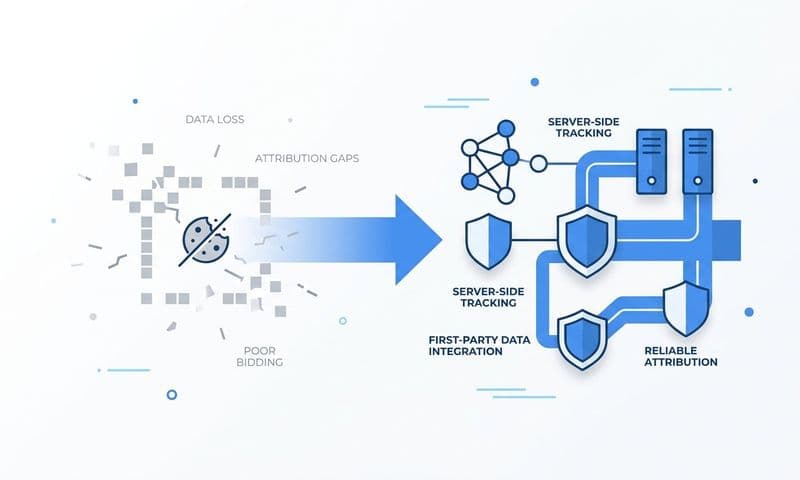
The core problem with pixel-based tracking is where it runs: inside the user's browser or app environment. That's exactly the space that iOS restrictions and Safari's ITP are designed to control. The solution, then, is to move tracking outside that environment entirely.
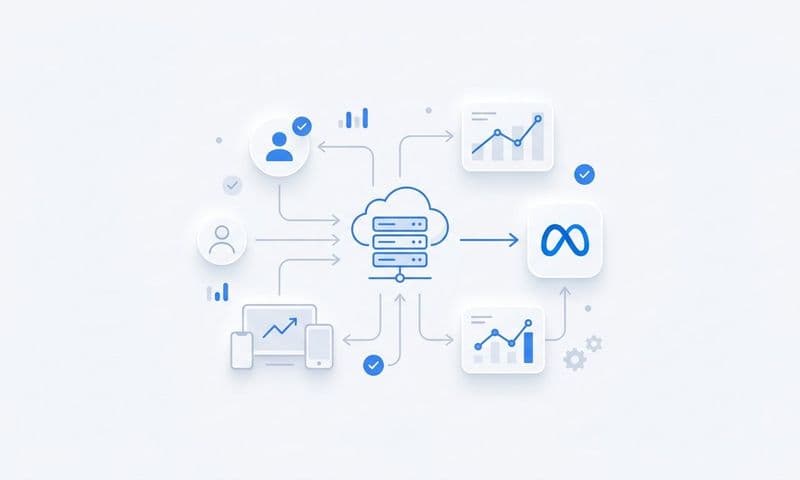
Server-side tracking works differently. Instead of firing a pixel from the user's browser when a conversion happens, your server sends the event data directly to the ad platform's API. The user's device is not involved in this exchange. iOS restrictions cannot intercept or block it. The event arrives with full fidelity regardless of what the user's privacy settings are. Understanding why server-side tracking is more accurate is the foundation of any modern measurement strategy.
This is the architecture behind Conversion APIs. Meta's Conversions API (CAPI) and Google's Enhanced Conversions are server-to-server solutions that allow advertisers to send conversion event data from their own infrastructure directly to the ad platform. Because this bypasses the browser entirely, the signal quality is dramatically better than what pixel-only setups can deliver in a post-iOS 14.5 world.
The quality of the signal depends on what data you send. This is where first-party data becomes central to the strategy. First-party data is information you collect directly from your own customers and users: email addresses from form submissions, CRM records, purchase events from your payment processor, and behavioral data from your own website. Unlike third-party identifiers that iOS blocks, first-party data belongs to you and is not subject to the same restrictions.
When you send a conversion event through a Conversion API, you can include first-party identifiers like hashed email addresses or phone numbers. The ad platform uses these to match the conversion to a user in their system, even if they can't rely on device identifiers. This is called event matching, and higher match rates mean better optimization and more accurate reporting.
First-party data enrichment takes this further. By connecting your CRM, website behavior data, and ad platform data into a unified tracking layer, you create a measurement infrastructure that iOS cannot disrupt. When a lead comes in through a form submission, that event can be sent server-side to Meta and Google with the user's hashed email. When that lead converts to a paying customer in your CRM, that revenue event can also be sent back to the ad platforms, closing the loop from ad click to closed deal.
This is not a temporary workaround. It's a fundamentally more robust architecture than pixel-only tracking ever was. Pixels were convenient but fragile. Server-side tracking with first-party data is more work to set up correctly, but it produces more reliable data that holds up as privacy restrictions continue to evolve.
For B2B SaaS teams, the practical implementation involves connecting your marketing stack: your ad platforms, your website, your CRM, and your billing system. Each of these systems holds a piece of the customer journey. Server-side tracking and Conversion APIs are the mechanism for connecting those pieces into a coherent picture.
Multi-Touch Attribution in a Privacy-First World
Last-click attribution was already a flawed model before iOS privacy changes. It assigns all conversion credit to the final touchpoint before conversion, ignoring every ad, email, content piece, and interaction that contributed to the decision. It's simple to implement and easy to understand, which is why it became the default for so many teams. But it was never accurate.
iOS changes made last-click attribution even more misleading. Here's why: many of the early touchpoints in a B2B buyer's journey happen on mobile devices. A prospect discovers your brand through a LinkedIn ad on their iPhone. They engage with your content on a mobile browser. These early iOS touchpoints, which were already difficult to track in a multi-device journey, became even harder to capture after ATT removed device identifiers from the equation.
What last-click attribution reports in this environment is not the last meaningful touchpoint. It's often the last touchpoint that happened to be trackable. That's a very different thing, and making budget decisions based on it leads to systematically undervaluing the channels that create awareness and intent at the top of the funnel.
Multi-touch attribution models distribute credit across the full customer journey rather than awarding it all to a single touchpoint. Linear models spread credit evenly. Time-decay models give more credit to touchpoints closer to conversion. Position-based models give extra weight to the first and last touches. Each has tradeoffs, but all of them produce a more complete picture than last-click. Reviewing the best marketing attribution software available today can help teams identify the right model for their sales cycle.
More importantly, multi-touch models are more resilient to signal loss. When an iOS touchpoint is invisible to pixel-based tracking, a last-click model might credit the wrong channel entirely. A multi-touch model, especially one that incorporates CRM data and server-side events, can still reconstruct a meaningful portion of the journey even when some data points are missing.
The most sophisticated approach is data-driven attribution, which uses aggregated and modeled signals rather than individual user-level tracking. Ad platforms like Google use this approach internally, analyzing patterns across large volumes of conversion data to estimate the contribution of each touchpoint. This method is naturally more compatible with a privacy-first world because it doesn't depend on tracking individual users across every interaction.
For B2B SaaS teams, the shift to multi-touch attribution requires connecting data sources that are often siloed. Your Google Ads data lives in one place. Your LinkedIn data lives in another. Your CRM holds the ground truth about which leads actually converted and when. Multi-touch attribution only works when these sources are unified, which is why the infrastructure question and the attribution model question are inseparable.
Rebuilding Reliable Ad Performance Measurement
Understanding the problem is useful. Knowing what to do about it is what matters. For B2B SaaS marketing teams, rebuilding reliable measurement after iOS changes involves a few concrete steps that build on each other.
Audit your current tracking setup: Before adding new tools or changing your configuration, understand what you have. Are you relying solely on browser pixels for conversion tracking? Are your attribution windows set appropriately for your actual sales cycle? Are there gaps between what your ad platforms report and what your CRM records? A clear picture of where your measurement is breaking down tells you where to focus first.
Implement server-side events: Replace or supplement your browser pixels with server-side tracking. Set up Meta's Conversions API and Google's Enhanced Conversions to send conversion events directly from your server. Include first-party identifiers like hashed emails to maximize event match rates. This single step restores a significant amount of the signal that iOS restrictions removed from pixel-only setups. Following a server-side tracking implementation guide ensures you configure each component correctly from the start.
Connect your CRM to your ad platforms: Platform-reported conversions measure what the ad platform can see, which is an incomplete picture. Your CRM records what actually happened: which leads came in, how they progressed through the pipeline, and which ones converted to paying customers. When you connect CRM pipeline and revenue data back to ad spend data, you create a measurement layer that operates independently of iOS restrictions. A lead that converted three weeks after clicking an ad will show up in your CRM regardless of whether the pixel fired correctly.
Adopt a single source of truth: One of the most persistent problems in marketing measurement is relying on siloed platform dashboards. Each platform reports its own numbers using its own attribution logic, and the totals never add up. A single source of truth brings all channels, touchpoints, and revenue outcomes into one unified view. This is not just more convenient. It's the only way to make accurate cross-channel comparisons and budget decisions. Following best practices for tracking conversions accurately is what separates teams that recover from iOS disruption from those that continue to fly blind.
Platforms like Cometly are built specifically for this kind of unified measurement. By connecting ad platforms, CRM data, and revenue events in one place, you get a view of ad performance that goes from first click to closed-won revenue, without depending on the third-party signals that iOS has made unreliable.
The teams that rebuild their measurement infrastructure this way don't just recover from the iOS changes impact on tracking. They end up with better data than they had before, because they're no longer depending on a fragile pixel-based system that was always one browser update away from breaking.
Staying Ahead as Privacy Standards Continue to Evolve
It would be a mistake to treat iOS privacy changes as a one-time disruption that you adapt to and move on from. What Apple introduced is part of a broader, accelerating shift toward user privacy across the entire digital ecosystem.
Google has been developing Privacy Sandbox as a replacement for third-party cookies in Chrome, the world's most widely used browser. Firefox and Brave already block third-party cookies by default. Regulatory frameworks in various regions continue to add requirements around user consent and data handling. The direction of travel is clear: the open, identifier-rich tracking environment that digital advertising was built on is being systematically dismantled, and it won't be rebuilt.
This means server-side tracking and first-party data strategies are not a temporary fix for an Apple-specific problem. They are the durable long-term architecture for marketing measurement. Every investment you make in this infrastructure compounds over time as restrictions tighten further. Teams that build it now will have a significant advantage over those who wait. Preparing for ongoing changes like the iOS 17 link tracking shield is part of building a measurement strategy that doesn't need to be rebuilt with every new update.
AI-powered analytics add another layer of resilience. One of the real challenges in a privacy-first world is that your data will always have gaps. Not every touchpoint will be captured. Not every user journey will be complete. AI can help fill those gaps by identifying patterns across aggregated data sets and surfacing which campaigns are likely driving results even when direct attribution is limited.
Rather than waiting for a complete data set that will never exist, AI-driven attribution uses what's available to make intelligent inferences about performance. It can flag campaigns that are generating strong pipeline signals even when platform-reported conversions look modest. It can identify patterns in the leads that convert to revenue, helping you optimize toward quality rather than volume. The impact of machine learning on marketing analytics is making this kind of gap-filling inference increasingly reliable for teams operating in privacy-constrained environments.
The strategic takeaway is straightforward. Marketers who build privacy-resilient infrastructure now, combining server-side tracking, Conversion APIs, first-party data, and multi-touch attribution, will be able to measure and optimize their campaigns accurately regardless of what privacy changes come next. Those who continue to rely on browser pixels and platform-reported conversions will find their measurement becoming progressively less reliable with each new update.
Privacy is not going away. The question is whether your measurement infrastructure is built for the world that exists today, or the one that existed five years ago.
Putting It All Together
iOS privacy changes did not end effective ad tracking. They ended tracking that depended on third-party signals and browser-based identifiers that were never fully within your control. The gap between what ad platforms reported and what actually happened was always there to some degree. iOS just made it impossible to ignore.
For B2B SaaS marketers, the path forward is clear. Server-side tracking and Conversion APIs restore the signal quality that pixel-only setups lost. Multi-touch attribution models give you a more accurate picture of how your channels work together across long, complex sales cycles. Connecting CRM pipeline and revenue data to ad spend creates a measurement layer that iOS cannot disrupt.
The teams that get this right don't just solve a tracking problem. They build a durable competitive advantage: accurate data that drives smarter budget decisions, better campaign optimization, and more reliable pipeline forecasting.
Cometly is built specifically for this challenge. It connects every touchpoint from first ad click to closed-won revenue, unifying your ad platforms, CRM, and website data into a single source of truth that works within the modern privacy landscape. You get real-time visibility into which ads and channels are actually driving pipeline and revenue, not just what the platforms choose to report.
If you're ready to move beyond broken attribution and build measurement that holds up as privacy standards continue to evolve, Get your free demo today and see how Cometly captures every touchpoint to maximize your conversions.