Outbound sequences are generating pipeline for your team. You know this because the meetings are getting booked and deals are closing. But ask your leadership team exactly which email, which call attempt, or which LinkedIn touch actually moved the needle, and you will likely get silence, followed by a debate nobody can settle with data.
This is the core tension facing B2B SaaS sales and marketing teams today. Outbound sequences are a significant investment of time, headcount, and tooling, yet most organizations have no reliable way to attribute closed revenue back to specific sequence steps or channels. They track activity metrics like emails sent and calls made, but they cannot answer the question that actually matters: which touchpoints drove the deal?
The problem compounds when you factor in paid advertising. Many prospects receive cold outreach while simultaneously seeing retargeting ads, attending webinars, or engaging with organic content. When a deal closes, which channel gets credit? Without a structured attribution framework, you are making budget and headcount decisions based on incomplete data, and that is an expensive blind spot to carry into any planning cycle.
Outbound sequence attribution is the framework that closes this gap. It connects individual sequence touchpoints to downstream outcomes like pipeline created and closed-won revenue, giving sales and marketing teams a shared, data-grounded view of what is actually working. Here is how it works, why it matters, and how to build a system that makes it actionable.
Why Outbound Sequences Fall Through the Attribution Gap
Traditional attribution tools were designed around inbound behavior. They track ad clicks, form fills, page visits, and email opens from marketing campaigns. They are exceptionally good at telling you which paid channel drove a lead to raise their hand. What they were never built to capture is the outbound motion that often runs in parallel.
Cold emails sent through Outreach, Salesloft, or Apollo generate engagement data inside those platforms, but that data rarely flows into your marketing attribution system in a structured, unified way. A reply to a sequence step, a connected call, or a LinkedIn message that prompted a prospect to visit your pricing page, these are all meaningful touchpoints in the customer journey. Most attribution models treat them as if they never happened.
The result is a fragmented picture. Your marketing attribution dashboard shows a prospect converted after clicking a Google ad, but your SDR knows they had already exchanged three emails with that prospect before the ad click ever occurred. Neither system has the full story, and the version each team believes shapes how they allocate resources going forward.
This overlap between outbound and paid creates real organizational friction. Marketing points to last-touch ad attribution and claims credit for pipeline. Sales points to sequence activity and argues the outbound effort was what actually warmed the prospect. Without a unified data model, both arguments are partially right and neither is actionable.
The deeper issue is that budget and headcount decisions get made on this incomplete data. If outbound-influenced pipeline is invisible to your attribution model, you will systematically undervalue outbound as a channel and overinvest in whatever paid channel happens to capture the last click. Over time, this distortion compounds into a misaligned go-to-market strategy.
Capturing outbound touchpoints as structured data events in your attribution model is not a nice-to-have. It is the prerequisite for making any confident decision about your revenue-generating activities.
What Outbound Sequence Attribution Actually Measures
Before you can build an outbound attribution system, you need to be precise about what it is measuring. Outbound sequence attribution is not just about knowing that an outbound sequence contributed to a deal. It is about understanding which specific elements of that sequence drove conversion, so you can replicate and scale what works.
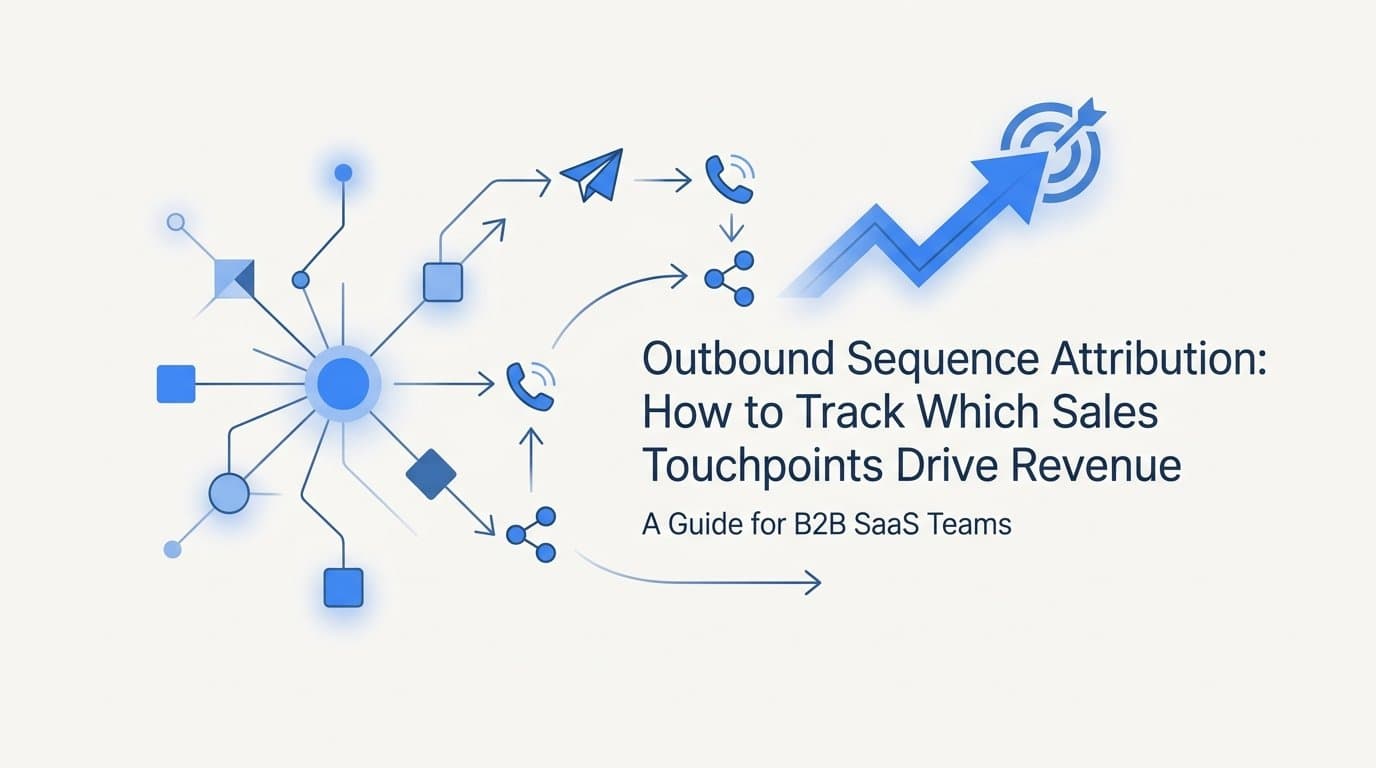
At the broadest level, outbound sequence attribution maps each step of a sales sequence to downstream outcomes. Those steps might include an initial cold email, a follow-up email on day three, a call attempt on day five, a LinkedIn connection request, and a final breakup email. Each of these touchpoints can be treated as a trackable event that either moved a prospect forward or did not.
Attribution at the sequence level asks: which sequence type correlates with the highest conversion rates? A sequence targeting enterprise accounts with a longer, more personalized cadence might outperform a shorter, high-volume sequence targeting SMBs. Without attribution data, you are guessing which approach to invest in. With it, you can compare pipeline-to-sequence ratios across different playbooks and make evidence-based decisions.
Attribution at the touchpoint level goes deeper. This is where you identify whether step three of a seven-step sequence is consistently the conversion trigger, or whether LinkedIn touches in the middle of a sequence correlate with higher reply rates than email-only sequences. This level of granularity is what separates teams that iterate intelligently from teams that run the same sequences indefinitely without improvement.
There is also an important distinction between activity metrics and attribution metrics. Activity metrics tell you what your team did: emails sent, calls made, connection requests accepted. Attribution metrics tell you what actually drove outcomes: which touchpoints correlate with demos booked, which sequence steps appear in the journey of your highest-value closed deals, and which channels within a sequence are doing the heavy lifting.
Most sales teams are swimming in activity metrics and starving for attribution metrics. Shifting your measurement framework toward attribution is what allows outbound to be treated as a scalable, optimizable channel rather than a high-effort, low-visibility effort.
How Attribution Models Apply to Outbound Sequences
Attribution models are frameworks for distributing credit across the touchpoints that influenced a conversion. In a marketing context, these models are commonly applied to ad clicks and web sessions. The same logic applies directly to outbound sequences, and choosing the right model depends on what question you are trying to answer.
First-Touch Attribution: This model gives full credit to the outbound touchpoint that initiated contact with a prospect. If a cold email was the first interaction that eventually led to a closed deal, first-touch attribution credits that email entirely. This model is most useful when you want to evaluate which prospecting lists, sequence types, or initial messaging angles are opening the most new conversations. It is a good lens for top-of-funnel optimization.
Last-Touch Attribution: The inverse of first-touch, this model credits the final touchpoint before conversion. In an outbound context, that might be the follow-up call that prompted a prospect to book a demo. Last-touch is useful for understanding what closes the loop on a sequence, but it systematically undervalues the earlier touches that built familiarity and trust over time.
Multi-Touch Attribution: This is where outbound sequence analysis gets genuinely powerful. Multi-touch models distribute credit across every touchpoint that influenced a prospect before they converted. Linear multi-touch gives equal credit to each step. Time-decay models weight recent touchpoints more heavily. Position-based models give more credit to the first and last touches while distributing the remainder across the middle.
For outbound sequences specifically, multi-touch attribution is the most accurate reflection of how deals actually close in B2B SaaS. A prospect rarely converts after a single email. They convert after a series of interactions that collectively build enough trust and urgency to take action. Crediting only one of those interactions misrepresents the sequence's true contribution.
Revenue Attribution: This is the most defensible model for outbound programs when presenting to finance or leadership. Rather than attributing pipeline or leads, revenue attribution connects sequence activity to actual closed-won revenue. It allows you to calculate true ROI per sequence and per rep in terms that transcend activity metrics entirely.
The right model is not universal. Teams with short sales cycles may find last-touch or first-touch sufficient. Teams with complex, multi-month sales motions will benefit most from multi-touch and revenue attribution. The key is choosing a model intentionally and applying it consistently so you can compare performance over time.
Connecting Outbound Data to Your Broader Attribution Stack
Outbound sequences do not operate in isolation, and your attribution system should not treat them as if they do. In B2B SaaS, a typical customer journey might look like this: a prospect sees a LinkedIn ad, receives a cold email two days later, clicks a retargeting ad a week after that, and then replies to a follow-up call from an SDR. Four distinct touchpoints, three different channels, and one deal.
Without a unified attribution stack, each of those touchpoints lives in a different system. The LinkedIn ad data sits in your ad platform. The email and call data lives in your sales engagement tool. The retargeting click might show up in your marketing analytics. And the CRM records the closed deal with whatever attribution logic it was configured to apply, usually last-touch by default.
Building a complete customer journey view requires passing CRM events from your sales engagement platform into your attribution system alongside ad click data and web events. This means treating outbound touchpoints as structured data events with the same rigor you apply to ad conversions. Each sequence step that a prospect engages with should be logged with a timestamp, a channel identifier, and a contact record that ties it to the same individual tracked across your other systems.
UTM parameters and contact-level tracking play a critical role here. When a prospect clicks a link in a cold email, that click should carry tracking parameters that connect it to the outbound sequence and the specific step it came from. This allows your attribution system to see that a web session originated from outbound outreach, not just from direct traffic or an unknown source.
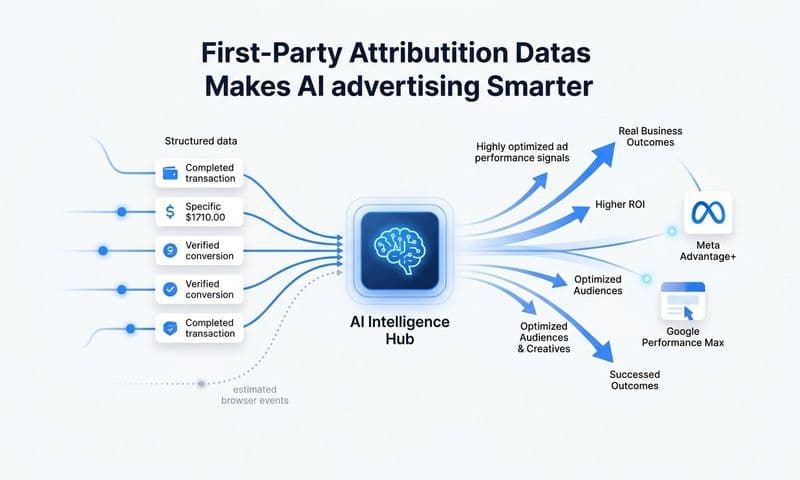
Server-side tracking and first-party data strategies are increasingly important in this context. As third-party cookies become less reliable and ad platforms tighten data access, the ability to pass enriched conversion events server-side ensures that outbound-influenced conversions are captured accurately. A platform like Cometly enables this by connecting your CRM, ad platforms, and web data into a single attribution layer, so outbound touchpoints appear alongside paid and organic interactions in a unified customer journey timeline.
The goal is a single source of truth where every touchpoint, regardless of channel or team, is visible, timestamped, and tied to a revenue outcome. That is the foundation for making confident decisions about where to invest your go-to-market resources.
Key Metrics That Make Outbound Attribution Actionable
Data without action is just noise. The value of outbound sequence attribution comes from translating it into metrics that drive specific decisions. Here are the metrics that matter most and what they enable.
Pipeline Attribution per Sequence: This metric reveals which outbound playbooks generate the most qualified opportunities. By tracking how much pipeline each sequence type produces, you can identify which cadences to scale, which to retire, and which to test against new variants. It shifts the conversation from "which sequences are most active" to "which sequences are most valuable."
Sequence-to-Revenue Rate: This measures how much closed revenue can be traced back to a specific outbound sequence. It is the most direct indicator of sequence ROI and gives sales and marketing a shared performance metric that transcends departmental silos. When both teams are optimizing toward the same revenue number, alignment becomes significantly easier to maintain.
Cost per Pipeline from Outbound: When you combine sequence attribution data with the cost of running outbound programs, including tooling, SDR salaries, and management overhead, you can calculate a true cost per pipeline opportunity. Comparing this against cost per pipeline from paid channels gives growth leaders a principled basis for allocating budget across acquisition channels.
Touchpoint-to-Conversion Rate by Step: This granular metric identifies which specific steps within a sequence correlate with the highest conversion rates. If step four of your enterprise sequence consistently appears in the journey of prospects who book demos, that is a signal worth investigating and replicating.
Outbound Influence on Inbound Conversions: Perhaps the most underappreciated metric, this measures how often outbound touchpoints appear in the journey of prospects who eventually converted through an inbound channel. This reveals the warming effect of outbound on inbound performance, a relationship that is completely invisible without unified attribution data.
Together, these metrics transform outbound from a qualitative judgment call into a quantifiable, optimizable channel that can be managed with the same rigor as paid acquisition.
Building an Outbound Attribution System That Actually Works
Understanding the theory of outbound sequence attribution is one thing. Building a system that actually captures and surfaces this data is another. Here is a practical framework for getting it right.
Step 1: Define your conversion events precisely. Start by identifying the specific outcomes that matter in your sales motion: reply received, meeting booked, opportunity created, and closed-won. Map each of these to a trackable CRM stage. Vague stage definitions create attribution gaps. If your CRM does not clearly log when and how a prospect moved from one stage to the next, your attribution data will reflect that ambiguity.
Step 2: Integrate your sales engagement platform with your attribution system. Platforms like Outreach, Salesloft, and Apollo generate rich sequence activity data. That data needs to flow into your attribution layer as structured events, not just as notes in a contact record. Work with your ops team to configure API connections or native integrations that pass sequence steps, engagement signals, and channel identifiers into your attribution platform in real time.
Step 3: Implement contact-level tracking across channels. Ensure that every outbound touchpoint is tied to the same contact record that tracks ad clicks and web sessions. This is what enables the unified customer journey view. Use consistent identifiers across systems, whether email addresses, CRM contact IDs, or custom tracking parameters, to stitch together touchpoints that occurred across different tools and timelines.
Step 4: Use attribution data to run structured sequence experiments. Once your attribution system is capturing outbound touchpoints accurately, you can begin running controlled experiments. Compare reply rates and pipeline rates across sequence variants. Test different step counts, messaging angles, and channel mixes. Use attribution data to measure which variants produce better downstream outcomes, not just higher open rates.
Step 5: Review attribution data in regular cross-functional meetings. Outbound sequence attribution is most valuable when it is reviewed by both sales and marketing together. Build a cadence where both teams look at the same attribution data, discuss what it reveals about the customer journey, and make joint decisions about where to invest effort and budget. This shared visibility is what breaks down the silos that make attribution debates so common in the first place.
Cometly is built to support exactly this kind of unified attribution workflow. By connecting your ad platforms, CRM, and web data into a single source of truth, it gives your team the visibility to see outbound touchpoints alongside paid and organic interactions, track the full customer journey from first contact to closed revenue, and make data-driven decisions with confidence.
The Bottom Line on Outbound Sequence Attribution
Outbound sequence attribution is not a reporting exercise you do at the end of the quarter. It is the operational foundation for scaling outbound efficiently, defending budget decisions with real revenue data, and aligning sales and marketing around a shared understanding of what drives growth.
When you can trace closed revenue back to specific sequence steps, channel combinations, and messaging angles, you stop guessing and start optimizing. You know which playbooks to scale, which reps are running the most effective sequences, and how outbound effort interacts with paid campaigns to accelerate deals. That level of clarity is a competitive advantage in any market.
The teams that will win in outbound are not the ones sending the most emails. They are the ones who know exactly which emails, sent to whom, at which point in the sequence, in combination with which other touchpoints, are driving revenue. Attribution is what separates those teams from everyone else.
Cometly provides the attribution layer that makes this possible. It unifies outbound CRM events, ad platform data, and web activity into a single customer journey view, so every touchpoint is visible, every conversion is explained, and every budget decision is grounded in real revenue data.
Ready to stop guessing and start knowing? Get your free demo today and start capturing every touchpoint in your customer journey so your team can scale outbound with confidence.