
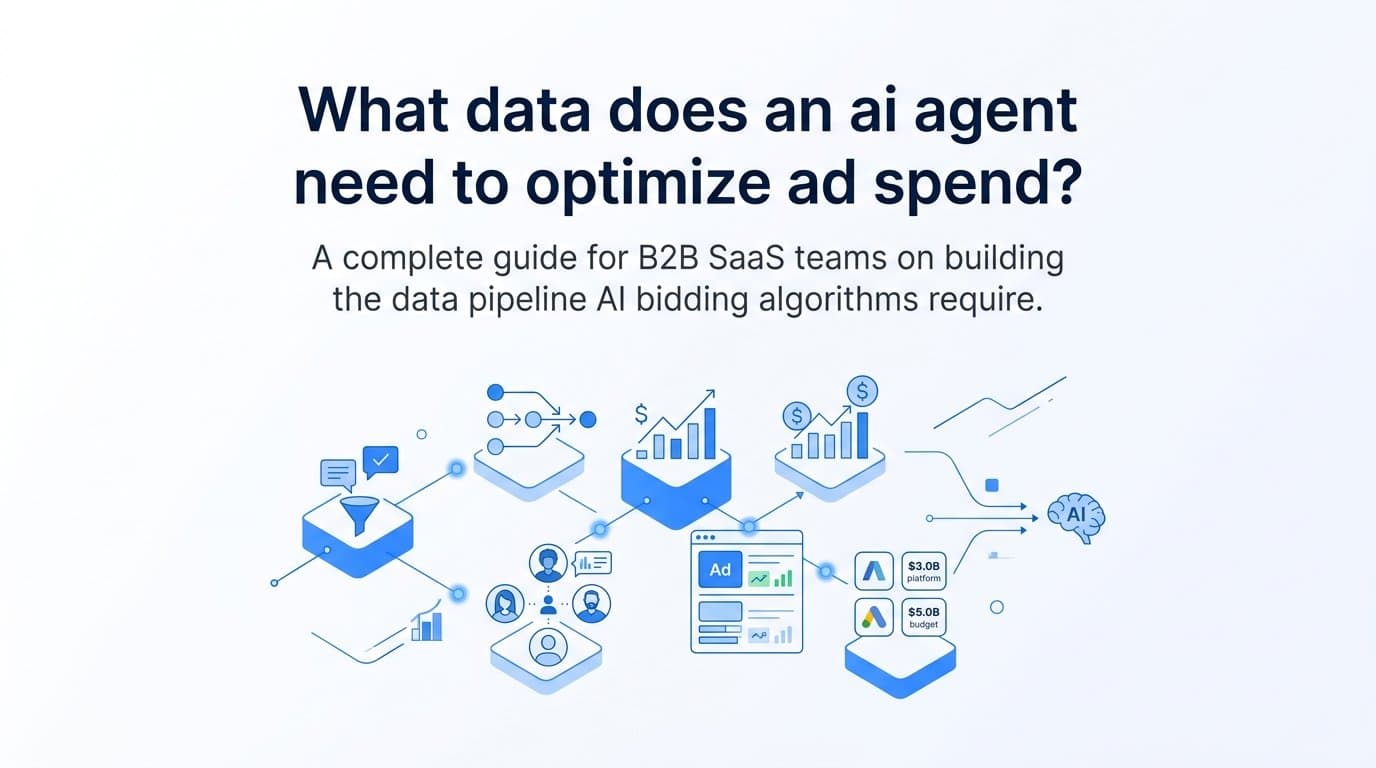
An AI agent needs six core data types to optimize ad spend effectively: conversion events, multi-touch attribution data, revenue and pipeline outcomes, audience signals, creative performance metrics, and cross-channel spend data. Without all six, the AI is making decisions on an incomplete picture, which leads to misallocated budget and poor return on ad spend.
This matters more than most marketing teams realize. Ad platform AI bidding algorithms are only as smart as the data you feed them. If your conversion signals are incomplete, your attribution is last-click only, or your revenue data never makes it back to the platform, the AI is essentially flying blind on the decisions that matter most.
Cometly is built specifically to solve this problem for B2B SaaS teams. It connects ad platforms, CRM events, and server-side conversion data into a single source of truth, then feeds enriched signals back to Meta, Google, and other platforms so their AI has what it needs to actually optimize. Whether you are running campaigns on Meta, Google, or LinkedIn, the quality of your AI optimization is only as good as the data pipeline behind it.
Here is a breakdown of each data type, why it matters, and what you need to do to make sure your AI agent is actually receiving it.
1. Conversion Event Data
The Challenge It Solves
Ad platform AI cannot optimize toward outcomes it cannot see. When conversion events are missing, delayed, or duplicated, the algorithm loses its primary signal for determining which audiences, placements, and creatives are driving results. Browser-based tracking alone is no longer sufficient: ad blockers, iOS privacy changes, and cookie restrictions regularly cause significant data loss between the user action and the platform receiving the event.
The Strategy Explained
Server-side tracking, often called Conversion API (CAPI) or enhanced conversions, sends conversion events directly from your server to the ad platform rather than relying on a browser pixel. This bypasses the restrictions that cause data loss and improves event match quality scores on platforms like Meta and Google.
For B2B SaaS, the key conversion events to track include form fills, trial signups, demo requests, and free-to-paid upgrades. Each event should be deduplicated so the platform does not count both a browser pixel fire and a server-side event as two separate conversions for the same action.
Cometly's server-side conversion tracking and Conversion API integration handle this automatically, ensuring your ad platforms receive clean, complete, and deduplicated conversion data in real time.
Implementation Steps
1. Audit your current conversion events in each ad platform and identify where data gaps exist compared to your actual form submission or signup data.
2. Implement server-side tracking via a Conversion API integration for Meta, Google enhanced conversions, and any other active ad platforms.
3. Set up deduplication logic using event IDs so browser-based and server-side events for the same action are not double-counted.
4. Verify event match quality scores in each platform's events manager and troubleshoot any low-quality matches.
Pro Tips
Include hashed customer data like email addresses in your server-side events wherever privacy policies allow. This significantly improves event match quality on Meta and helps the platform connect your conversion events to real user profiles, which strengthens the AI's targeting signal for lookalike audiences.
2. Multi-Touch Attribution Data
The Challenge It Solves
Last-click attribution assigns 100 percent of conversion credit to the final touchpoint before a conversion. For B2B SaaS companies with longer sales cycles, this systematically undervalues the upper-funnel channels that introduce prospects to your product. If your AI agent is optimizing based on last-click data, it is making budget decisions on a distorted view of what is actually working.
The Strategy Explained
Multi-touch attribution models distribute conversion credit across all the touchpoints in a customer journey. A linear model splits credit equally, a time-decay model weights recent touchpoints more heavily, and a data-driven model uses statistical analysis to assign credit based on actual conversion patterns. Each model gives the AI a more complete conversion value to optimize toward than last-click alone.
For B2B SaaS, this is particularly important because a typical buyer might encounter a LinkedIn ad, click a Google search ad, read a blog post, and then convert through a direct visit days later. Last-click attributes everything to the direct visit and nothing to LinkedIn or Google. Multi-touch attribution ensures each channel gets appropriate credit, which leads to more rational budget allocation decisions.
Cometly's multi-touch attribution capabilities let you compare attribution models side by side and understand true channel contribution across the entire customer journey.
Implementation Steps
1. Map out the typical touchpoint sequence for your buyers, from first ad impression to closed deal, using your CRM and analytics data.
2. Implement UTM parameter tracking consistently across all paid channels so every touchpoint can be identified and recorded.
3. Choose an attribution model that fits your sales cycle length and use it as the primary signal for budget decisions rather than platform-reported last-click data.
4. Review attribution model comparisons regularly to identify channels that are undervalued by last-click but contributing meaningfully in multi-touch models.
Pro Tips
Do not rely solely on the attribution data reported by individual ad platforms. Each platform has an incentive to claim as much credit as possible, which leads to inflated numbers and cross-platform double-counting. Use a neutral third-party attribution layer to get an unbiased view of channel contribution.
3. Revenue and Pipeline Data
The Challenge It Solves
Most ad platforms receive lead or form submission events as their primary conversion signal. For B2B SaaS, a lead and a closed-won deal worth thousands in monthly recurring revenue are very different outcomes. When AI agents optimize for lead volume without revenue context, they often surface high-volume, low-quality lead sources that look great on a cost-per-lead basis but produce almost no actual customers.
The Strategy Explained
Passing closed-won revenue, MRR, pipeline stage progression, and MQL-to-SQL conversion rates back to your ad platforms transforms the AI's optimization target from lead volume to business outcomes. This is often called offline conversion import or CRM integration, and it is one of the highest-leverage changes a B2B SaaS marketing team can make to their data pipeline.
When the AI knows that a lead from Campaign A converted to a paying customer worth $800 per month and a lead from Campaign B rarely progressed past the discovery call, it will naturally shift budget toward Campaign A. Without that revenue data, both campaigns look identical at the lead level.
Cometly integrates directly with Stripe and CRM platforms to pull closed-won revenue and pipeline data, then connects it to the original ad touchpoints so you can see which campaigns are actually driving revenue, not just leads.
Implementation Steps
1. Connect your CRM to your attribution platform so that deal stage changes and closed-won events are captured automatically.
2. Map CRM deal stages to conversion events that can be imported back to your ad platforms as offline conversions.
3. Assign revenue values to conversion events so the AI bidding algorithm can optimize for revenue rather than just event volume.
4. If you use Stripe or another billing platform, connect it to your attribution data to pull actual MRR values tied to specific ad-sourced customers.
Pro Tips
Start with MQL-to-SQL conversion rate as a proxy for lead quality if you are not yet ready to pass full revenue data back to ad platforms. Even this intermediate signal significantly improves AI targeting quality compared to raw lead volume optimization.
4. Audience Signal Data
The Challenge It Solves
Ad platform AI uses audience signals to identify which users are most likely to convert and to build lookalike models for targeting expansion. When those signals are based on low-quality or incomplete first-party data, the AI's targeting decisions suffer. Third-party audience segments have become less reliable as privacy restrictions have tightened, making first-party data quality more important than ever.
The Strategy Explained
First-party audience signals include your CRM contact lists, website behavioral events, customer email lists, and enriched firmographic data. When these are fed into custom audience and lookalike models on Meta, Google, and LinkedIn, the AI has a much richer profile of who your actual customers are and can find similar users with greater accuracy.
Data enrichment adds context to raw event data. For example, a website visit event enriched with company size, industry, and job title data gives the AI far more signal to work with than a raw IP address or cookie. This is especially valuable for B2B SaaS companies where the ideal customer profile is specific and firmographic targeting matters.
Cometly captures behavioral events across the customer journey and enriches them with CRM data, giving your ad platform AI a complete and accurate picture of who your best customers are.
Implementation Steps
1. Export your closed-won customer list from your CRM and upload it as a custom audience to each ad platform you are running campaigns on.
2. Build behavioral event audiences based on high-intent actions like pricing page visits, demo requests, and trial activations.
3. Create lookalike audiences from your highest-value customer segments rather than your full lead list, to ensure the AI is modeling from your best customers.
4. Refresh your custom audiences regularly so the AI is working with current data rather than a stale list.
Pro Tips
Segment your customer list by revenue tier or product tier before creating lookalike audiences. A lookalike built from your enterprise customers will behave very differently from one built from your SMB customers, and mixing them together dilutes the signal the AI is working from.
5. Creative Performance Data
The Challenge It Solves
CTR and impressions tell you whether people are clicking, but they do not tell you whether those clicks are turning into customers. Ad-level creative data that stops at click-through rate leaves the AI optimizing for engagement rather than conversion. This often results in budget flowing to attention-grabbing creative that drives clicks but not revenue.
The Strategy Explained
Comprehensive creative performance data includes hook rate (the percentage of people who watch past the first few seconds of a video ad), hold rate (how long viewers stay engaged), scroll stop rate, and critically, conversion rate and downstream CRM outcomes by creative variant. When these metrics are connected to actual pipeline and revenue data, you can identify which creative concepts drive customers rather than just clicks.
This matters for AI optimization because ad platforms use engagement signals to decide which creative variants to serve more broadly. If you can identify which creative themes correlate with high-value customers in your CRM and feed that insight back into your creative testing and budget decisions, you create a feedback loop that improves over time.
Cometly connects ad-level creative identifiers to downstream CRM outcomes, so you can see which specific ads and creative concepts are generating pipeline and revenue, not just top-of-funnel engagement.
Implementation Steps
1. Standardize your creative naming conventions so ad-level data can be consistently tracked and analyzed across campaigns and platforms.
2. Track hook rate and hold rate for video ads alongside standard click and conversion metrics to understand where viewers are dropping off.
3. Connect your ad creative identifiers to your CRM data so you can see which creative variants are producing customers, not just leads.
4. Use this downstream performance data to inform creative briefs and testing priorities rather than relying on platform-reported engagement metrics alone.
Pro Tips
Look for patterns at the concept level, not just the individual ad level. A specific hook style, value proposition, or visual format might consistently outperform others across multiple campaigns. Identifying those patterns and systematically testing variations is where creative data becomes a genuine competitive advantage.
6. Cross-Channel Spend and Performance Data
The Challenge It Solves
When each ad platform reports its own attributed conversions independently, total attributed conversions often exceed actual conversions due to overlap and double-counting. Meta claims credit, Google claims credit, and LinkedIn claims credit for the same conversion. Acting on these inflated, siloed numbers leads to poor budget allocation decisions and an inaccurate picture of true channel performance.
The Strategy Explained
A unified, deduplicated cross-channel view aggregates spend, impressions, clicks, and conversions across all ad platforms into a single dataset. This allows you to compare true channel contribution rather than each platform's self-reported numbers, and it gives AI agents the accurate cross-channel context they need to make rational budget reallocation recommendations.
For B2B SaaS teams running campaigns on multiple platforms simultaneously, this unified view is essential. Without it, you cannot accurately answer basic questions like which channel has the lowest cost per customer acquisition or where incremental budget will generate the highest return.
Cometly aggregates data from over 70 native integrations into a single attribution layer, giving you a deduplicated, cross-channel view of your entire ad program in real time.
Implementation Steps
1. Connect all active ad platforms to a single attribution platform so spend and conversion data flows into one place rather than being reviewed in separate dashboards.
2. Implement deduplication logic so that a single conversion is counted once, even if multiple platforms claim credit for it.
3. Build a unified performance dashboard that shows cost per acquisition and ROAS by channel using deduplicated data rather than platform-reported numbers.
4. Use this unified view as the basis for budget reallocation decisions rather than relying on individual platform recommendations, which are inherently biased toward their own channel.
Pro Tips
Run a cross-channel attribution audit at least quarterly. Compare your platform-reported conversions to your actual CRM-sourced conversions and calculate the discrepancy. This gap is a direct measure of how much double-counting is distorting your budget decisions, and closing it typically reveals significant opportunities to reallocate spend more effectively.
7. Related Questions About AI Ad Optimization Data
Does an AI agent need historical data to optimize ad spend?
Yes. Ad platform AI bidding algorithms require a minimum number of conversion events within a defined learning window before they exit the learning phase and begin optimizing effectively. The specific thresholds vary by platform and are documented by Meta and Google, but the general principle is consistent: the more historical conversion data available, the more accurately the AI can identify patterns and make optimization decisions. Campaigns with thin conversion histories tend to remain in learning mode longer and produce less stable results.
What is the minimum data requirement for AI ad optimization?
Most ad platforms publish minimum conversion volume thresholds for their automated bidding strategies to function reliably. Below those thresholds, the AI does not have enough signal to distinguish between high-performing and low-performing audiences or placements. For B2B SaaS companies with lower conversion volumes, this often means optimizing toward a higher-funnel event with more volume, like trial signups or demo requests, rather than closed-won deals, then using offline conversion import to pass revenue data back separately.
How does server-side tracking improve AI optimization?
Server-side tracking improves AI optimization in three specific ways. First, it reduces data loss caused by ad blockers, browser privacy settings, and iOS restrictions, so the AI receives more complete conversion data. Second, it improves event match quality by including hashed customer identifiers that help the platform connect events to real user profiles. Third, it enables offline conversion import for events that happen outside the browser, such as CRM stage changes and closed deals, which are the highest-value signals for B2B SaaS AI optimization.
Can an AI agent optimize ad spend without CRM data?
An AI agent can optimize without CRM data, but it will optimize for the wrong thing. Without CRM integration, the AI treats all leads as equal and optimizes for lead volume. For B2B SaaS, where lead quality varies enormously based on company size, job title, and buying intent, this typically results in high lead volume from low-quality sources. CRM data is what allows the AI to distinguish between a lead that becomes a paying customer and a lead that never progresses past the first email.
What happens when AI agents receive conflicting data from different platforms?
When AI agents or marketing teams rely on platform-reported data from multiple channels simultaneously, they often encounter conflicting attribution claims where the sum of attributed conversions across platforms exceeds actual conversions. This leads to contradictory optimization recommendations from each platform's AI, since each is working from its own biased dataset. A neutral, deduplicated attribution layer resolves this by providing a single source of truth that all budget decisions can be based on.
Putting It All Together
AI agents can only optimize what they can measure. The six data types covered here form the complete data pipeline that separates AI agents driving profitable, scalable campaigns from those that waste budget on incomplete signals.
Most B2B SaaS marketing teams have gaps in at least two or three of these areas. Revenue and pipeline data and multi-touch attribution are the most common missing pieces, and they are also the ones that have the greatest impact on AI optimization quality. Closing those gaps is where platforms like Cometly deliver the most value.
Cometly connects your ad platforms, CRM, and website into a unified attribution layer, then feeds enriched conversion events back to Meta, Google, and other ad platforms so their AI has the complete data it needs to optimize effectively. From server-side conversion tracking to Stripe revenue integration and 70+ native ad platform connections, it is built specifically to give B2B SaaS teams the data infrastructure their AI needs.
The practical next step is an audit. Review each of the six data types against your current setup and identify where the gaps are. Which conversion events are you missing? Is revenue data making it back to your ad platforms? Are you working from a deduplicated cross-channel view or siloed platform dashboards? Those gaps are where your AI is currently making its worst decisions.
Once you know where the gaps are, you can close them systematically and give your AI agent the complete data set it needs to make decisions you can actually trust. Get your free demo and see how Cometly can build that complete data pipeline for your team.