Marketing spend is climbing. Campaigns are running across paid search, paid social, display, and maybe a few emerging channels you're still testing. The team is busy, the dashboards are full, and yet when leadership asks the question that actually matters, which efforts are driving pipeline and revenue, no one has a clean answer.
This is the moment many B2B SaaS growth leaders start asking whether it's time to hire a marketing analyst. And it's a legitimate question. But it's also one that deserves more nuance than a simple headcount decision.
Hiring a dedicated marketing analyst can be a genuine inflection point for a scaling team. It can also be the wrong move if the underlying data infrastructure isn't ready to support the work. The smarter question isn't just "should we hire?" It's "have we actually outgrown our current analytics capacity, or can better tooling close the gap first?"
This guide walks through both sides of that decision with honesty. You'll come away with a clearer picture of what a marketing analyst actually does in a B2B SaaS context, the signals that indicate you genuinely need one, the situations where tooling is the right first move, and how to set up whichever path you choose for success.
What a Marketing Analyst Actually Does on a B2B SaaS Team
The title "marketing analyst" gets applied to a wide range of roles, which makes the hire decision harder than it needs to be. In a B2B SaaS context, the job has a specific focus that's worth understanding clearly before you write a job description or evaluate a candidate.
A marketing analyst in this environment is primarily responsible for connecting marketing activity to business outcomes. That means building and maintaining attribution models that show which campaigns, channels, and touchpoints contribute to pipeline and closed revenue. It means analyzing funnel performance across the entire customer journey, from first ad impression to opportunity creation to closed-won. And it means surfacing insights that directly inform how budget gets allocated across channels.
This is distinct from what a general data analyst does. A data analyst might work across multiple business functions, pulling reports from various systems and building dashboards that describe what happened. A marketing analyst in a B2B SaaS company is focused specifically on the question of marketing effectiveness, with the domain knowledge to understand paid acquisition mechanics, CRM data structures, sales cycle dynamics, and attribution methodology.
It's also distinct from what a marketing manager does when reporting is part of their job. Most marketing managers handle analytics as a secondary responsibility alongside campaign management, content strategy, or demand generation. When reporting becomes a significant portion of their weekly time, it's usually a sign that the analytical workload has grown beyond what a non-specialist can handle without sacrificing strategic work.
The core output of a dedicated marketing analyst isn't dashboards. Dashboards are a means to an end. The real output is decisions: which channels deserve more budget, where the funnel is leaking, which campaigns are genuinely driving revenue versus just generating activity, and what the data suggests about where to invest next quarter.
That distinction matters because it shapes what you should expect from the role. If you're hiring someone to build prettier reports, you're underusing the position. If you're hiring someone to translate raw marketing data into strategic direction, you're using it correctly.
Clear Signals Your Team Is Ready for a Dedicated Analyst
There's no universal headcount threshold or revenue milestone that automatically triggers the need for a marketing analyst. The signals are qualitative, and they tend to cluster together when a team has genuinely outgrown its current analytics capacity.
You're running campaigns across three or more paid channels without a unified performance view. When paid search, paid social, and display or video are all running simultaneously, each platform reports its own version of results. Platform-reported metrics are almost always inflated because every platform takes credit for conversions it touched, regardless of whether it was the deciding factor. Without a unified attribution layer sitting above all of those platforms, you're working with competing narratives rather than a single source of truth.
Budget decisions are being made based on platform metrics rather than pipeline data. This is one of the clearest signs that analytical capacity has become a strategic liability. If your team is allocating budget based on cost-per-click, platform-reported ROAS, or last-click conversions rather than actual pipeline contribution and revenue influence, the decisions being made are likely misaligned with what's actually working. A marketing analyst's job is to close that gap.
Your team is spending significant time on manual reporting each week. When marketers are pulling data from multiple platforms, reconciling numbers in spreadsheets, and building weekly reports by hand, that time is coming directly out of the hours that should be spent on strategy, optimization, and creative work. If reporting has become a meaningful time sink for people whose primary job is to run and improve campaigns, the analytical function has become a bottleneck.
Leadership is asking questions that your current setup can't answer. When the CMO or CEO asks which channels contributed to last quarter's pipeline and the honest answer is "we're not sure," that's a signal worth taking seriously. If the questions being asked at the leadership level consistently exceed what your current analytics setup can answer, the gap is real and it's affecting decision-making at the top of the organization.
You're preparing to significantly scale paid acquisition spend. There's a meaningful difference between managing a modest paid acquisition budget across a few campaigns and scaling aggressively across multiple channels with complex audience segmentation and multi-touch nurture sequences. As spend scales, the cost of misattribution scales with it. A dedicated analyst becomes more valuable as the stakes of getting attribution wrong increase.
If two or three of these signals are present simultaneously, the case for a dedicated marketing analyst is strong. If only one applies, it's worth evaluating whether tooling can address the specific gap before committing to a full-time hire.
When Hiring Is Not the Right First Move
Here's a reality that doesn't get discussed enough in conversations about hiring marketing analysts: a skilled analyst working with broken or incomplete data will spend most of their time cleaning and validating data rather than producing strategic insights. The quality of the analysis is bounded by the quality of the underlying data infrastructure.
If your tracking setup relies primarily on browser-based pixels, if your CRM data isn't connected to your ad platforms, or if your attribution model is essentially last-click by default because that's what the platforms report, then hiring an analyst before fixing those foundations is an expensive way to get data cleanup work done.
The right order of operations is to build a reliable data foundation first, then layer in human analytical capacity as the complexity of questions grows beyond what the tooling can answer on its own.
For teams at earlier growth stages with limited channel complexity, a well-configured attribution platform can surface the insights that would otherwise require a dedicated hire. Multi-touch attribution, customer journey tracking, and cross-channel performance visibility are all capabilities that modern attribution platforms deliver without requiring a full-time analyst to build and maintain them manually.
Think about the scenario this describes: a B2B SaaS marketing team of three to five people running campaigns across paid search and paid social, generating a meaningful volume of leads, and needing to understand which channels and campaigns are contributing to pipeline. That team doesn't necessarily need a full-time analyst. What it needs is a platform that connects ad spend data to CRM outcomes, applies multi-touch attribution across the customer journey, and surfaces those insights in a format that the existing team can act on.
The cost and time investment of a well-configured attribution platform is substantially lower than a full-time marketing analyst salary, and the time-to-value is faster. A platform can be configured and producing insights within weeks. A new analyst hire typically takes months to fully ramp, understand the business context, build the necessary data connections, and start producing the strategic outputs you hired them for.
This doesn't mean tooling replaces the analyst indefinitely. It means that for many teams, tooling is the right first move, and the analyst hire becomes the right next move once the team has grown into a level of complexity that exceeds what the platform can handle on its own.
The Attribution Infrastructure That Makes Any Analyst More Effective
Whether you hire a marketing analyst now or later, the quality of their work will be directly tied to the quality of the data infrastructure they're working with. This is worth understanding in concrete terms.
Browser-based tracking has become less reliable as privacy regulations tighten, browsers restrict third-party cookies, and users increasingly block or clear tracking scripts. An analyst working primarily with pixel-based data is working with an incomplete picture, and the gaps in that picture affect the accuracy of every attribution model they build.
Server-side tracking, Conversion API integrations like Meta's Conversion API and Google's Enhanced Conversions, and first-party data enrichment are increasingly the foundation of reliable marketing measurement. These approaches capture conversion data at the server level rather than relying on the browser, which means they're more durable, more accurate, and less susceptible to signal loss from ad blockers or browser restrictions.
When an analyst has access to clean, server-side data that connects ad platform events to CRM outcomes and website behavior, the nature of their work changes. Instead of spending time reconciling discrepancies between platform data and CRM data, or trying to account for conversion gaps caused by tracking failures, they can focus on the analytical questions that actually drive decisions: which channels contribute to pipeline at different stages, how campaign performance varies by audience segment, and where budget reallocation would produce the highest return.
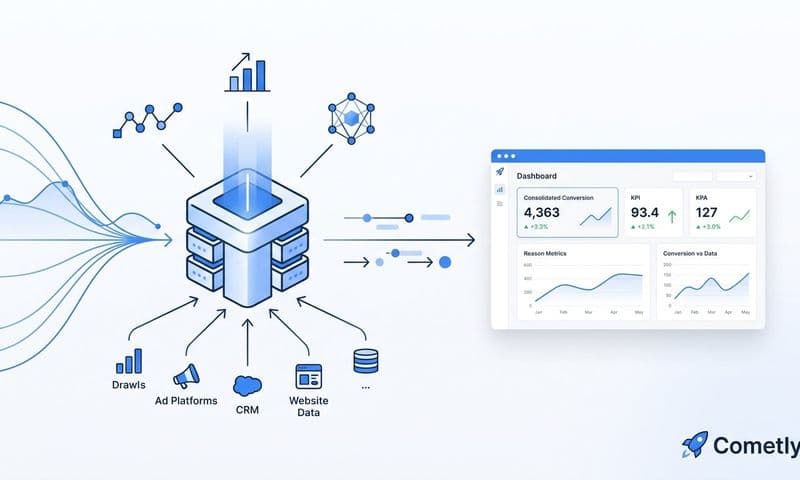
A platform that creates a single source of truth by connecting ad spend, CRM events, and website behavior reduces the data wrangling burden on your analyst and increases the proportion of their time spent on strategic analysis. That's a meaningful productivity multiplier, especially in the early months when a new analyst is still ramping up.
The highest-leverage setup for a scaling B2B SaaS marketing team is the combination of strong attribution infrastructure and a skilled analyst working within it. The tooling handles data collection, normalization, and surface-level reporting. The analyst handles interpretation, strategic framing, and the nuanced questions that require business context and judgment. Each makes the other more effective.
Platforms like Cometly are built specifically for this dynamic. By connecting ad platforms, CRM data, and website behavior into a unified attribution layer with AI-driven insights, Cometly gives analysts a clean, reliable data foundation to work from and reduces the time they spend on the work that doesn't require human judgment.
How to Evaluate the Hire vs. Tool Decision Objectively
The hire versus tool decision deserves an honest, structured evaluation rather than an instinctive one. Here's a practical framework for thinking through it.
Assess your current data complexity. How many paid channels are you running? How many active campaigns and ad sets? How sophisticated are the attribution questions your leadership team is asking? If the complexity is moderate and the questions are relatively straightforward, a well-configured platform likely covers the gap. If the complexity is high and the questions require nuanced interpretation of multi-touch data across long sales cycles, a dedicated analyst adds genuine value.
Evaluate your team's current capacity allocation. How much time is your marketing team currently spending on reporting and data work versus strategy and execution? If reporting is consuming a significant portion of the team's week, that's a capacity problem. The question is whether better tooling reduces that burden or whether the volume and complexity of analytical work genuinely requires a dedicated person.
Compare the honest costs. A full-time marketing analyst represents not just salary but also benefits, ramp time, management overhead, and the opportunity cost of a slower time-to-value. A well-configured attribution platform represents a monthly or annual subscription cost and an implementation investment, but typically delivers value much faster. For many teams, the platform delivers a stronger near-term ROI, with the analyst hire becoming the right move as complexity grows.
Identify the stage where both are needed together. There's a point in the growth of a B2B SaaS marketing organization where campaign complexity, budget scale, and strategic ambition all exceed what tooling alone can handle. At that stage, the right answer is both: a robust attribution platform that handles data infrastructure and surface-level insights, and a skilled analyst who can work within that infrastructure to answer the harder questions. Recognizing when you've reached that stage is the key judgment call.
Setting Your Marketing Analyst Up to Succeed From Day One
If you've worked through the decision framework and determined that a dedicated marketing analyst is the right move, the next question is how to make that hire productive as quickly as possible.
The biggest risk with a new analyst hire is that they spend their first three to six months building data foundations rather than producing strategic insights. You can reduce that risk significantly by ensuring the data infrastructure is in place before they arrive. That means server-side tracking is configured, your attribution platform is connected to your ad platforms and CRM, and your core data pipelines are functioning reliably.
Define the analyst's core deliverables upfront and communicate them clearly during the hiring process. What is the reporting cadence you expect? What are the specific analytical questions the leadership team needs answered regularly? What does success look like at 30, 60, and 90 days? Analysts who join with clear deliverables and access to clean data ramp significantly faster than those who have to figure out both the data landscape and the organizational expectations simultaneously.
Stakeholder alignment matters too. A marketing analyst's work touches multiple functions: marketing, sales, finance, and leadership. If those stakeholders have different definitions of what a conversion is, different expectations about attribution methodology, or different ideas about what the analyst should be prioritizing, the analyst will spend significant time navigating organizational ambiguity rather than producing analysis.
AI-powered analytics tools change the capacity equation for a single analyst in meaningful ways. When routine reporting is automated, when AI surfaces anomalies and high-performing campaigns without manual investigation, and when the platform generates recommendations that the analyst can evaluate and act on rather than build from scratch, one analyst can cover analytical workload that previously required a larger team. This is increasingly the reality for marketing teams working with modern attribution platforms, and it's worth factoring into your expectations for what a single hire can accomplish.
Putting It All Together
The decision of when to hire a marketing analyst comes down to three intersecting factors: the complexity of your channel mix and attribution questions, the current state of your data infrastructure, and the specific analytical outputs your leadership team needs to make confident budget decisions.
If your data foundation is fragmented or unreliable, fix that first. An analyst working with poor data produces poor insights, regardless of their skill level. If your team is at an early-to-mid growth stage with manageable channel complexity, a well-configured attribution platform may close the gap without the overhead of a full-time hire. If you're scaling aggressively across multiple channels, making significant budget decisions, and asking questions that require nuanced interpretation of complex multi-touch data, the dedicated analyst hire becomes the right move, ideally layered on top of strong tooling infrastructure.
The smartest path for most B2B SaaS marketing teams is to build the data foundation first, use that foundation to get analyst-level clarity on channel performance and attribution, and then layer in dedicated human analytical capacity as the complexity of the questions grows beyond what the platform can answer on its own.
Cometly is built specifically to support this progression. It gives B2B SaaS marketing teams the attribution infrastructure, AI-driven insights, and cross-channel visibility that make every analyst more effective, and that help smaller teams get analyst-level clarity without the immediate headcount investment. From server-side tracking and Conversion API integrations to multi-touch attribution and AI-powered campaign recommendations, Cometly creates the data foundation that makes the hire-versus-tool decision easier and the analyst's work more impactful when you do make that hire.
If you're ready to build that foundation, Get your free demo and see how Cometly helps B2B SaaS teams turn marketing data into confident decisions.