You've just wrapped your weekly marketing review. Demo requests are up, pipeline looks healthy, and then you open your attribution dashboard. A significant chunk of your best leads this month show up as "direct" or "none" for source. No campaign. No channel. No context. Just traffic that appeared out of nowhere and converted.
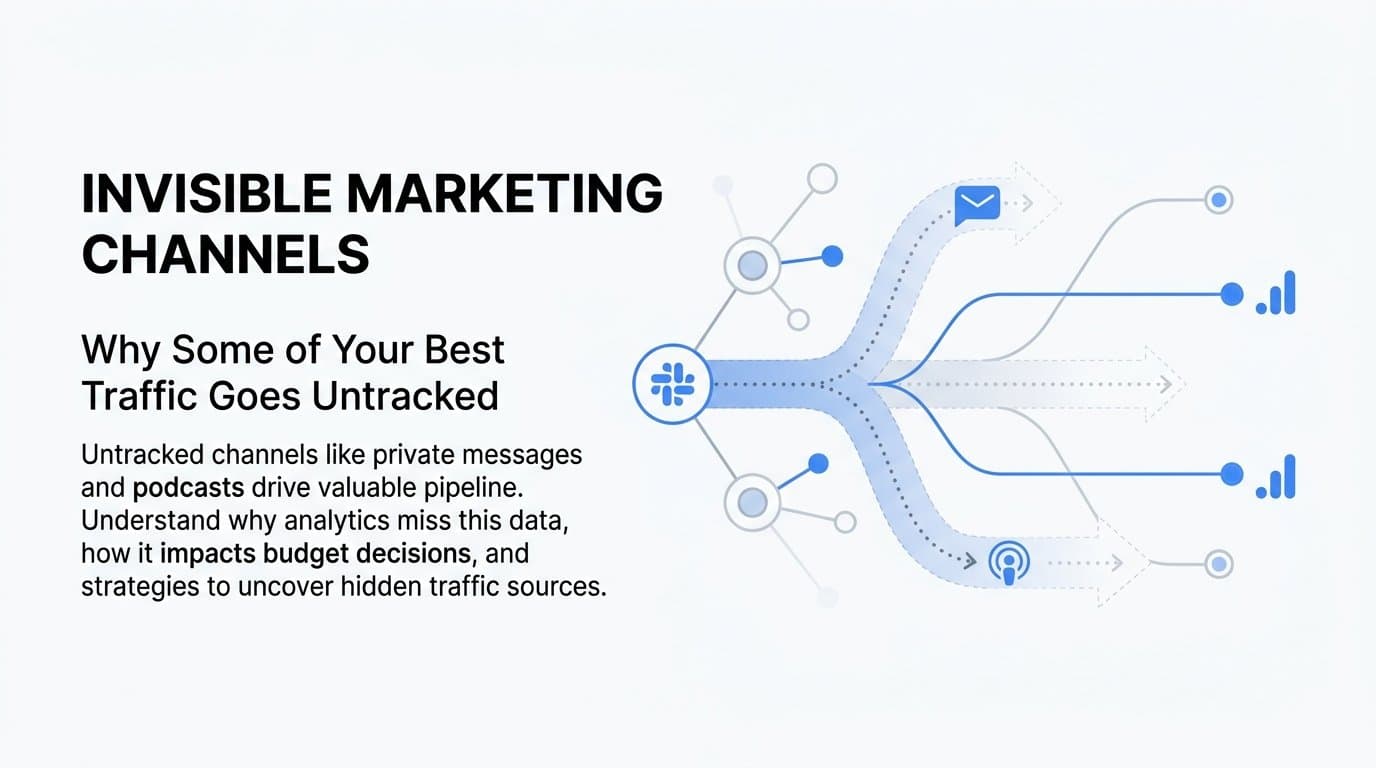
Sound familiar? This is the invisible marketing channel problem, and it's more common than most B2B SaaS teams realize. The traffic didn't appear from nowhere. It came from a Slack message, a podcast recommendation, a screenshot shared in a private community, or a colleague who forwarded a blog post. But your analytics tools have no idea, and so neither do you.
This matters far beyond data hygiene. When channels go untracked, budget decisions get made on incomplete information. The sources actually driving pipeline get starved of investment because they don't show up in the reports. Meanwhile, channels with clean attribution but weaker results continue to absorb spend simply because they're visible. The invisible channel problem isn't just a measurement issue. It's a resource allocation problem that compounds with every budget cycle.
This article breaks down what invisible marketing channels actually are, why they go dark in your analytics, and how modern attribution practices can recover the signal you're currently missing.
The Hidden Layer Beneath Your Attribution Data
Invisible marketing channels are touchpoints that genuinely influence a buyer's decision but never register in your standard analytics or ad platform reporting. They're not gaps caused by poor campaign setup. They're structural blind spots created by how traditional attribution was designed.
Think of it this way: your attribution data is a map, but it only shows roads that were built before certain technologies existed. Dark social, direct traffic misattribution, and offline word-of-mouth that triggers branded searches are all real roads that buyers travel. They just don't appear on the map.
The problem starts with how most companies still measure performance. Last-click attribution gives 100% of the credit to the final touchpoint before conversion. First-touch gives it all to the first recorded interaction. Both models are structurally blind to everything in between. For a B2B SaaS company with a 60-day sales cycle, "everything in between" might include a dozen touchpoints that actually did the heavy lifting of building trust and intent.
This creates a systematic distortion. Channels that appear late in the journey, like branded search or direct navigation, consistently get credited for conversions they didn't cause. Channels that build awareness and warm up prospects earlier, like content, social, or community engagement, get credited for nothing even when they initiated the relationship.
The compounding effect is particularly damaging for SaaS companies with longer sales cycles. When a prospect takes 30, 60, or 90 days to move from first awareness to demo request, they accumulate touchpoints across multiple sessions, devices, and contexts. Many of those touchpoints fall outside standard attribution windows. A prospect who read your blog in week one, saw a LinkedIn post in week three, joined a webinar in week six, and finally searched your brand name in week eight will often be attributed entirely to branded search, even though three prior touchpoints shaped the decision.
The longer the sales cycle, the more the invisible channel problem compounds. And for B2B SaaS, that means the companies with the most to gain from accurate attribution are often the ones most exposed to this blind spot.
Where Buyers Go That Your Tracking Cannot Follow
To understand why channels go invisible, you need to understand where buyers actually spend their time during a B2B purchase journey. The answer, increasingly, is in places where no UTM parameter can follow.
Dark social is the most significant category. The term was coined by journalist Alexis Madrigal in The Atlantic in 2012 to describe the large volume of web traffic that arrives without referrer data because it originates in private or closed environments. In 2026, dark social has become central to how B2B buyers discover and evaluate software. Buying decisions are shaped inside private Slack workgroups, Discord servers for niche industries, LinkedIn DMs between peers, and email threads where someone forwarded a useful article. None of these interactions leave a traceable digital footprint in your analytics.
For B2B SaaS specifically, this dynamic is especially significant. Buyers are professionals who operate in communities. They ask their peers for recommendations before they ever visit a vendor's website. A product manager might share your pricing page in a private Slack channel for product leaders. A VP of Marketing might forward your case study to three colleagues via email. A developer might post your documentation link in a Discord server. All of those shares drive real traffic, and all of it arrives as direct in GA4 with no source, no medium, and no campaign.
Branded search triggered by untracked awareness is the second major category. When a buyer hears about your product through a podcast, a conference talk, or a peer recommendation, they often don't click a link. They open a new tab and search your brand name. Google Analytics records that session as organic branded search. But the actual source of awareness, the podcast, the event, the conversation, is completely invisible. You see the branded search. You don't see what caused it.
Content that travels without attribution is the third category. A blog post shared as a screenshot in a Slack group generates no clickable link. A LinkedIn post copied and pasted into an email loses all tracking. A podcast host who mentions your product name drives listeners to search directly. These are all real marketing touchpoints that influence real buyers, but they arrive in your analytics as either direct traffic or not at all.
The common thread across all these categories is that modern B2B buyers move through private, peer-driven channels that predate or bypass web analytics entirely. Your tracking infrastructure was built for a more linear, link-click-based world. The actual buyer journey has moved on.
Why Standard Analytics Tools Miss the Signal
Even when buyers do click tracked links, the technical environment has made accurate attribution increasingly difficult. Several converging forces are systematically degrading the quality of your tracking data.
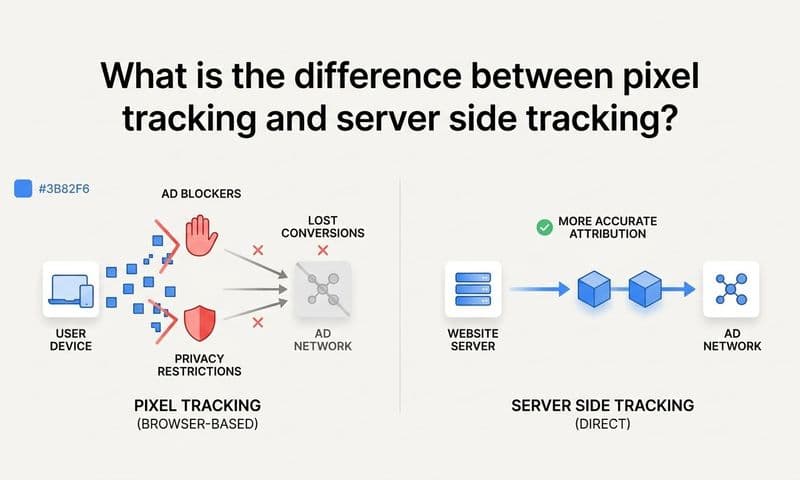
Browser privacy restrictions have progressively limited what client-side pixels can capture. Third-party cookies, which allowed ad platforms to track users across different websites, have been restricted by Safari and Firefox for years. Chrome has been moving in the same direction. When third-party cookies are blocked, the pixel on your website can't connect a visitor's session to the ad they clicked on a different platform. The attribution chain breaks.
Apple's App Tracking Transparency framework, introduced with iOS 14.5, required apps to ask users for permission before tracking them across other apps and websites. The majority of users opted out. This significantly reduced the signal available to pixel-based tracking for mobile traffic, particularly affecting Meta's ad attribution. A conversion that happened on an iPhone might never get connected to the ad that drove it.
Referrer stripping is a less-discussed but pervasive issue. When a user navigates from an HTTPS site to an HTTP site, browsers don't pass referrer information by design. Many messaging apps, email clients, and link shorteners also strip referrer data before the request reaches your server. A link shared in Gmail, Slack, or a mobile messaging app often arrives at your site with no referrer, making it indistinguishable from someone typing your URL directly.
Cross-device journeys fragment the picture further. A buyer might discover your product on their phone, research it on a work laptop, and submit a demo request on a different device entirely. Standard analytics tools treat each of these sessions as separate, unrelated visits unless a user is logged in and identified across all devices. For most anonymous web traffic, the journey appears as three disconnected sessions rather than one continuous path.
Session timeouts create additional fragmentation. If a user pauses their research and returns to your site hours later, analytics tools often count that as a new session, potentially with a different source attribution if they arrived via a different path the second time.
Underneath all of this is a first-party data gap that most B2B SaaS companies haven't fully addressed. Client-side pixels fire inconsistently, blocked by ad blockers and browser restrictions. They miss server-side events entirely. And critically, they cannot connect an anonymous web session to an identified CRM contact without a server-side tracking layer that bridges the two. The result is that your analytics data and your CRM data live in separate worlds, and the customer journey between them remains largely invisible.
How Multi-Touch Attribution Surfaces What Was Hidden
Multi-touch attribution is the framework designed to address the distortion created by single-touch models. Instead of assigning all credit to one touchpoint, it distributes credit across all recorded interactions in a customer journey. This doesn't solve the invisible channel problem entirely, but it does dramatically reduce the distortion it causes.
The practical difference is significant. Under last-click attribution, a prospect who engaged with five touchpoints before converting gives all the credit to the fifth. Under multi-touch attribution, each touchpoint receives a share of the credit based on the model's logic. The channels that built awareness and intent earlier in the journey finally show up in your performance data.
Different attribution models reveal different parts of the picture, and choosing the right one depends on your sales cycle and channel mix.
Linear attribution distributes credit equally across all touchpoints. It's a good starting point for understanding which channels participate in conversions, even if it doesn't weight them by influence. For teams new to multi-touch attribution, linear is often the most intuitive model to start with.
Time-decay attribution gives more credit to touchpoints that occurred closer to the conversion event. This makes sense for shorter sales cycles where recency is a strong signal of influence, but it can undervalue awareness-stage channels in longer B2B sales cycles.
Position-based models (often called U-shaped or W-shaped) give heavier weight to specific touchpoints: typically the first touch, the lead creation event, and the opportunity creation event. These models are well-suited to B2B SaaS because they acknowledge that the touchpoints that initiate and advance the relationship matter more than mid-funnel touches.
Data-driven attribution uses machine learning to assign credit based on the actual conversion patterns in your data. It's the most accurate model when you have sufficient volume, because it reflects what's actually happening in your specific customer journeys rather than applying a fixed rule.
The real power of multi-touch attribution emerges when you connect ad platform data, CRM pipeline data, and server-side conversion events into a single attribution layer. When those data sources are unified, you can see assisted conversions: the channels that contributed to a win even if they weren't the last recorded touch. A content piece that appeared three touchpoints before a demo request becomes visible. A LinkedIn campaign that consistently shows up early in winning journeys gets the credit it deserves. The channels that were previously invisible start to surface in your reporting.
Server-Side Tracking and First-Party Data: Closing the Gap
Multi-touch attribution can only work with the data it receives. If the underlying tracking is broken, even the most sophisticated attribution model will produce distorted results. This is where server-side tracking becomes essential.
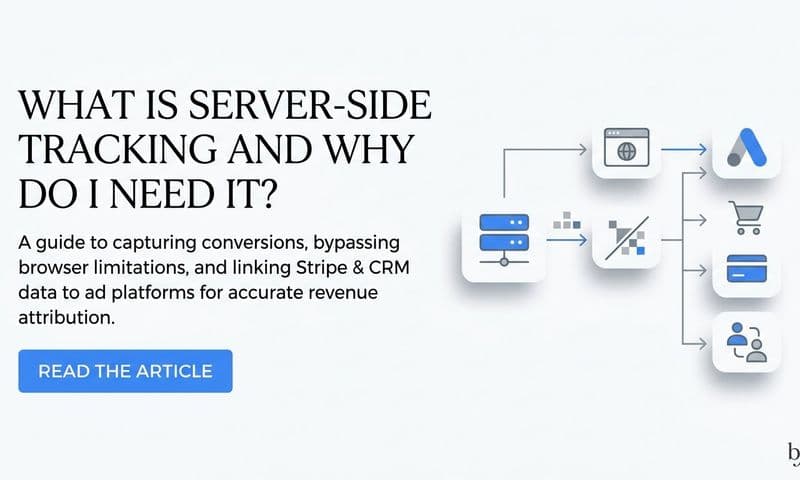
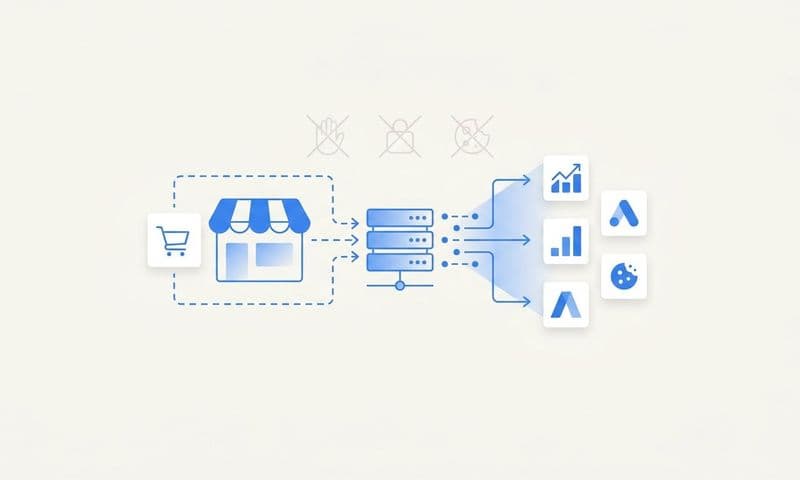
Server-side tracking means sending conversion events directly from your server to ad platforms, rather than relying on a browser-based pixel to fire client-side. Instead of waiting for a user's browser to execute a tracking script (which can be blocked, delayed, or prevented by privacy settings), your server sends the event data directly via an API connection. The signal arrives regardless of what the user's browser is doing.
Meta's Conversions API (CAPI) and Google's Enhanced Conversions are the two most important implementations of this approach. Both are documented, supported features offered directly by the ad platforms. When you send events via CAPI or Enhanced Conversions, you're transmitting first-party data from your own server, which is far more reliable than a third-party pixel firing in a browser that may have restrictions in place.
In practice, this is how it works. When a lead submits a demo request form, your server captures that event and sends it to Meta or Google with relevant first-party data: a hashed email address, a phone number, or another identifier the platform can use to match the conversion to a user and an ad. The platform can then attribute the conversion to the correct campaign even if the browser pixel was blocked or the cookie was absent.
First-party data enrichment takes this further. When that same form submission is matched to a CRM contact, you can append the full touchpoint history to the conversion event. The ad platform doesn't just learn that a conversion happened. It learns that this conversion came from a prospect who was a high-quality lead based on your CRM scoring, which helps the platform's own machine learning optimize toward better prospects.
One critical step that cannot be skipped is event deduplication. When you run both client-side pixels and server-side tracking simultaneously (which is the recommended approach for maximum coverage), both systems may fire for the same event. Without deduplication logic, your conversion counts inflate, and the data you've worked to fix becomes corrupted in a different way. Proper deduplication uses a unique event ID to tell the platform that a client-side event and a server-side event refer to the same conversion, so it only counts once.
Server-side tracking doesn't make invisible channels visible on its own, but it closes the gap between what happened and what your tools recorded. It's the technical foundation on which accurate attribution is built.
Building a Strategy to Track What Was Always There
Recovering visibility into invisible marketing channels requires a layered approach. No single tool or tactic solves it. But a structured framework applied consistently gets you much closer to the truth.
Start with UTM governance. Before any technical implementation, establish a consistent tagging policy for every paid and owned channel. Every campaign, every email, every social post, every partner link should carry a UTM string that follows a defined naming convention. This sounds basic, but inconsistent UTM tagging is one of the most common reasons traffic gets misattributed to direct. A link without a UTM that gets shared widely will generate direct traffic in your analytics even though it originated from a specific source.
Layer in server-side tracking for conversion events. Implement Conversion API connections for your primary ad platforms. Ensure that your key conversion events (demo requests, trial signups, form submissions) are firing server-side with first-party identifiers attached. This recovers signal that browser restrictions are blocking and improves the quality of data flowing back to ad platforms for optimization.
Connect CRM pipeline data to close the revenue loop. Tracking clicks and form fills is only half the picture. To understand which channels are actually driving revenue, you need to connect those upstream events to downstream outcomes: opportunities created, deals closed, contract values. When your CRM data is connected to your attribution layer, you can see not just which channels generate leads, but which channels generate leads that become customers.
Use self-reported attribution as a qualitative layer. Ask every new lead "how did you hear about us?" in your demo request or trial signup form. This single question captures dark social signal that no technical tracking can reach. A prospect who found you through a Slack community recommendation will tell you so if you ask. Aggregate these responses over time and you'll start to see patterns: which communities are sending you leads, which podcasts are driving awareness, which peer networks are recommending your product. This qualitative data won't replace quantitative attribution, but it validates and supplements it, especially for the channels that are structurally invisible to your analytics tools.
This is where Cometly brings everything together. Rather than managing separate tools for ad platform data, CRM events, and conversion tracking, Cometly unifies these layers into a single attribution platform built specifically for B2B SaaS companies. It connects your ad platforms, CRM, and server-side conversion events so you can see which channels are driving pipeline and revenue, including the ones that were previously showing up as direct. With multi-touch attribution, AI-powered recommendations, and real-time insights across every channel, Cometly gives marketing teams the complete picture they need to make confident budget decisions rather than guessing at what's working.
The Path Forward for B2B SaaS Marketers
Invisible marketing channels are not a minor data quality issue you can defer until next quarter. They represent real buyer journeys that your current tools are failing to capture, and for B2B SaaS companies with long sales cycles and high customer acquisition costs, the cost of this blind spot compounds with every budget decision made on incomplete data.
The good news is that the path forward is clear. Implement consistent UTM tagging so every owned and paid channel is properly identified. Deploy server-side tracking via Conversion APIs to recover the signal that browser restrictions are blocking. Connect your CRM pipeline data to close the loop from first touch to closed-won revenue. Use a multi-touch attribution model that distributes credit across the full journey rather than collapsing it onto a single touchpoint. And layer in self-reported attribution to capture the dark social signal that no technical tool can reach.
Each of these steps individually improves your data. Together, they transform your ability to see what's actually driving growth, including the channels that have always been working but never got the credit.
If you're ready to stop making budget decisions based on incomplete attribution data, Get your free demo of Cometly and see how it tracks every touchpoint from first ad click to closed-won revenue, so the channels that were always driving results finally show up in your reports.